AI search visibility tracking means measuring four things: how often AI assistants mention your brand, how many of your pages they cite as sources, your share of the answers against named competitors, and whether what they say about you is accurate. The data comes from AI visibility tools, a fixed prompt set you run every month, AI crawler hits in your server logs, and referral traffic from assistant domains. Prompts where you are invisible become content briefs; pages that already get cited show you the pattern to repeat.

On this page
- Why AI search visibility needs its own measurement
- AI visibility vs traditional rankings: what each metric proves
- The four AI visibility metrics that actually matter
- Where AI search visibility data comes from
- How to build an AI visibility prompt set
- The monthly tracking process, step by step
- Reading the numbers without fooling yourself
- What actually earns an AI citation
- Turning invisible prompts into a content plan
- Fixing what assistants get wrong about you
- Reading AI crawler logs
- Attributing business impact to AI search
- A monthly AI visibility report that takes an hour
- Common mistakes in AI visibility tracking
- A 90-day plan to get AI visibility tracking running
- Frequently asked questions
Why AI search visibility needs its own measurement
For twenty years one number described search performance: where you ranked. AI search broke that. When Google’s AI Overviews and AI Mode, ChatGPT, Gemini, Copilot or Perplexity answer a question, they read several sources, synthesise an answer and cite a handful of them. You can be quoted in an answer without ranking first for the query — and you can hold position one and never be mentioned at all. This guide explains AI search visibility tracking: how to measure brand mentions and citations in ChatGPT, Perplexity, Google AI Overviews and AI Mode, and which AI visibility tools are worth using.
That gap is why AI search visibility tracking has become its own discipline. Traditional rank tracking answers “can we be found?” AI visibility tracking answers a commercially sharper question: “are we being recommended?” In an AI answer there is no page two to climb from. There is a shortlist, and you are either named on it or you are not.
The behaviour change underneath this is simple to observe in your own analytics. Informational queries increasingly resolve inside the answer, so impressions can hold steady while clicks soften. Commercial and local queries still send traffic, but the visitor often arrives later in the decision, having already been given a shortlist by an assistant. Measuring only sessions in that environment tells you how many people finished their research on your site, not how many were told about you.
Rankings tell you whether you can be found. AI search visibility tells you whether you are being recommended. They move independently, so you need both on the same report.
The rest of this guide is the working method our team uses: which metrics to track, where the data actually comes from, how to build a prompt set that mirrors real buying questions, how to read the numbers without fooling yourself, and how to turn the gaps into published pages. It pairs with our generative engine optimisation playbook, which covers the optimisation side of the same loop.
AI visibility vs traditional rankings: what each metric proves
Before adding metrics, it helps to be precise about what each one can and cannot prove. Most disappointing “AI SEO” reports fail here — they present a number that does not support the claim being made about it.
| Metric | What it proves | What it does not prove |
|---|---|---|
| Keyword ranking | Your page is eligible to be found for that query | That anyone saw it, or that an AI answer used it |
| Impressions | Your page was served in results | That it was read, or quoted in an answer |
| AI brand mention | An assistant named you in its answer | That the user clicked, or that the mention was positive |
| AI citation (cited page) | An assistant used your URL as a source | That your brand was recommended — you may be cited as background |
| Share of answers | How often you appear against named rivals | Absolute market position — it is limited to your prompt set |
| Assistant referral session | Someone clicked through from an AI answer | The full influence of AI search, which is mostly click-free |
Read that table twice before you promise a client a number. The single most common credibility failure in AI SEO reporting is presenting a sampled, prompt-dependent mention count as though it were a census of the internet. It is not. It is a repeatable indicator — valuable precisely because it is repeatable, not because it is complete.
The four AI visibility metrics that actually matter
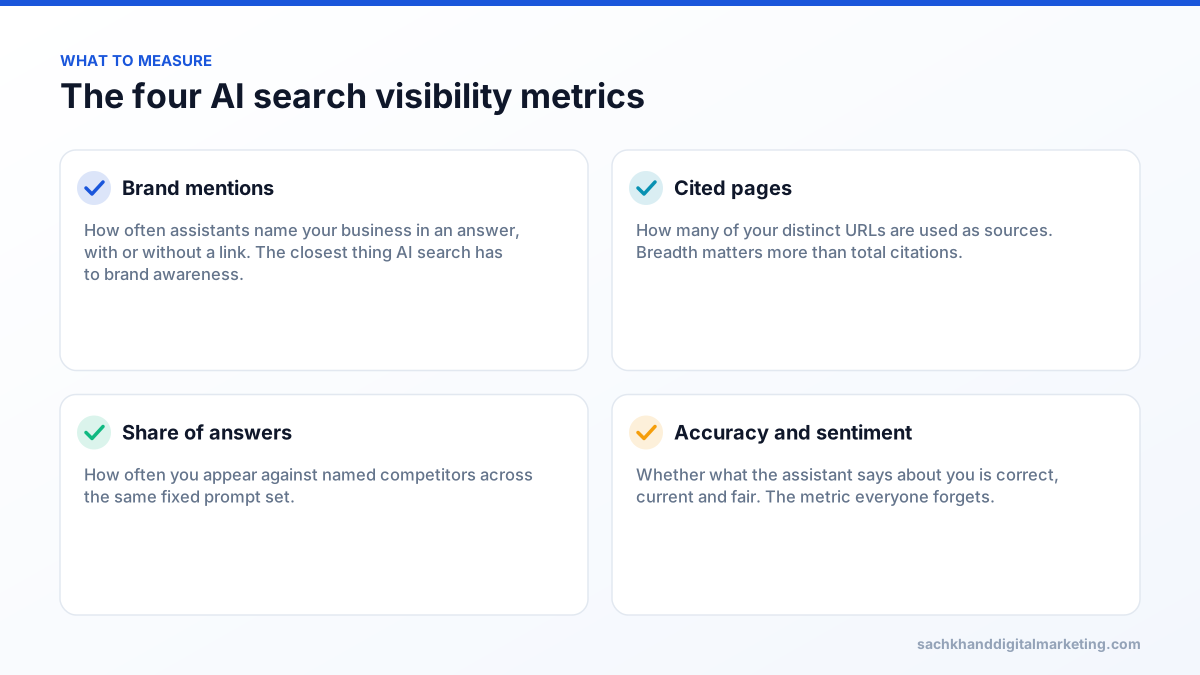
Across client reporting we have settled on four metrics. Together they describe whether an assistant knows you, trusts your content, prefers you over rivals, and describes you correctly.
| Metric | The question it answers | Where the data comes from |
|---|---|---|
| Brand mentions | How often do assistants name us in answers? | AI visibility tools, manual prompt testing |
| Cited pages | How many of our URLs are used as sources? | AI visibility tools, referral data, logs |
| Share of answers | How often do we appear versus named competitors? | Your own prompt set, run across platforms |
| Accuracy and sentiment | Is what they say about us correct and fair? | Manual review of the answer text |
1. Brand mentions
A mention is the assistant naming your business in the body of an answer, with or without a link. This is the closest thing AI search has to brand awareness. Mentions tend to respond to off-site signals — reviews, directories, press, forum discussion, comparison pages on other people’s sites — more than to your own content. If you are invisible here but your content is strong, the problem is usually that the wider web does not describe you often enough for a model to have learned who you are.
2. Cited pages
A citation is an assistant using one of your URLs as a source. Citations respond to content: clear answers, clean structure, specifics, and pages that exist for the question being asked. Counting distinct cited URLs matters more than counting citations, because breadth tells you how much of your site is doing useful work rather than one popular article carrying everything.
3. Share of answers
Run a fixed prompt set, record who gets named, and you have a share-of-voice figure for AI search. This is the metric that survives contact with a sceptical board, because it is comparative. “We are named in 34% of the 40 questions our buyers ask, against 51% for our nearest competitor” is a sentence that starts a budget conversation. “We had 1,240 mentions” is not.
4. Accuracy and sentiment
The metric everyone forgets. Assistants routinely describe businesses using stale or third-hand information: service areas you dropped two years ago, prices that moved, a founding story that belongs to a different company, a product tier that no longer exists. Every month, read what the assistants actually say about you and log anything wrong. Inaccuracy is both a visibility problem and a conversion problem, and unlike rankings it is often quick to fix.
Where AI search visibility data comes from
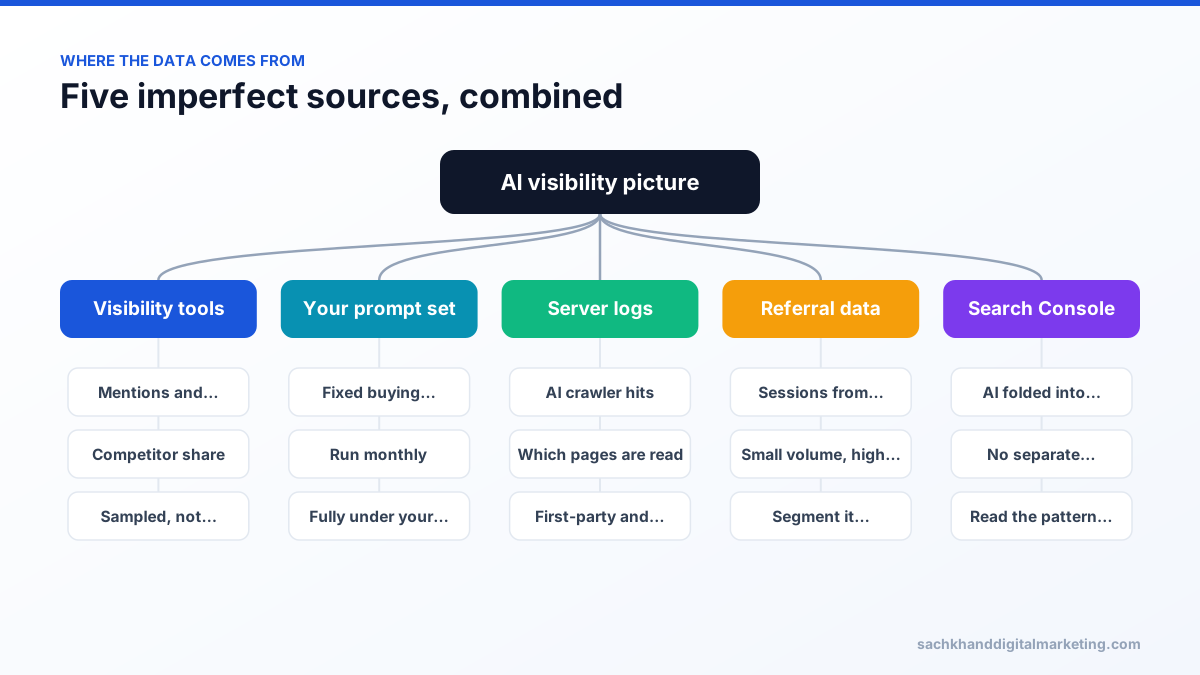
There is no single Search Console for AI answers. You build the picture from five imperfect sources, and the discipline is in combining them rather than trusting any one.
AI visibility tracking tools
A growing category of platforms now report brand mentions, cited URLs and competitor share across the major assistants. They work by running prompt sets of their own at intervals, so they sample the space rather than observing all of it. Different tools will give you different absolute numbers for the same brand, which is expected. Pick one, keep it, and read the trend — switching tools resets your baseline and makes six months of reporting incomparable.
Your own prompt set
The most reliable signal you control, and the one clients find most persuasive because they can watch it happen. A fixed list of buying questions, run on a fixed cadence, logged in a consistent format. Section five covers how to build one.
Server logs and AI crawler hits
AI crawlers and fetchers identify themselves in the user-agent string. Logging them tells you which of your pages are being read by which system, and how often — a leading indicator that usually moves before citations do. It is also how you discover that your firewall has been quietly blocking the crawlers you most wanted to attract.
Analytics referrals from assistants
Visits from assistant domains appear as referral traffic. The volume is usually small and the intent usually high. Segment it explicitly rather than letting it dissolve into “other referral”, and track enquiries from that segment separately.
Search Console, with its limits stated
Google folds its AI search experiences into standard Search performance reporting rather than breaking them out as a separate dimension, so you cannot cleanly isolate AI Overview clicks. Check Google’s current documentation before promising a client a number the interface does not give you. What Search Console does show usefully is the shape of the change: query-level impressions holding while clicks fall is the classic signature of answers absorbing the click.
Referral traffic from assistants is the visible tip of AI visibility. Most answers never produce a click, so judging AI search by referral sessions alone will always undercount its influence on demand. Report it as a bonus signal, never as the headline.
How to build an AI visibility prompt set
The prompt set is the backbone of AI search visibility tracking. Twenty to forty prompts is enough for most businesses. What matters is that they mirror how real buyers talk to an assistant — full sentences, constraints, context — rather than the two-word keywords you track in a rank tracker.
| Prompt type | What it tests | Example |
|---|---|---|
| Problem | Whether you appear at the symptom stage | “my AC is blowing warm air, what should I check first?” |
| Solution | Whether you are named when options are compared | “should I repair or replace a 12-year-old furnace?” |
| Local intent | Whether you appear in shortlists for your area | “who are the best emergency plumbers in Plano?” |
| Comparison | Whether you appear next to rivals | “alternatives to [competitor] for field service software” |
| Commercial | Whether you appear at the buying moment | “what should a full HVAC system replacement cost in 2026?” |
| Brand | What assistants say about you specifically | “is [your brand] reliable? what do reviews say?” |
Two rules keep a prompt set honest. First, write the prompts before you look at the answers, so you are not unconsciously selecting questions you already win. Second, freeze the wording. Changing a prompt changes the result, and a set that drifts every month measures nothing but your own editing.
Log five fields for every run: date, platform, prompt, mentioned (yes/no), and the cited URL if there is one. A spreadsheet is genuinely fine at this size. Add two optional fields if you have the patience — position of the mention within the answer, and a one-line note on anything inaccurate.
Assistants can answer the same prompt differently on consecutive days. Run each prompt once a month on a fixed date rather than chasing daily changes, and judge movement over quarters, not weeks.
The monthly tracking process, step by step
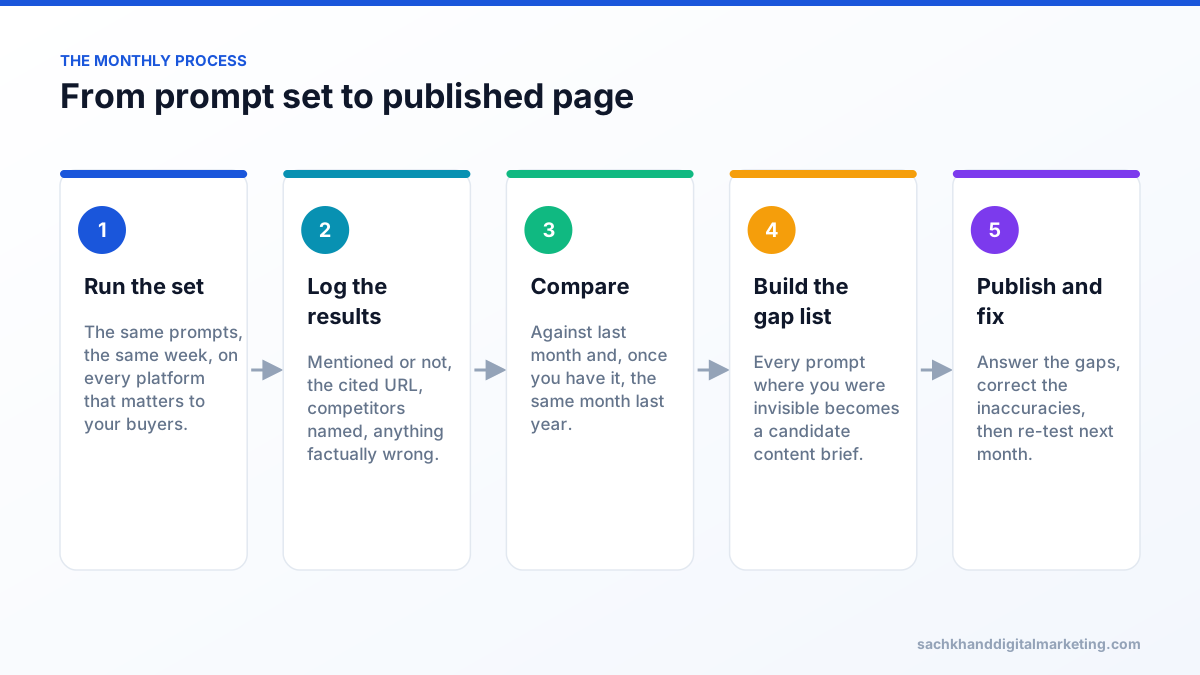
- Run the prompt set on each platform that matters to your audience, in the same week each month.
- Log the raw results — mentioned, cited URL, competitors named, anything factually wrong.
- Pull tool data for mentions and cited pages, and export the same date range every time.
- Filter server logs for AI crawler user agents, grouped by bot and by landing path.
- Segment analytics for assistant referral sessions and any enquiries attached to them.
- Compare against last month, and against the same month last year once you have the history.
- Write the gap list: every prompt where you were not named becomes a candidate brief.
- Log corrections: every inaccuracy becomes a fix on a page, a listing or a profile.
The whole cycle takes an hour or two once the spreadsheet exists. The temptation is to automate it away, but running the prompts by hand for the first few months is worth the time: you see how the assistants frame your category, which competitors they consider peers, and which of your claims they repeat. That qualitative read is often more useful than the count.
Reading the numbers without fooling yourself
Once you have three or four months of data, patterns appear. A few interpretations we use regularly:
Mentions high, citations low
Assistants know your name but do not lean on your website. Typical of established brands with thin content. The fix is content: pages that answer the questions being asked, in a form that is easy to quote.
Citations high, mentions low
Your content is being used as a reference library, but you are not the subject of the recommendation. Common for publishers and for companies whose best content is unbranded and generic. The fix is entity strength: clearer positioning, more third-party coverage, and content that demonstrates who you are rather than only explaining a topic.
Both rising, traffic flat
The most common pattern in 2026, and the one that needs explaining to stakeholders before it happens rather than after. Influence is growing inside answers while clicks stay level. Report the mention and share numbers alongside enquiry volume, not alongside sessions, or the work will look like it is failing when it is not.
In the anonymised engagements published on this site, one national franchise group shows roughly 1.8K mentions against 585 cited pages, while a software company shows 504 mentions against 705 cited pages — two different shapes of visibility, needing two different plans. Both are in the SDM case studies with their baselines and limits stated.
What actually earns an AI citation
Across the pages that get cited repeatedly, the same characteristics recur. None of them are exotic; they are the classic content quality signals, applied with more discipline because the consumer is a model rather than a browsing human.
- An answer in the first two sentences. Not a preamble, not a definition of the industry — the answer, then the nuance.
- Structure that survives being stripped. Real headings, short paragraphs, lists and tables that carry meaning without styling.
- Specifics over adjectives. Numbers, ranges, conditions, timeframes, named methods. “Most jobs finish within a day” is quotable; “fast, reliable service” is not.
- Scope stated plainly. Who it applies to, where, and when — the qualifiers a model needs to decide whether your page answers the question in front of it.
- Structured data that matches the visible page. Schema is the machine-readable summary of what you claim; contradictions cost trust.
- Freshness where freshness matters. Dated guidance with a real review date, not a rolling year in the title.
- Corroboration elsewhere. Claims that appear on other credible sites are repeated more readily than claims that exist only on your own.
If you want the full optimisation checklist rather than the measurement side, that lives in the answer engine optimisation guide.
Get a prioritised action plan from our specialists, free.
Turning invisible prompts into a content plan
A tracking report that does not change the publishing plan is theatre. The conversion from gap to brief is mechanical:
| What the log shows | Diagnosis | Action |
|---|---|---|
| No mention, no page exists | Coverage gap | Brief a new page that answers the prompt directly |
| No mention, page exists | Format problem | Rewrite the opening as a direct answer; add specifics and structure |
| Competitor named, we are not | Authority gap | Add proof: data, cases, reviews, third-party coverage |
| We are cited, not recommended | Positioning gap | Make the page state who it is for and what you do, not just the topic |
| Wrong facts about us | Entity hygiene | Correct site, profile and listing data, then re-test next month |
Work the list in order of commercial value, not volume. A prompt asked by fifty high-intent buyers a month is worth more than one asked by five thousand students. This is the same prioritisation logic as our topical authority framework, applied to prompts instead of keywords.
Fixing what assistants get wrong about you
Entity hygiene is the highest-return, lowest-effort work in AI search visibility, and almost nobody does it deliberately. Assistants assemble a picture of your business from many sources; when those sources disagree, you get a confident, wrong answer.
- Your own pages first. One canonical About page with the facts stated plainly: what you do, where, since when, who runs it, how to buy.
- Structured data. Organization or LocalBusiness markup with consistent name, address, phone, areas served and
sameAslinks to your real profiles. - Google Business Profile. Categories, service areas, hours and services current — covered in our Google Maps SEO service.
- Major directories and review platforms. The same NAP details, the same service list, no abandoned duplicates.
- Third-party descriptions. Partner pages, association listings and press that describe you in outdated terms.
Fix, then re-test the brand prompts the following month. Corrections propagate at different speeds across platforms, and watching that propagation is itself a useful demonstration that the work matters.
Reading AI crawler logs
Server logs are the least glamorous and most under-used source in this entire discipline. They are also first-party, complete and free.
| User agent | Broadly what it does | What to check |
|---|---|---|
| GPTBot | Crawls for OpenAI | Whether it is allowed, and which paths it fetches |
| OAI-SearchBot | Indexing for ChatGPT search results | Coverage of your key commercial pages |
| ChatGPT-User | Fetches a page because a user asked now | Spikes here track live interest |
| PerplexityBot | Crawls for Perplexity | Whether cited pages match crawled pages |
| Google-Extended | Google’s control for generative training use | Your deliberate policy, not an accident |
| Other assistant bots | Varies by vendor | Review the list quarterly — it changes |
Three checks repay the effort every month: are the bots reaching your money pages, are they receiving 200s rather than 403s from your CDN or firewall, and does crawl activity rise before citations rise? In most accounts the answer to the last is yes, which makes log data a genuine leading indicator. Names and behaviours of these agents change; verify against each vendor’s current documentation rather than a list in a blog post — including this one.
Attributing business impact to AI search
Sooner or later someone asks what AI visibility is worth in revenue. There is no clean answer yet, but there are four honest partial answers, and using them together is far better than pretending one of them is complete.
- Segmented referral data. Sessions and enquiries from assistant domains, tracked as their own channel.
- Self-reported attribution. A “how did you hear about us?” field on the enquiry form, with an option for AI assistants. Crude, but it captures the click-free influence nothing else sees.
- Branded search lift. Rising branded query volume without a matching campaign often reflects assistants putting your name in front of people.
- Sales conversations. Ask the team how many prospects arrive already knowing the comparison. The shift is usually noticed on the phone before it shows in a dashboard.
Set the expectation early that AI visibility is measured like brand rather than like direct response. It compounds, it is hard to attribute cleanly, and it shows up in close rates and shortlist inclusion before it shows up in a last-click report. Our omnichannel ROI framework covers how to hold that alongside channels that do attribute cleanly.
A monthly AI visibility report that takes an hour
Same format every month, one page, six to eight lines. Consistency is what makes the trend readable.
- Brand mentions and distinct cited pages, with month-on-month change
- Share of answers across the prompt set, against two or three named competitors
- Prompts where you were invisible — this month’s content backlog
- Inaccuracies found and corrections made
- AI crawler hits by bot, and the top paths they fetched
- Assistant referral sessions and any enquiries attributed to them
- One qualitative note: how the assistants are currently framing your category
- Next month’s two priorities
That last line matters more than the numbers above it. A report that ends in two decisions gets read; a report that ends in a chart gets filed.
Common mistakes in AI visibility tracking
- Changing prompts every month. The set has to be frozen or the trend is meaningless.
- Switching tools mid-year. Different sampling, different baseline, lost history.
- Reporting sessions as the headline. It undercounts click-free influence and makes good work look bad.
- Cherry-picking one good answer. A screenshot of a single lucky response is not a measurement.
- Ignoring accuracy. Being mentioned wrongly can cost more than not being mentioned.
- Blocking the crawlers you want. Check the firewall, not just robots.txt.
- Tracking without acting. If the gap list never becomes briefs, stop tracking and save the hour.
A 90-day plan to get AI visibility tracking running
| Weeks | Focus | Output |
|---|---|---|
| 1–2 | Build the prompt set; define competitors; set up log filtering and referral segments | A baseline you can repeat |
| 3–4 | First full run across platforms; entity hygiene audit | Month one report, correction list |
| 5–8 | Publish against the biggest gaps; fix inaccuracies; re-test brand prompts | First movement on brand prompts |
| 9–12 | Second and third runs; trend review; agree the reporting format with stakeholders | A trend, a backlog and a standing report |
Ninety days is enough to get a stable baseline and the first signs of movement; it is not enough to judge the strategy. Treat the first quarter as instrumentation, the second as evidence.
Frequently asked questions
What is AI search visibility tracking?
AI search visibility tracking is the practice of measuring how often AI assistants such as Google’s AI Overviews, ChatGPT, Gemini, Copilot and Perplexity mention your brand, cite your pages, and recommend you against competitors — and whether what they say is accurate. It complements rank tracking rather than replacing it, because a business can hold a strong ranking and still go unmentioned in the summary a buyer reads instead of the results page.
Can Google Search Console show AI Overview clicks?
Not as a separate breakdown. Google folds clicks and impressions from its AI search experiences into standard Search performance reporting rather than splitting them out, so you cannot isolate them cleanly. Check Google’s current documentation before promising a client a figure the interface does not provide. What you can read is the pattern: steady impressions with falling clicks on informational queries usually means answers are absorbing the click.
Which AI visibility tracking tools should we use?
Several SEO platforms and specialist tools now report AI mentions and citations. They all sample prompts rather than observing everything, so absolute numbers differ between them. Choose one that covers the assistants your audience uses, keep it for at least a year, and read the trend rather than the raw count. Pair it with your own prompt set, which is the part you fully control.
How many prompts should an AI visibility prompt set contain?
Twenty to forty is enough for most businesses. Spread them across problem, solution, local, comparison, commercial and brand questions, write them as full sentences the way people speak to assistants, and freeze the wording so month-to-month results stay comparable.
How often should we track AI search visibility?
Monthly for reporting, with an extra check after any major platform change. Assistants can answer the same prompt differently on consecutive days, so weekly tracking mostly measures sampling noise rather than progress.
Do AI citations bring traffic?
Some, but fewer clicks than an equivalent ranking would deliver. The value is closer to a recommendation than a listing: being named shapes the shortlist even when nobody clicks. Track referral sessions from assistant domains as a secondary signal and use mentions, citations and share of answers as the primary ones.
Which AI crawlers should we allow?
Most businesses that want to be cited allow the crawlers that power answers, while making a separate decision about crawlers used mainly for model training. Blocking reduces your chance of being quoted. Decide it deliberately, write the policy down, check that your CDN or firewall agrees with it, and review it as the user agents change.
How do we fix incorrect information an AI assistant gives about our business?
Correct it at the sources the assistants read: your own About and service pages, your structured data, your Google Business Profile, the major directories and review platforms, and any third-party pages describing you in outdated terms. Then re-test the same brand prompts the following month, since corrections propagate at different speeds across platforms.
Is AI visibility worth tracking if our clicks are falling?
That is precisely when it is worth tracking. Falling clicks alongside steady or rising mentions means demand is moving into answers rather than disappearing. Without AI visibility data you only see the falling half of the picture, and you risk cutting the work that is still generating demand.
How long before AI visibility work shows results?
Expect a stable baseline within one quarter and meaningful movement on gap prompts within two, assuming you are publishing against the backlog rather than only measuring it. Entity corrections often show up faster — sometimes within weeks — because they fix a specific wrong fact rather than building authority from nothing.
Want to know where you stand in AI answers?
We build the prompt set, run it across the major assistants, check the citations and show you which questions your competitors are winning — as part of a free audit.