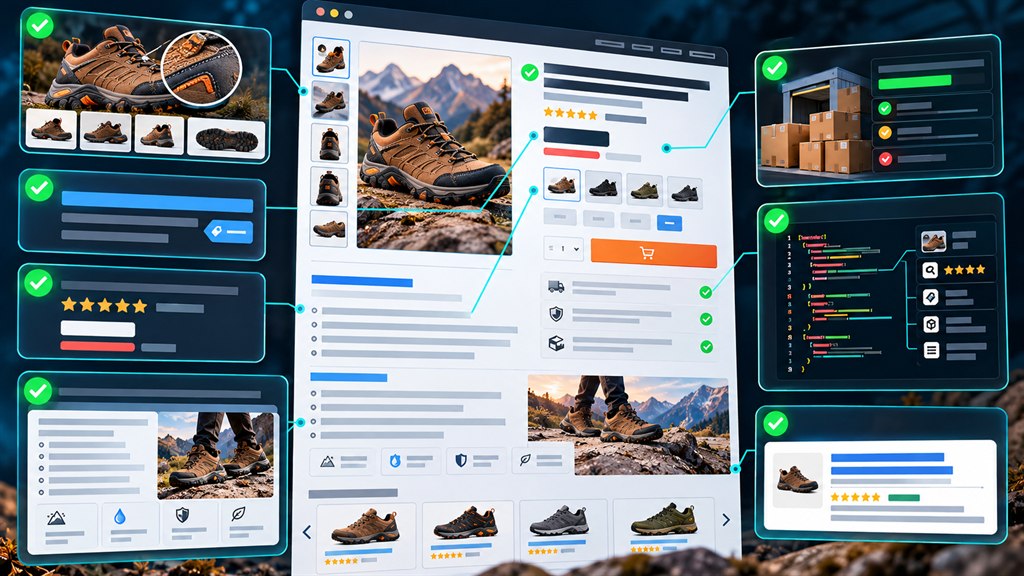
Product page SEO means making each product page rank for specific product searches and convert the visitors it gets. The essentials: a clear product title with the product name and key attributes, a unique product description (not the manufacturer’s), descriptive images with alt text, visible reviews, Product schema with price and availability, a clean URL, sensible handling of variants, links to related products and categories, and fast loading on mobile.
On this page
- 1. Product title SEO
- 2. Product descriptions that rank
- 3. Product image SEO
- 4. Product reviews and user-generated content
- 5. Product schema
- 6. Product variants SEO
- 7. URL structure and internal linking
- 8. Product page speed, UX and conversion rate
- Platform notes: Shopify and WooCommerce
- Product page SEO checklist
- Product page SEO by store type
- Product page best practices and a simple template
- Choosing product page keywords
- More platforms and marketplaces
- Frequently asked questions
Category pages usually win the broad searches, but product pages win the specific ones — the model numbers, sizes and exact product names that people type when they are ready to buy. This product page SEO checklist shows how to optimize product pages for SEO at scale. For the bigger picture, see our ecommerce SEO playbook.
1. Product title SEO
- Use the name customers search: brand + product + key attribute (“Nike Pegasus 41 Women’s Running Shoe”).
- Keep the H1 and the
<title>tag close, adding the store name only to the title tag. - Include the attribute people filter by — size, material, colour, model number — where it matters.
- Avoid stuffing several keywords into one title.
2. Product descriptions that rank
Duplicate product descriptions copied from manufacturer descriptions appear on dozens of other stores, so Google has no reason to rank yours. How to write product descriptions for SEO:
- Open with who the product is for and the main benefit.
- Add the details buyers ask about: sizing, materials, compatibility, care, what is in the box.
- Answer common questions in short FAQs.
- Use the product name and natural variations, not repeated keywords.
For large catalogues, prioritise your best sellers and highest-margin products for hand-written product description SEO; use structured templates for the long tail. Ecommerce copywriting services can scale this.
3. Product image SEO
- Use descriptive file names and image alt text for products (“black leather ankle boot side view”).
- Serve WebP or AVIF images sized for the display, with lazy loading below the fold.
- Show multiple angles, scale and the product in use — these help both conversion and Google Images.
4. Product reviews and user-generated content
Product reviews SEO matters twice: reviews add fresh, unique text that matches how customers describe products, and they persuade buyers. Encourage reviews after delivery, show them on the page in HTML (not only in a script widget), and include user generated content such as customer photos and Q&A.
5. Product schema
Add product schema with name, image, price, currency, availability, brand, SKU or GTIN, and review ratings. It makes products eligible for rich results and free product listings in Google Shopping. Our ecommerce schema guide covers this in detail.
6. Product variants SEO
For colours and sizes, usually keep one URL per product with selectable variants, so signals are not split. Create separate variant URLs only when people search for the variant specifically and you can make each page distinct (for example, a different model). Use canonical tags to point duplicate variant URLs at the main product. This is the most common product variants SEO mistake on growing stores.
7. URL structure and internal linking
- A clean product page URL structure:
/products/black-leather-ankle-boot, not long parameter strings. - Product page internal linking: link from relevant categories, buying guides and related products blocks.
- Breadcrumbs that show the category path, with BreadcrumbList schema.
8. Product page speed, UX and conversion rate
Product page speed affects both rankings and sales: compress images, limit third-party apps and test Core Web Vitals. Good product page UX — price, delivery, returns and stock status above the fold, a clear add-to-cart button, trust badges — lifts product page conversion rate. See our CRO guide.
Platform notes: Shopify and WooCommerce
- Shopify product page SEO: watch for duplicate product URLs created through collections, heavy app scripts and theme speed. See our Shopify SEO service.
- WooCommerce product SEO: control tag and attribute archives, keep plugins lean and make sure schema is output correctly.
We prioritise the product pages that drive the most revenue.
Product page SEO checklist
- Specific title and H1 with product name and key attribute
- Unique description answering buyer questions
- Compressed images with descriptive alt text
- Reviews in HTML, plus Q&A or customer photos
- Valid Product schema with price and availability
- One URL per product; variants handled with canonicals
- Links from categories, guides and related products
- Fast mobile loading and clear delivery and returns information
Need help with product page optimization at scale? Product page SEO services are a core part of what an ecommerce SEO agency delivers — see our ecommerce SEO services.
Product page SEO by store type
- Product page for fashion: fit and size information, a size guide, fabric and care details, model measurements, and plenty of photos. See SEO for fashion.
- Product page for electronics: full specifications, compatibility, warranty, a product comparison table against similar models, and setup product videos. See SEO for electronics.
- B2B product page: technical datasheets, minimum order quantities, lead times, certifications and a clear quote request.
- Furniture and home: dimensions, materials, assembly and room photos. See SEO for home & furniture.
Product page best practices and a simple template
A reusable product page template keeps quality consistent across a large catalogue:
- H1 with product name and key attribute.
- Price, stock status, delivery and returns above the fold.
- Image gallery and product video where useful.
- Short benefit-led summary, then full description and specifications.
- Reviews and customer photos.
- A product FAQ answering real customer questions.
- Related and frequently-bought-together products.
These product page best practices support both rankings and conversion. Write a unique product meta description for important products; templates are fine for the long tail.
Choosing product page keywords
Product page keywords are usually the product name plus attributes buyers search: model numbers, sizes, colours, materials and use cases. Long-tail product keywords such as “waterproof hiking boots for wide feet” often convert better than broad terms and belong on specific product or subcategory pages. Our keyword research guide explains the process.
More platforms and marketplaces
BigCommerce product SEO and Magento product page SEO follow the same checklist; check each platform’s handling of variant URLs and duplicate category paths. Weighing Amazon vs your own store? Marketplaces bring traffic but own the customer; your own product pages build lasting organic traffic and margin. Good product data also feeds Google Shopping free listings.
Product page SEO: frequently asked questions
How do I optimize product pages for SEO?
Use a specific title, write a unique description, add descriptive images and alt text, show reviews, add Product schema, keep one clean URL per product, link from categories and related products, and make the page fast on mobile.
Can I use manufacturer product descriptions?
You can, but the same text appears on many other sites, so it rarely ranks. Rewrite descriptions for your most important products first.
Should each product variant have its own page?
Usually not. Keep variants on one URL unless people search for a specific variant and you can make each page genuinely different.
Do product reviews help SEO?
Yes. Reviews add unique, relevant text and can make products eligible for review stars in search results, as well as increasing conversions.
How long should a product description be?
Long enough to answer buyers’ questions. For simple products that may be a short paragraph and a spec list; for complex or expensive products, several hundred words plus FAQs.
Does product page speed affect rankings?
Page experience is part of Google’s ranking systems, and speed strongly affects conversion rate, so slow product pages lose both rankings and sales.
What does a product page audit check?
A product page audit checks titles, descriptions, images, schema, variant handling, internal links, speed and conversion elements across your templates and top-selling products.
Should I hire an ecommerce SEO expert?
Hire an ecommerce SEO expert when your catalogue is large, you are migrating platforms, or organic revenue has stalled. Ecommerce product optimization at scale is mostly about getting templates right.
Can you show product page SEO examples?
Strong product page SEO examples share a specific title, unique benefit-led description, full specifications, many images, visible reviews, FAQs and clear delivery information.
Do product videos help SEO?
Yes indirectly: they help shoppers decide, increase time on page and can appear in Google video results when marked up correctly.