Category page SEO is optimising the pages that list a group of products — “women’s running shoes”, “oak dining tables” — so they rank for broad, high-intent searches. To optimize category pages: target one clear category keyword per page, write a short helpful introduction and a fuller guide lower down, show a well-ordered product grid, link to subcategories and related categories, handle pagination and filters cleanly, and keep the page fast.
On this page
- Category pages vs product pages
- Choosing category page keywords
- Category descriptions and category page content
- Ecommerce site structure and internal links
- Pagination SEO, load more and infinite scroll
- Category page filters and canonicals
- Category page conversion
- Platform notes
- Category page template and best practices
- Ecommerce navigation, mega menus and breadcrumbs
- Category page SEO examples by store type
- WooCommerce and BigCommerce
- Frequently asked questions
Shoppers search for categories far more often than for individual products, and Google usually ranks category pages for those searches. That makes ecommerce category page SEO the biggest organic opportunity for most stores. This guide shows how to optimize category pages step by step, going deeper than the category section of our ecommerce SEO playbook.
Category pages vs product pages
| Category pages | Product pages | |
|---|---|---|
| Typical search | “women’s trail running shoes” | “salomon speedcross 6 women” |
| Volume | Higher | Lower, very specific |
| Lifespan | Permanent | Products come and go |
| Best for | Broad, comparison-stage searches | Ready-to-buy searches |
The category pages vs product pages balance is why most stores should map their highest-value keywords to categories first. See our product page SEO checklist for the other half.
Choosing category page keywords
- Use the term shoppers search, not internal jargon: “sofa beds”, not “convertible seating”.
- Create subcategory pages for attribute searches with real demand: “grey sofa beds”, “small sofa beds”.
- Check what ranks: if Google shows category pages for a term, a category page should target it.
- Give every category one primary keyword to avoid cannibalisation between similar categories.
Category descriptions and category page content
Good category descriptions help shoppers choose, not just Google rank. A practical layout:
- Category page H1 matching the keyword.
- A one- or two-sentence intro above the products.
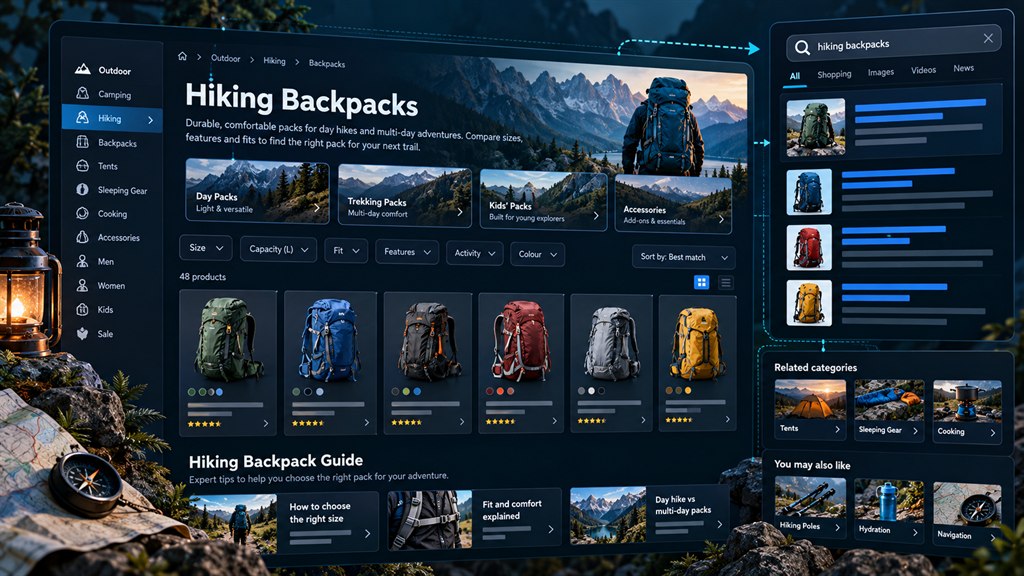
- The product grid.
- Further category page content below: how to choose, size guides, materials, FAQs.
Link from that content to detailed buying guides — informational content that supports the commercial page.
Ecommerce site structure and internal links
A clear ecommerce site structure — home, category, subcategory, product — helps Google understand which pages matter. Strengthen category page internal links from the main menu, breadcrumbs, related categories and buying guides. Avoid burying important categories more than three clicks from the homepage.
Pagination SEO, load more and infinite scroll
- Use crawlable paginated URLs (
?page=2) with normal links, and let each page self-canonicalise. - Load more vs pagination: either works if each set of products is reachable at a crawlable URL.
- Infinite scroll SEO: back it with paginated URLs so Google can reach products beyond the first screen.
Getting pagination SEO right matters most for large categories.
Category page filters and canonicals
Category page filters (size, colour, price) can create thousands of URLs. Keep most filter combinations out of the index and use a category page canonical pointing at the main category, except for valuable filtered views you deliberately turn into subcategories. Our faceted navigation guide explains how.
We find the category keywords you are missing and the structure holding you back.
Category page conversion
Category page conversion improves with sensible default sorting (best sellers or relevance), useful filters, visible prices and stock, quick-view options and clear delivery messages. A product listing page SEO strategy that ignores conversion leaves revenue on the table.
Platform notes
- Shopify collection SEO: collection pages are Shopify’s category pages — add descriptions, control duplicate collection URLs and tag-filtered views. See Shopify SEO.
- Magento category SEO: manage layered navigation URLs and category canonicals carefully.
- Collection page SEO on any platform follows the same principles as category pages.
For large catalogues, an ecommerce SEO consultant or ecommerce SEO company can run a category page optimization service across hundreds of categories — see our ecommerce SEO service.
Category page template and best practices
A reusable category page template:
- Category page title and H1 with the category keyword.
- A one- or two-line intro and an optional category banner — keep banners small so products appear above the fold.
- Subcategory links for large categories.
- The product grid, with featured products or best sellers first.
- Buying advice and a short category page FAQ below the grid.
Write a unique category page meta description for each main category. On category description length: there is no fixed rule — a short intro plus 150–400 words of genuinely useful content below the grid works for most stores. SEO text on category pages that nobody reads, written only for search engines, does little.
Ecommerce navigation, mega menus and breadcrumbs
- Ecommerce navigation should reflect how shoppers think, not your warehouse.
- Mega menu SEO: link to important categories, but avoid hundreds of links in every menu, which dilutes importance.
- Breadcrumbs SEO: show the path (Home › Women › Running shoes) with BreadcrumbList schema.
- A clear category hierarchy with a reasonably flat site architecture keeps important pages within three clicks of the homepage.
Category page SEO examples by store type
- Fashion: categories by product type, with colour and style subcategories where demand exists.
- Home and furniture: categories by room and product, with buying guides on sizes and materials.
- B2B and industrial: categories by application and specification, with technical selection guides.
These category page SEO examples show the same category page best practices adapted to different buyers.
WooCommerce and BigCommerce
WooCommerce category SEO: add category descriptions, control tag archives and check the theme displays descriptions in the right place. BigCommerce category SEO: manage faceted search URLs and default sort order. On every platform, a regular category page audit catches thin, duplicate or cannibalising categories.
Category page SEO: frequently asked questions
How do I optimize category pages for SEO?
Target one category keyword per page, add a short intro and fuller supporting content, show a well-sorted product grid, link to subcategories and guides, handle pagination and filters cleanly, and keep the page fast.
Should category pages have text?
Yes, but helpful text: a short intro above the products and buying advice or FAQs below, rather than keyword-stuffed paragraphs.
Are category pages more important than product pages for SEO?
For most stores, yes, because they target higher-volume searches and stay live permanently, while products come and go.
How should I handle pagination on category pages?
Use crawlable paginated URLs with normal links and self-referencing canonicals, so Google can reach every product.
When should I create a subcategory?
When there is real search demand for the attribute (for example “small sofa beds”) and enough products to make a useful page.
How long should a category description be?
Long enough to help shoppers: a short intro above the products and roughly 150 to 400 words of useful buying advice below is a common pattern.
Do mega menus hurt SEO?
Not inherently, but very large menus with hundreds of links dilute internal link signals. Link to your most important categories and let subcategory pages carry the rest.
What should an ecommerce SEO strategy prioritise first?
Most ecommerce SEO strategy work should start with category pages, because they target the highest-value searches, then product pages and technical issues such as faceted navigation.
How much does ecommerce SEO cost?
Ecommerce SEO pricing depends on catalogue size, platform and competition. See our SEO budget guide and SEO pricing.