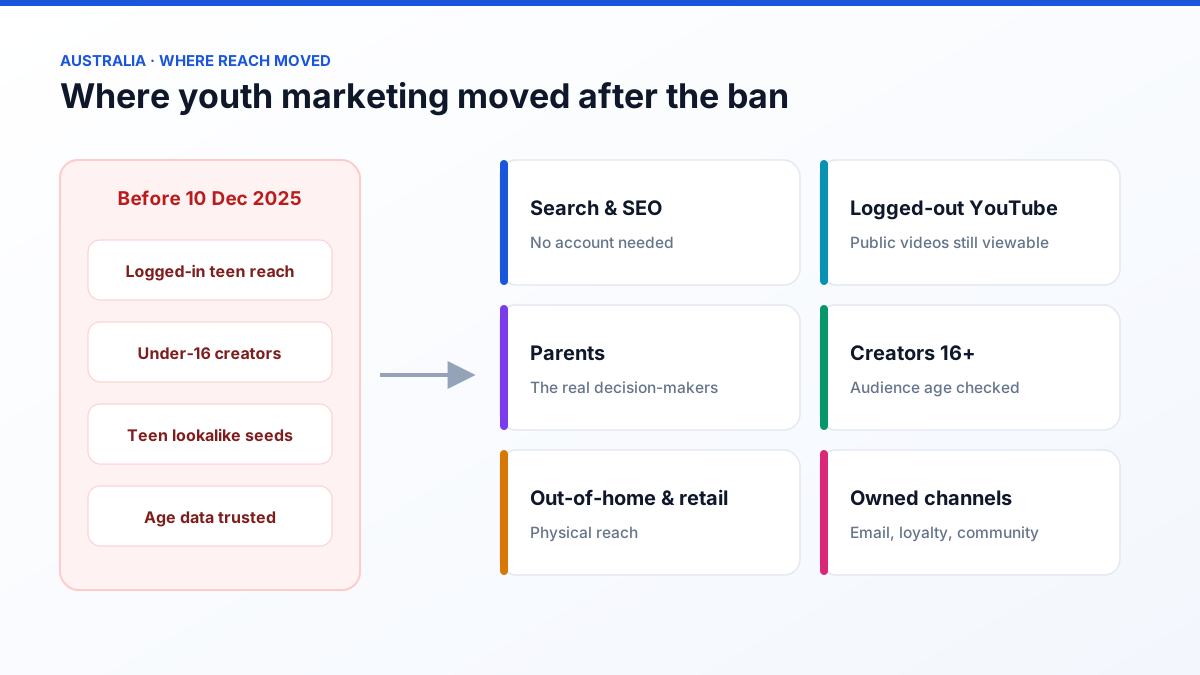
Since 10 December 2025, age-restricted platforms in Australia, including Facebook, Instagram, TikTok, Snapchat, X and YouTube, must take reasonable steps to stop under-16s holding accounts, with penalties of up to A$49.5 million for platforms. Advertisers are not fined, but under-16 reach on logged-in social has largely gone and age data has become less reliable. Brands have shifted to search, logged-out YouTube, parents, creators with 16+ audiences, out-of-home and owned channels.

On this page
- What is Australia’s under-16 social media ban?
- From law to one year on: a short timeline
- What changed for advertisers
- Where youth and family marketing moved
- A search playbook for teen and parent questions
- Creator vetting checklist after the ban
- Measuring youth campaigns without reliable age data
- Is the under-16 social media ban working?
- What brands must and must not do
- Impact by industry
- What it means for small Australian businesses
- Will other countries follow?
- A 2027 plan for youth and family marketing in Australia
- Frequently asked questions
On 10 December 2025, Australia became the first country to require major social media platforms to stop under-16s from holding accounts. A year later, the under-16 social media ban is still being enforced, tested and argued over, and other countries are watching closely. For Australian businesses that market to families, students or young adults, it has quietly changed the media plan.
Below: the platforms covered, the knock-on effects for ad targeting and creator deals, the channels that picked up the slack and a 2027 plan for brands whose customers are teenagers or their parents. It is written for marketers, not lawyers; check the eSafety Commissioner’s latest guidance before acting.
What is Australia’s under-16 social media ban?
Australia’s Social Media Minimum Age law requires age-restricted social media platforms to take reasonable steps to stop Australians under 16 from creating or keeping accounts. It took effect on 10 December 2025. The obligation sits with the platforms, not with parents, children or advertisers, and platforms that fail to comply face penalties of up to A$49.5 million.
The rules are set out in the Online Safety Amendment (Social Media Minimum Age) Act 2024 and enforced by the eSafety Commissioner.
Which platforms are covered?
| Status (eSafety list at launch) | Platforms |
|---|---|
| Age-restricted | Facebook, Instagram, Threads, Snapchat, TikTok, X, YouTube, Reddit, Twitch and Kick, among others |
| Not age-restricted at launch | Messenger, Discord, Roblox, Steam, YouTube Kids, LEGO Play, GitHub and Google Classroom |
eSafety has said the list can change, so check the current version before planning. Two details matter a lot for marketers:
- It is about accounts, not viewing. Under-16s can still watch public content that needs no login, including most YouTube videos.
- Messaging and gaming are treated differently. Several messaging, gaming and education services were not on the restricted list at launch.
From law to one year on: a short timeline
| When | What happened |
|---|---|
| November 2024 | Parliament passed the Online Safety Amendment (Social Media Minimum Age) Act, giving platforms a year to prepare. |
| 2025 | eSafety published regulatory guidance and assessed which services count as age-restricted social media. |
| 10 December 2025 | The obligation took effect; platforms began removing under-16 accounts and adding age checks. |
| 2026 | eSafety monitored compliance and put several platforms on notice over accounts still held by under-16s. |
| 10 December 2026 | First anniversary; evaluations and debate over extending the list continue. |
What changed for advertisers
1. Under-16 targeting on social has effectively gone
Most major platforms already prevented ads targeted at minors by interest. With accounts removed, under-16s also disappear from logged-in reach, lookalike seeds and engagement data. Campaigns that relied on teen reach, such as snack brands, gaming accessories and youth fashion, lost their easiest channel.
2. Audience data got noisier
Some teens have kept accounts by giving false ages or using workarounds, and eSafety has publicly put platforms on notice over compliance. That means reported audience age on social platforms is less reliable than it looks. Treat age breakdowns in ad reports with caution and judge youth campaigns on outcomes, such as sales and sign-ups, rather than reach by age band.
3. Influencer marketing narrowed
Creators under 16 lost their accounts, and creators aged 16 and over lost part of their younger audience. Industry views differ on how much this matters: some argue only a small number of under-16 creators earned meaningful income, while others expect partnerships aimed at teens to need rethinking. Either way, brands should check a creator’s audience age before signing and favour creators whose followers are mainly 16+ or parents.
4. Parents became the main audience
For many youth categories, the decision-maker was always a parent. The ban has pushed brands to talk to parents directly through Facebook and Instagram (parents still use them), search, email and community channels, rather than relying on pester power from teens.
Where youth and family marketing moved
| Channel | Why it gained | How to use it |
|---|---|---|
| Google Search and SEO | Search needs no account, and teens and parents still research there | Pages that answer real questions from both teens and parents; product and comparison content |
| Logged-out YouTube | Public videos remain viewable without an account | Helpful how-to and review videos; YouTube SEO matters more than ever |
| Gaming and messaging platforms | Several were outside the restricted list at launch | Proceed carefully, follow each platform’s youth policies and watch for list changes |
| Out-of-home and retail media | Reaches young people in physical places | Billboards near schools and shopping centres, retail media in stores teens visit |
| Schools, sport and events | Community reach without data collection | Sponsorships with clear, appropriate messaging |
| Email and owned communities | Direct relationship with consenting adults | Parent newsletters, loyalty programmes, 16+ communities |
Organic search is the biggest beneficiary for most brands. A well-structured website that answers the questions teens and parents ask is not affected by account rules at all. See our SEO services in Australia and YouTube marketing service.
A search playbook for teen and parent questions
Teenagers and parents did not stop asking questions when the accounts went; they moved more of that research to search engines and AI assistants. Map the questions each group asks and give each a clear page.
| Who is searching | Typical questions | Page that should answer |
|---|---|---|
| Teens 16–17 | best budget headphones for school, part-time jobs near me, how to choose a uni course | Honest comparison and how-to guides with prices |
| Parents | is this app safe for kids, best tutor near me, school holiday activities Sydney | Safety and policy pages, local service pages, Google Business Profile |
| Schools and clubs | sports uniform supplier, excursion providers, education programs for students | B2B pages with clear processes and accreditation |
Write for the parent as well as the young person: the same page can explain benefits for the teen and safety, cost and supervision for the parent. Pages that answer clearly are also more likely to be quoted by AI assistants; see how to rank in AI search.
Creator vetting checklist after the ban
- The creator is 16 or older, and over 18 for categories with stricter advertising codes.
- You have seen a breakdown of their audience by age and country from the platform’s own analytics.
- Most of their audience is 16+ or parents, not younger fans who may have lost accounts.
- Content will be clearly labelled as advertising under Australian consumer law guidance.
- The brief excludes anything that encourages followers to get around age checks.
- Success is judged on traceable outcomes: codes, links, sign-ups and sales.
Measuring youth campaigns without reliable age data
When platform age data cannot be trusted, measure what you can verify. Use unique offer codes per channel, landing pages per campaign, post-purchase “how did you hear about us” questions and, for larger budgets, regional tests that switch a channel off in one area and compare sales. Track search demand for your brand in Google Search Console and Google Trends; if social reach falls but branded searches hold up, the audience is still finding you. Our SEO KPIs guide covers which numbers to report.
Is the under-16 social media ban working?
It is too early for a firm answer, and the evidence is mixed. Platforms reported removing large numbers of accounts after December 2025. At the same time, eSafety has said some under-16s are keeping accounts, opening new ones or getting around age checks, and has put several platforms on notice. Independent evaluations are under way, and the government has been asked to review how the law works in practice.
For marketers, the practical conclusion is the same either way: do not build a plan that depends on reaching under-16s on social media, and do not assume the age data on those platforms is accurate.
What brands must and must not do
- You are not responsible for platform age checks, but you are responsible for your own conduct. Do not encourage under-16s to create accounts, lie about their age or use workarounds such as VPNs.
- Keep within advertising codes. Australian codes on advertising to children, and category rules for food, alcohol and gambling, still apply on every channel.
- Handle personal information carefully. Australia’s Privacy Act applies when you collect data from young people on your own website, apps or competitions. Ask for only what you need and be clear about how it is used.
- Brief creators properly. Require partners to confirm their audience age and avoid content designed to pull under-16s onto restricted platforms.
We will show where your audience is still searching and watching, and how to reach parents directly.
Impact by industry
| Industry | Main change | Suggested shift |
|---|---|---|
| Education and tutoring | Fewer direct student leads from social | Parent-focused search and email; YouTube study content |
| Fashion and beauty | Teen creator partnerships narrowed | Creators aged 16+ and 18+, retail media, SEO for product searches |
| Food, drink and snacks | Already-limited youth targeting became harder | Out-of-home, retail media, family messaging |
| Gaming and tech accessories | Audiences partly moved to gaming platforms | Search, reviews, YouTube and in-store presence |
| Sport, music and events | Community reach matters more | Clubs, schools, local listings and Google Business Profile |
What it means for small Australian businesses
Most local businesses never targeted under-16s directly, so the direct impact is small. The indirect effects are worth checking, though. Tutoring centres, dance and sports academies, music teachers, holiday programs and youth retailers often relied on students sharing posts or following the business page. Those businesses should make sure parents can find them without social media: a complete Google Business Profile with reviews from parents, a website page for each program with prices and timetables, and an email list for families who have enrolled before. For most of them, local SEO now does the job that teen word of mouth on Instagram used to do. Our local SEO service covers this setup.
Will other countries follow?
Several governments, including in Europe and Asia, have debated or announced similar age limits, and the UK, Malaysia and New Zealand have all discussed the issue publicly. Brands that operate in several markets should expect more age rules over the next few years and build marketing that does not depend on reaching minors through social accounts. Australia is the test case.
A 2027 plan for youth and family marketing in Australia
- Audit your audience: how much of your sales came from under-16s or from campaigns aimed at them before December 2025?
- Re-target to parents and 16+: rewrite briefs, personas and creative for the people who now see your ads.
- Invest in search: build pages that answer teen and parent questions, from product comparisons to “is this safe” content.
- Strengthen YouTube: optimise public videos so they are found without logging in.
- Grow owned channels: email, loyalty and communities for consenting adults.
- Measure outcomes: sales, enquiries and sign-ups by channel, not reach by age band.
For the analytics side, our analytics and tracking service helps compare channels fairly as the mix changes.
Related guides
- Social Media Marketing Guide
- Short-Form Video Strategy
- Instagram Marketing for Small Business
- Zero-Click Searches in 2026
Australia’s under-16 social media ban: frequently asked questions
When did Australia’s under-16 social media ban start?
On 10 December 2025, when age-restricted platforms became required to take reasonable steps to stop under-16s holding accounts.
Does the under-16 social media ban include YouTube?
YouTube is on eSafety’s age-restricted list, so under-16s cannot hold accounts. They can still watch public videos without logging in, and YouTube Kids was not age-restricted at launch.
Does the ban include WhatsApp, Discord or Roblox?
At launch, eSafety did not treat Messenger, Discord or Roblox as age-restricted platforms. The list can change, so check eSafety’s current guidance.
Who gets fined under the ban?
Platforms, not parents, children or advertisers. Platforms that fail to take reasonable steps face penalties of up to A$49.5 million.
Can brands still advertise to teenagers in Australia?
Yes, through channels that are not age-restricted, such as search, logged-out video, out-of-home and retail media, within advertising codes. Brands should not encourage under-16s to get around the ban.
Is Australia’s social media ban working?
Evidence is mixed. Many accounts were removed, but eSafety has reported under-16s keeping or opening accounts and has put platforms on notice. Formal evaluations are continuing.
How should influencer marketing change?
Check each creator’s audience age, prefer creators with mainly 16+ or parent audiences, and judge partnerships on sales and sign-ups rather than reach.
Sources
Rebuild your youth and family marketing for 2027
Lost reach since December 2025? We will map where your audience still searches and watches, and how to reach parents directly.