To rank in ChatGPT, Perplexity and Google AI Overviews, make your content easy to retrieve and easy to quote. Let AI search crawlers in, put a 40–60 word answer under each question-style heading, add original data and sourced statistics, use HTML tables and clean lists, describe your organisation and authors with schema, and earn mentions on the third-party sites AI engines trust. Then track citations, brand mentions and AI referral traffic every month. That is Generative Engine Optimization (GEO).
On this page
- What is Generative Engine Optimization (GEO)?
- How AI search engines choose which sources to cite
- 6 actionable steps to optimize your content for AI search
- How to track your AI search visibility
- Common GEO mistakes to avoid
- Audit your top 5 posts with this checklist
- SEO isn’t dead. It’s becoming multi-platform visibility
- Frequently asked questions
Search behaviour has shifted. Instead of scanning ten blue links, more people now type a full question into ChatGPT, Perplexity or Google and read the answer the AI writes for them. That answer usually names a handful of brands and cites a handful of sources. Everyone else is invisible.
The old playbook of repeating a keyword and buying a few backlinks does not get you into that answer. An AI engine can summarise your topic perfectly well without ever mentioning your website, unless it has a clear reason to quote you. Generative Engine Optimization (GEO) is the work of giving it that reason.
This guide is the practical version: what GEO is, how AI search engines decide which sources to cite, six steps to optimize your content for AI search, and how to measure whether it is working. If you want the strategic view across teams, read our GEO playbook alongside it.
What is Generative Engine Optimization (GEO)?
Generative Engine Optimization (GEO) is the practice of making your brand and content more likely to be mentioned, quoted and cited inside answers written by AI systems such as ChatGPT, Perplexity, Gemini, Copilot and Google AI Overviews. Where SEO competes for a ranking position, GEO competes for a place inside the answer itself.
You will also see it called Answer Engine Optimization (AEO), AI search optimization or LLM SEO. The labels overlap; the goal is the same.
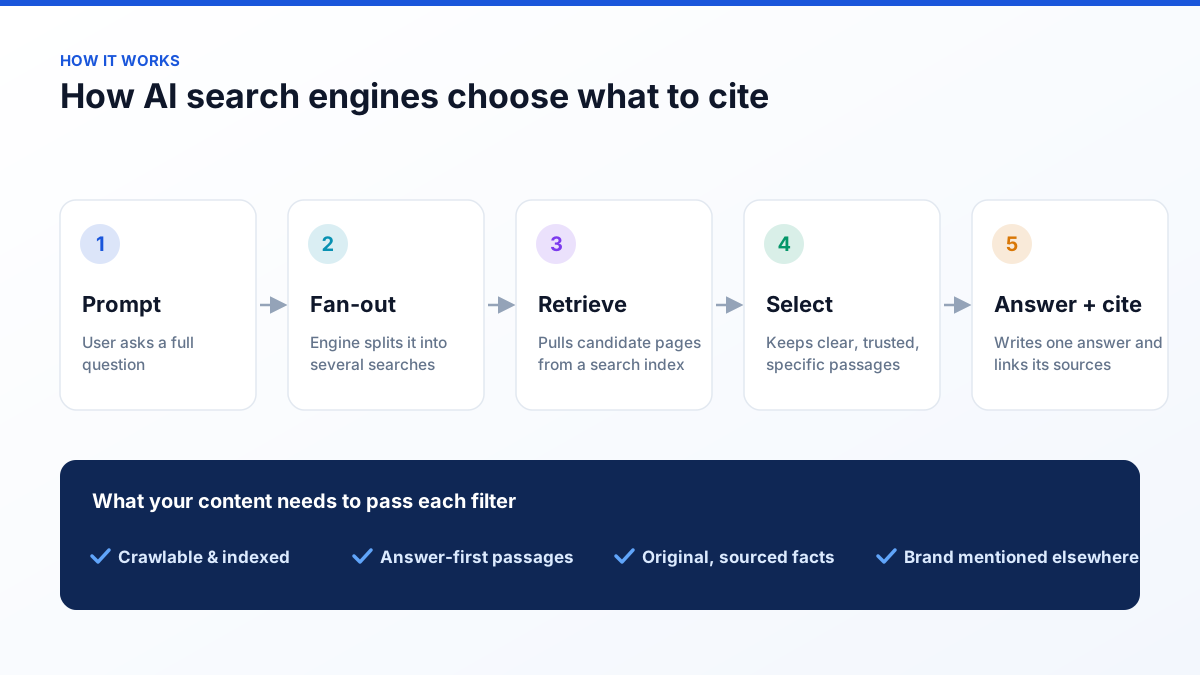
The difference from classic search is in how the result is produced. A traditional search engine crawls pages, indexes them and ranks whole pages against a query. An AI search engine adds three steps on top:
- Interpret and expand the prompt. A single question is often broken into several background searches, sometimes called query fan-out.
- Retrieve and select passages. The engine pulls candidate pages from a search index (Google’s own, Bing, or its own crawler) and picks the specific paragraphs, tables and facts that answer each part of the question.
- Synthesize and cite. A large language model (LLM) writes one answer from those passages and links to some of them as sources.
Some answers also draw on what the model learned in training, with no live search at all. That is why how often your brand is discussed across the web matters, not just what is on your own site.
GEO vs. traditional SEO: key differences
| Factor | Traditional SEO | Generative Engine Optimization |
|---|---|---|
| Goal | Rank a page high in search results | Be mentioned, quoted or cited inside the AI answer |
| Unit of competition | The whole page | Individual passages, facts and tables |
| Key signals | Relevance, backlinks, page experience | Clarity, factual precision, entity authority, third-party corroboration |
| Best content format | Comprehensive, keyword-targeted pages | Answer-first sections, original data, tables and lists that can stand alone |
| Success metrics | Rankings, clicks, organic sessions | Citations, brand mentions, share of voice, AI referral traffic |
GEO does not replace SEO. Most AI engines retrieve from search indexes, so a page that is not indexed or trusted rarely gets cited. Think of SEO as the entry ticket and GEO as what gets you quoted once you are in the room.
How AI search engines choose which sources to cite
No AI company publishes its citation formula, and each engine behaves differently. But the patterns across ChatGPT, Perplexity and Google’s AI features are consistent enough to act on. Before an engine recommends a brand or cites a page, it looks for:
- Entity authority and brand mentions. Is your brand clearly understood as a real organisation that is known for this topic? Mentions on trusted third-party sites such as industry publications, review platforms, directories, Reddit and other community forums act as corroboration. A brand that only talks about itself on its own website is hard for an AI to vouch for.
- Factual precision and clear data. Engines favour passages that state something specific: a definition, a number with a source, a named example, a direct comparison. Vague, general copy gives them nothing to quote.
- Technical accessibility. If an engine’s crawler is blocked in
robots.txt, or your key content only appears after JavaScript runs, the page may never make it into the candidate pool. - Freshness. For fast-moving topics such as prices, regulations or software, recently updated pages with visible dates have an edge.
- Consensus. When several independent sources agree on a fact or a recommendation, engines repeat it with more confidence.
6 actionable steps to optimize your content for AI search
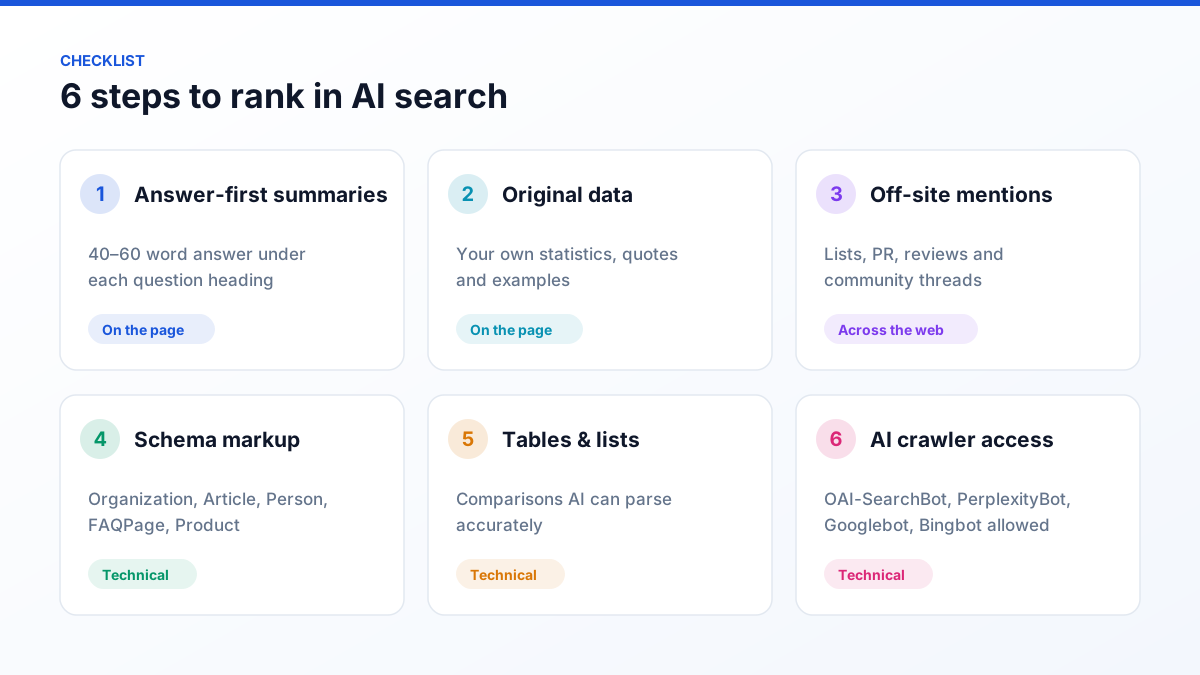
1. Write direct, “answer-first” summaries
Turn your key headings into the questions buyers actually ask, then put a 40 to 60 word answer directly beneath each one. That short paragraph should make sense on its own, without the rest of the page, because that is exactly how an AI engine will use it.
- Weak: “There are many factors to consider when thinking about the cost of a website, and every business is different…”
- Strong: “A small business website in India typically costs ₹25,000 to ₹1,50,000 to build. The main cost drivers are the number of pages, custom design, e-commerce features and ongoing content. Template sites sit at the low end; custom builds with integrations sit at the high end.”
Lead with the answer, then add detail, evidence and nuance underneath. Readers benefit too: they get the point in the first two sentences.
2. Add original statistics, quotes and unique data
AI engines are built to synthesize, so a blog post that rewrites what ten other posts already say adds nothing they need. Primary sources do. The research paper that coined the term GEO (Aggarwal et al., 2023) found that adding statistics, quotations and source citations to content was among the most effective ways to raise its visibility in generative answers.
Practical ways to create information only you have:
- Benchmarks from your own client or customer data, anonymised and aggregated.
- A short survey of your customers or industry peers.
- Quotes from named experts on your team, with their role and experience.
- Before-and-after results from real projects, with dates and methods.
- Your own pricing ranges, timelines or failure rates, stated plainly.
When you cite someone else’s statistic, link to the original source, not to the blog that quoted it.
3. Build co-occurrence and brand mentions off-site
Language models learn associations from text. If your brand name repeatedly appears near a topic, such as “[your brand]” alongside “dental SEO” or “HVAC software”, across many independent sites, engines are more likely to connect the two when someone asks for a recommendation. This is co-occurrence, and it is built off your website:
- “Best X” and comparison lists: pitch to be included, with honest information about where you fit.
- Digital PR: offer data, commentary and expert quotes to journalists and industry publications. See our digital PR for AI search service.
- Communities: answer questions genuinely on Reddit, Quora and niche forums, as a named expert rather than a sales account.
- Reviews and directories: keep profiles complete and consistent on the platforms that matter in your industry.
- Podcasts, webinars and partner content: each one creates more independent text that ties your brand to your expertise.
4. Implement comprehensive schema markup
Structured data tells search engines, in machine-readable form, who you are and what a page contains. It does not guarantee a citation on its own, but it reduces ambiguity, and AI systems that rely on search indexes benefit from that clarity. Use schema markup that matches what is genuinely on the page:
| Schema type | What it clarifies |
|---|---|
Organization | Your official name, logo, contact details and sameAs links to your verified profiles |
Article / BlogPosting | Headline, author, publish and update dates of your content |
Person | Who the author is, their role and where else they are recognised, supporting E-E-A-T |
FAQPage | Question-and-answer pairs on the page (Google now shows FAQ rich results only for a few site types, but the markup still describes the content) |
Product | Product name, price, availability and reviews for e-commerce pages |
Local businesses should add LocalBusiness as well, and keep it identical to their Google Business Profile.
5. Structure content with comparison tables and clean lists
When someone asks “X vs Y” or “best tools for Z”, an AI engine has to pull several attributes for several options and keep them straight. A well-built HTML table, with one option per row and one attribute per column, is far easier to parse accurately than the same facts scattered across paragraphs.
- Use real
<table>,<ul>and<ol>elements, not images of tables or styled<div>grids. - Use numbered lists for processes and bulleted lists for options or features.
- Keep one idea per list item, and start each item with the key term in bold.
- Keep a clear heading hierarchy (one H1, then H2s and H3s) so each section’s topic is obvious.
6. Audit your technical AI crawler access
Each AI company uses different crawlers for different jobs, and blocking the wrong one can quietly remove you from AI answers. The main ones to know:
| User agent | Company | What it does |
|---|---|---|
OAI-SearchBot | OpenAI | Indexes pages for ChatGPT search results. Block it and you can drop out of ChatGPT’s cited answers. |
GPTBot | OpenAI | Collects content that may be used to train models. Blocking it is a separate business decision. |
PerplexityBot | Perplexity | Indexes pages so they can be surfaced and cited in Perplexity answers. |
Googlebot | Crawls for Google Search, which also powers AI Overviews and AI Mode. | |
Bingbot | Microsoft | Crawls for Bing, which feeds Copilot and is used by other AI tools. |
A robots.txt that allows search-related AI crawlers looks like this:
User-agent: OAI-SearchBot
Allow: /

User-agent: PerplexityBot
Allow: /

User-agent: Googlebot
Allow: /

Sitemap: https://www.example.com/sitemap.xml
Then run through this quick checklist:
robots.txtdoes not blockOAI-SearchBot,PerplexityBot,GooglebotorBingboton pages you want cited.- Your CDN or firewall bot protection is not challenging or blocking these crawlers (check your server logs, not just
robots.txt). - Key pages are indexed in both Google and Bing, with sitemaps submitted to Search Console and Bing Webmaster Tools.
- Main content is in the HTML source, not loaded only by JavaScript after the page renders.
- No
nosnippetor very restrictivemax-snippetrules on pages you want quoted. - Pages load quickly and pass Core Web Vitals, so crawlers can fetch them reliably.
Get a prioritised AI visibility action plan from our specialists, free.
How to track your AI search visibility
The question every marketer asks: “How do I measure this?” There is no single AI equivalent of a rankings report yet, so combine three methods.
Manual prompt testing
Write a fixed set of 20 to 30 prompts your buyers would really type, such as “best [service] in [city]”, “[your brand] vs [competitor]” and “how much does [service] cost”. Run them in ChatGPT, Perplexity and Google once a month and log, for each one: were you mentioned, were you cited, which URL, which competitors appeared, and was the description of your brand accurate. AI answers vary from run to run, so watch the trend over months, not a single result.
AI referral traffic in GA4
In Google Analytics 4, go to Reports → Acquisition → Traffic acquisition, switch the dimension to Session source, and filter with this regular expression:
chatgpt\.com|chat\.openai\.com|perplexity\.ai|gemini\.google\.com|copilot\.microsoft\.com|claude\.aiFor ongoing reporting, create a custom channel group called “AI assistants” using the same rule, and track conversions from it, not just sessions. Note one blind spot: clicks from Google AI Overviews and AI Mode are reported as ordinary Google organic traffic, so they cannot be separated out in GA4.
AI visibility tracking tools
A newer category of tools automates prompt testing at scale, tracking mentions, citations, sentiment and share of voice against competitors across engines. They save time once you are tracking more than a few dozen prompts. We compare the options in our guide to AI citation analysis tools, and cover reporting in depth in AI search visibility tracking.
Common GEO mistakes to avoid
- Blocking AI bots by accident. Many sites added blanket rules against AI crawlers to stop scraping, and blocked the search crawlers along with the training ones. Treat each user agent separately, and check firewall and CDN bot settings as well as
robots.txt. - Publishing thin, AI-generated fluff. Mass-produced pages with no first-hand experience add nothing an AI engine cannot already write itself, and they can breach Google’s scaled content abuse policy. Show real E-E-A-T: named authors, real examples, original data. Our guide to AI content SEO covers how to use AI tools without this problem.
- Ignoring your reputation on community platforms. Reddit and Quora threads are frequently cited in AI answers. If the only discussion of your brand there is an unanswered complaint, that is what may be repeated to buyers. Monitor it and respond helpfully.
- Trying to trick the model. Hidden text, prompt instructions aimed at AI crawlers and self-serving “best of” lists that only rank yourself first are short-term tactics that damage trust once spotted.
Audit your top 5 posts with this checklist
Start small. Pick your five best-performing blog posts or service pages and score each one against these questions:
| Check | Pass if… |
|---|---|
| Answer-first | Every question-style H2 is followed by a 40–60 word direct answer |
| Original value | The page has at least one statistic, example or quote that is unique to you |
| Sources | Third-party facts link to their original source |
| Structure | Comparisons are in HTML tables; steps are in numbered lists |
| Authorship | A named author with a real bio and a visible last-updated date |
| Schema | Article, Person and Organization markup validate without errors |
| Access | The page is indexed in Google and Bing, and AI search crawlers are allowed |
Fix the gaps, note the date, and re-run your prompt set four to six weeks later to see what changed.
SEO isn’t dead. It’s becoming multi-platform visibility
Ranking in ChatGPT, Perplexity and Google AI Overviews is not a separate discipline that replaces SEO. It is SEO extended to every place your buyers now ask questions. The brands that get cited are the ones that are easy to crawl, easy to quote, backed by original evidence and talked about by others. None of that is a trick, and all of it compounds.
Start this week: audit your top five posts with the checklist above, check your robots.txt, and write down the 20 prompts you most want to appear in. If you would like a second pair of eyes, our team offers an AI visibility audit that shows exactly where you are cited today and where competitors are winning instead.
Related guides
- Generative Engine Optimization (GEO): The 2026 Playbook
- AEO: Ranking in ChatGPT & Perplexity
- How to Optimize for Google AI Mode in 2026
- AI Search Visibility Tracking: Measure Your Brand
- Content Clusters and Topical Authority
Ranking in AI search: frequently asked questions
Can you pay to rank in ChatGPT or Perplexity answers?
No. ChatGPT now sells ads, but they appear as separate, labelled sponsored units; OpenAI says ads do not influence its answers. Organic citations have to be earned through content, authority and technical access.
How long does it take to appear in AI answers?
Engines that search the web live, such as Perplexity and ChatGPT search, can reflect page improvements within weeks of a recrawl. Building brand mentions and authority strong enough to be recommended consistently usually takes several months.
Do I need to rank on Google to appear in AI Overviews?
Pages cited in AI Overviews must be indexed and eligible to show in Google Search, and they often rank well already. You do not need the number one position, but you do need to be a strong, trusted result for the question.
Should I block GPTBot?
GPTBot collects content for model training, while OAI-SearchBot powers ChatGPT search. You can block GPTBot and still allow OAI-SearchBot, so blocking training does not have to remove you from ChatGPT’s cited answers.
Is GEO only for big brands?
No. Smaller and local businesses often win specific, niche prompts because they have the most precise, first-hand answers. A complete Google Business Profile, genuine reviews and detailed service pages go a long way.
Sources
- Aggarwal et al., “GEO: Generative Engine Optimization” (arXiv, 2023) – the paper that coined the term
- OpenAI: Overview of OpenAI crawlers – OAI-SearchBot, GPTBot and ChatGPT-User
- Perplexity: Perplexity crawlers – PerplexityBot
- Google Search Central: AI features and your website – AI Overviews and AI Mode eligibility
- Google Search Central: FAQ structured data – FAQ rich result eligibility
Want your brand cited in ChatGPT, Perplexity and AI Overviews?
Talk to our team about your goals. We will show you where AI engines mention you today and where the biggest wins are, starting with a free, no-obligation audit.