Google judges the page, not the tool that made it. What gets demoted is scaled, unhelpful content with nothing new in it. The workflow that works: AI for research, clustering, outlines, first drafts and repurposing; humans for facts, first-hand experience, judgement, examples and the final edit. Publish only pages that pass an information gain test, keep real author accountability, and measure non-brand clicks, enquiries and AI citations rather than the number of posts published.

On this page
- What Google actually says about AI content
- Why most AI content underperforms
- The information gain test
- A safe AI content workflow, stage by stage
- Writing the brief: where quality is actually decided
- E-E-A-T when the first draft is machine-written
- Guardrails worth writing down
- How much editing is enough?
- Where AI genuinely earns its place
- AI content for local and service pages
- Publishing is half the job: distribution and internal linking
- Measuring whether AI-assisted content is working
- Briefing AI tools: prompt patterns that produce usable drafts
- Content governance: who approves what
- The refresh problem AI quietly creates
- A 90-day plan for AI-assisted content
- Frequently asked questions
What Google actually says about AI content
Google’s position has been consistent and is narrower than the panic around it. It rewards helpful, reliable content made for people, however it was produced. Its spam policies target scaled content abuse — producing many pages primarily to manipulate rankings rather than to help anyone — and that applies identically whether the pages were written by a person, a model, or the two together. This guide covers whether AI-generated content can rank in Google, how E-E-A-T applies to AI-assisted writing, and an AI content SEO workflow that adds information gain.
So the risk was never “we used AI”. The risk is publishing pages that add nothing. Unsupervised AI production happens to be an extremely efficient way to create exactly those pages, which is why the two questions get conflated.
The practical implication for a marketing team is liberating. You do not need to hide AI use, avoid it, or buy detection software to police your own writers. You need an editorial standard that a page must clear before it publishes, and a workflow that puts human judgement where it changes the outcome.
If a reader who has already read the top three results learns nothing new from your page, it does not deserve to rank — whoever or whatever wrote it. Every guardrail below exists to enforce that one sentence.
Why most AI content underperforms
When an AI-assisted content programme fails, it usually fails for one of six reasons. None of them are mysterious, and all of them are fixable in the process rather than the tooling.
- Sameness. Models are trained on what already ranks, so an unguided draft restates the consensus in slightly different words. Search engines have no reason to prefer the eleventh version of the same answer.
- No first-hand experience. No jobs completed, no numbers from real accounts, no photographs, no failures, no judgement calls. The E of E-E-A-T is the part a model structurally cannot supply.
- No information gain. Nothing on the page that was not already on page one.
- Invented specifics. Plausible statistics, studies and quotes that do not survive a check. One fabricated number can cost more trust than ten good articles earn.
- Volume instead of coverage. Forty thin pages where five strong ones were needed, which dilutes internal linking and splits relevance across near-duplicates.
- No maintenance. Published and abandoned. AI makes publishing cheap, which makes the update backlog grow faster than anyone planned for.
Notice that five of the six are editorial decisions, not model limitations. The output quality of any AI content programme is set almost entirely by the brief and the edit.
The information gain test
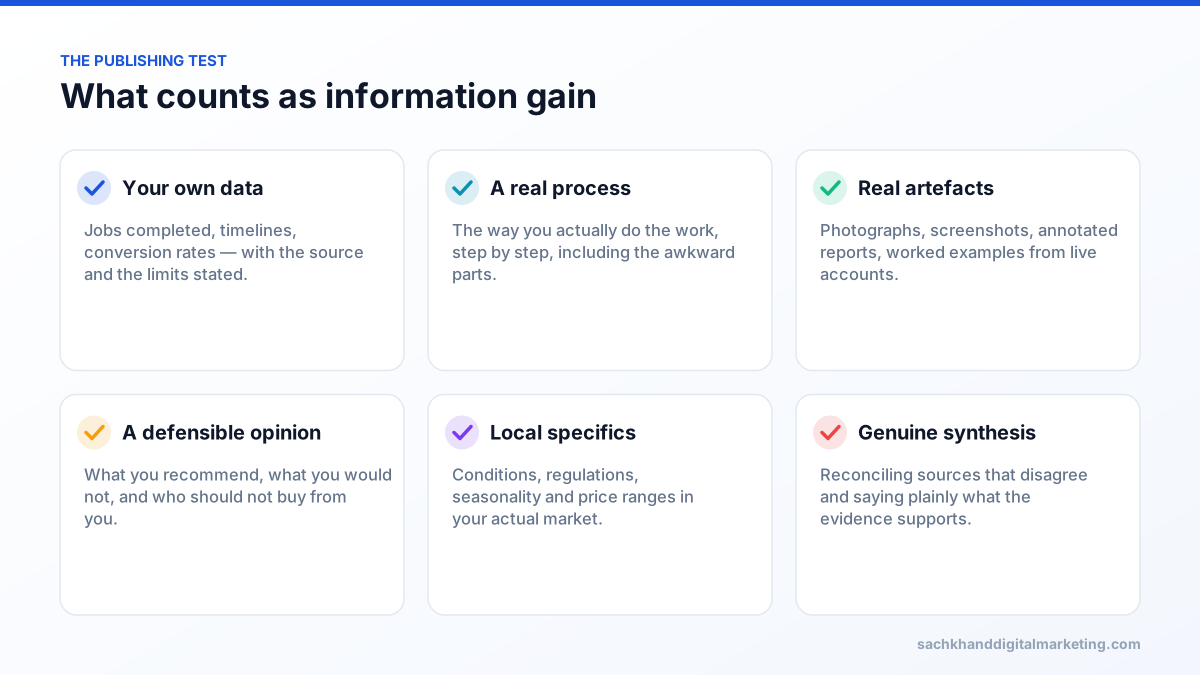
Before anything publishes, it has to answer one question: what does this page contain that the current results do not? Acceptable answers are concrete and checkable.
- Your own data. Jobs completed, timelines, conversion rates, before-and-after numbers — with the source and the limits stated.
- A process you actually run. Described step by step, including the parts that are awkward.
- Real artefacts. Photographs, screenshots, worked examples, annotated reports.
- A defensible opinion. Including what you would not recommend, and who should not buy from you.
- Local or sector specifics. Conditions, regulations, seasonality, price ranges in your market.
- Synthesis nobody else has done. Comparing sources, reconciling contradictions, and saying plainly what the evidence supports.
If the honest answer is “nothing”, the page is not ready, and no amount of rewriting by a model will fix it, because the missing ingredient is knowledge rather than prose. This is the test that builds topical authority rather than page count.
A safe AI content workflow, stage by stage
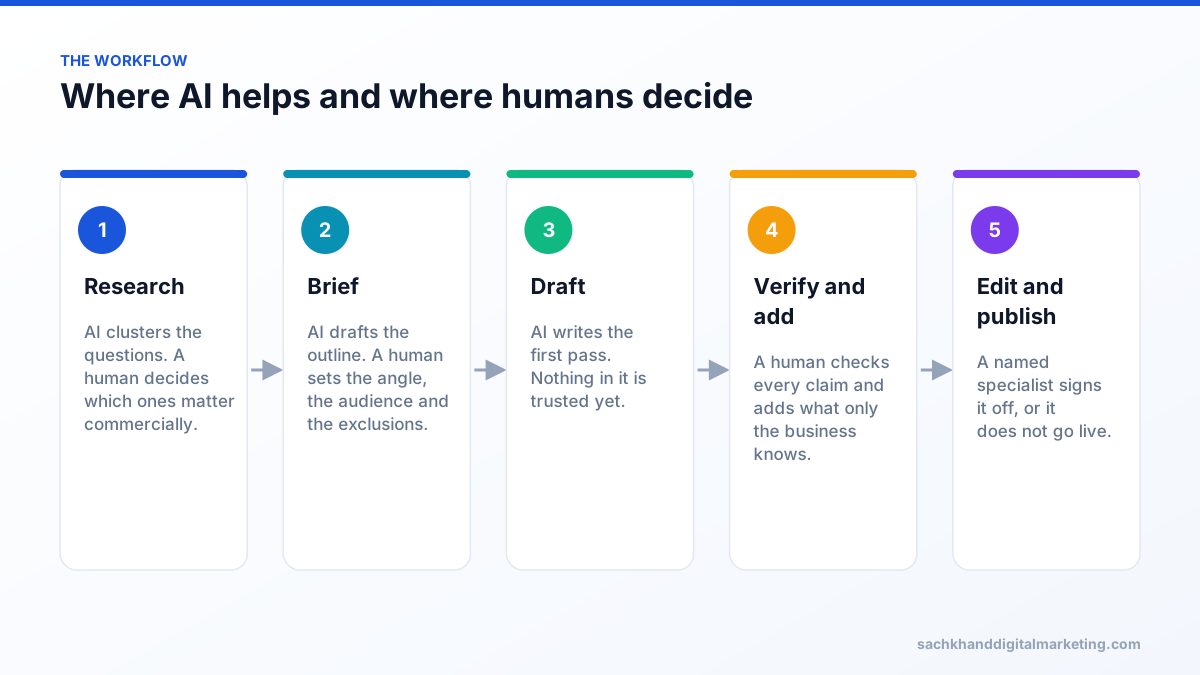
The workflow below is what our content team runs. The principle is simple: AI handles the work that is mechanical or generative, humans handle the work that carries risk or requires knowledge.
| Stage | AI does well | Human keeps control of |
|---|---|---|
| Research | Clustering questions, summarising sources, spotting gaps | Deciding which questions matter commercially |
| Brief | Structuring an answer-first outline from the cluster | The angle, the point of view, the audience |
| Draft | A fast, complete first pass in the agreed structure | Every claim, number, name and example |
| Fact-check | Flagging unsupported statements for review | Verifying against primary sources |
| Experience layer | Nothing useful | Cases, photos, caveats, judgement, what went wrong |
| Edit | Tightening, headline options, readability passes | Voice, accuracy, structure, final sign-off |
| Schema and meta | Drafting markup and meta variants | Checking markup matches the visible page |
| Repurpose | Summaries, social variants, email versions | Approving what goes out under the brand |
| Refresh | Spotting decay and outdated references | Deciding what to update, merge or retire |
AI can write what is already known. A human has to add what only you know. A page containing none of the second part should not go live, however polished the prose is.
Writing the brief: where quality is actually decided
Most of the difference between useful and useless AI-assisted content is set before a single word is drafted. A brief that earns its keep contains:
- The specific question the page answers, phrased as a buyer would ask it.
- Who it is for and what they already know — a homeowner and a facilities manager need different pages.
- The angle: what this page argues that the current results do not.
- Required evidence: which internal data, cases, photos or quotes must appear.
- Entities to cover: the concepts, products, standards and places that belong in a complete answer.
- Internal links: the service pages and related guides this must connect to.
- Explicit exclusions: claims not to make, competitors not to name, promises not to imply.
That last line matters more than it looks. Compliance problems in AI-assisted content almost always come from the model helpfully filling a gap the brief left open — a guarantee you do not offer, a certification you do not hold, a result you cannot evidence.
E-E-A-T when the first draft is machine-written
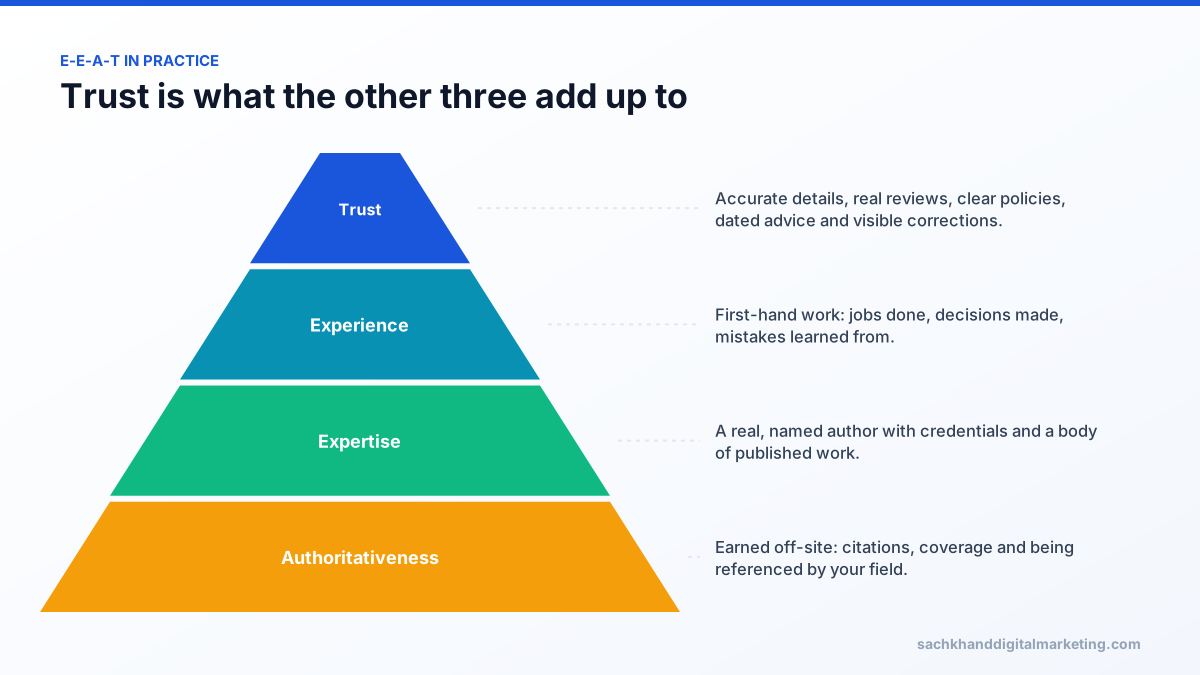
E-E-A-T is a framework describing what Google’s raters look for, not a score in an algorithm. Treated as a checklist for making trustworthiness visible, it is genuinely useful — and it is where AI-assisted content most often falls short.
Experience
The hardest to fake and the easiest to add if you actually do the work. One paragraph describing a real job, with the constraint, the decision and the outcome, does more than a thousand words of general guidance.
Expertise
Attribute content to a real person with a genuine profile, credentials and a body of work. Our articles carry named authors with author pages for exactly this reason. Invented personas are a liability: they are increasingly easy to detect and they destroy trust when found.
Authoritativeness
Earned off-site more than on it — citations, mentions, coverage, being referenced by people in your field. Content is the reason someone cites you; it is not itself the citation.
Trust
The practical layer: accurate contact details, clear pricing information, real reviews, visible policies, dates on time-sensitive advice, and corrections when you get something wrong. Trust signals are also what AI assistants lean on when deciding whose description of a business to repeat.
Guardrails worth writing down
- No invented statistics. Every number gets a source and a date, or it does not appear. If you cannot verify it in two minutes, cut it.
- Real bylines only. Attribute to someone who can defend the content in a conversation.
- Check the specifics. Names, prices, regulations, dates and product details are where drafts fail most often.
- Match the promise. If the title says checklist, the page contains a checklist.
- No fabricated reviews, cases or testimonials. Obvious to say, routinely broken under deadline pressure.
- Disclose where it matters. An editorial note on how content is produced is a trust asset, not a confession.
- Refresh on a cadence. Schedule reviews for commercially important pages instead of publishing more.
Write these down as a one-page editorial standard and attach it to every brief. Guardrails that live in someone’s head do not survive a busy quarter or a new freelancer.
How much editing is enough?
The honest benchmark is that a specialist should be willing to put their name on it. In practice that usually means:
- Restructuring the argument so the answer comes first
- Verifying or cutting every specific claim
- Adding at least one thing only your business could say
- Removing hedging, filler transitions and restated introductions
- Cutting roughly a quarter to a third of the draft’s length
- Rewriting the opening and closing in your own voice
Teams that measure editing time often find it does not fall as much as expected — the saving shows up in research and first-draft time instead. That is the correct outcome. If your edit time collapses to nothing, you are publishing the model’s judgement rather than your own.
Get a prioritised action plan from our specialists, free.
Where AI genuinely earns its place
Used deliberately, AI removes drudgery rather than judgement. The tasks where it consistently pays:
- Turning a messy keyword export into clusters, briefs and a publishing order
- Drafting answer-first opening paragraphs and FAQ blocks for review
- Suggesting internal links across a large site, for a human to approve
- Writing structured data drafts to be validated against the page
- Producing first-pass localisations of an approved page for a native speaker to correct
- Repurposing one strong article into email, social, sales enablement and script formats
- Summarising long primary sources so a writer can find the part worth quoting
- Auditing a content library for decay, overlap and cannibalisation candidates
Every item on that list has a human approval step. That is not caution for its own sake — it is where the quality comes from.
AI content for local and service pages
The single most common misuse we audit is mass-generated location pages: one template, fifty suburbs, nothing changed but the place name. They rarely rank, they dilute relevance, and they are precisely what the scaled content abuse policy describes.
Location pages work when they contain things only a local operator knows: the areas genuinely covered and the ones excluded, response times in practice, local conditions that change the job, jobs completed nearby, reviews from that area, and the pricing realities of that market. AI can structure the page and draft the connective prose; it cannot supply any of the above.
The same applies to service pages. A useful one states what is included, what is not, how long it takes, what it typically costs, what can go wrong, and what happens next — the answers a good salesperson gives. Those answers exist inside your business, not inside a model. Our local SEO service page covers how these fit the wider structure.
Publishing is half the job: distribution and internal linking
Faster production magnifies an old weakness. Teams that could previously publish four articles a month and promote each one properly start publishing twelve and promoting none. The result is a larger library with the same total reach.
Internal links are the highest-return distribution you own
Every new page should link to the service pages it supports and be linked from the pages that already have authority. Orphaned content is invisible to search engines, to readers and to the assistants that crawl your site, no matter how good it is. Plan the links in the brief rather than retrofitting them in a quarterly audit.
One page, several formats
A strong article is a newsletter section, a sales follow-up, a social thread, a short video script and an answer in your FAQ. AI is genuinely good at the reformatting, which makes the economics of proper distribution much better than they used to be — provided someone approves what goes out.
Refresh beats republish
Updating a page that already has links and history usually outperforms publishing a new one on the same topic. Check whether an existing page should be improved before commissioning a replacement; the answer is yes more often than most content calendars assume.
A simple rule keeps it balanced: no new page publishes without its internal links in place and at least one distribution action attached. If the distribution cannot be resourced, the page probably should not be commissioned yet.
Measuring whether AI-assisted content is working
Publishing volume is an input, not a result. The measures that tell you the truth:
| Metric | What it tells you | Cadence |
|---|---|---|
| Non-brand clicks per page | Whether the page earns demand you did not already have | Monthly |
| Assisted enquiries | Whether the content contributes to pipeline | Monthly |
| AI citations and mentions | Whether assistants find the page quotable | Monthly |
| Page-level decay | Which pages need refreshing rather than replacing | Quarterly |
| Cost per published page | Whether efficiency gains are real | Quarterly |
| Editorial rejection rate | Whether the brief-and-edit process is holding | Quarterly |
If AI-assisted production is working, non-brand clicks and enquiries rise while cost per page falls. If only the page count rises, you have automated waste efficiently. The rejection rate is the quiet early warning: when it drops to zero, standards have slipped rather than drafts improved.
Briefing AI tools: prompt patterns that produce usable drafts
Prompting is not magic, but a few patterns reliably raise the floor on draft quality and reduce the editing burden. All of them work by removing the model’s freedom to invent.
Supply the evidence, do not request it
Paste your own data, transcripts, case notes and source material into the brief and instruct the draft to use only what it has been given. A model asked to “include recent statistics” will produce plausible ones. A model given your numbers will use yours.
Name the reader and the decision
“Write for a facilities manager choosing between repair and replacement on a 15-year-old rooftop unit” produces a different and far more useful draft than “write about HVAC maintenance”. The decision the reader is making determines what the page has to contain.
Ask for structure before prose
Generate the outline, edit the outline, then draft from the edited outline. Fixing the argument at the outline stage costs minutes; fixing it after 2,000 words have been written costs an afternoon and usually gets skipped.
Constrain the claims explicitly
State what must not be claimed: no guarantees, no unverified statistics, no comparisons to named competitors, no implied certifications. Models fill gaps helpfully, and an unstated boundary is a gap.
Ask for the weaknesses
A useful final pass is to ask the model what a knowledgeable reader would object to in the draft. The objections are often the missing sections — and answering them is exactly the information gain the page needs.
Content governance: who approves what
AI-assisted production breaks when nobody owns the output. The fastest fix is an explicit, boring approval chain agreed before volume increases.
| Role | Owns | Signs off on |
|---|---|---|
| Strategist | The plan: clusters, priorities, briefs | What gets commissioned and why |
| Writer or editor | Draft quality, structure, voice | That the page meets the editorial standard |
| Subject expert | Accuracy of technical and commercial claims | Facts, figures, method, caveats |
| Compliance or owner | Risk: promises, regulated claims, brand | Anything that could be held against the business |
| SEO | Search fit: intent, structure, internal links, schema | That the page can actually be found and cited |
For small teams one person may hold several of these roles, which is fine as long as the checks are performed as distinct steps rather than blurred into a single skim. The failure mode is a draft that passes because it reads fluently — fluency is precisely what AI provides for free, so it can no longer serve as a proxy for quality.
The refresh problem AI quietly creates
Cheap production creates an expensive maintenance liability. A library that grows three times faster than before needs three times the review capacity, and almost no team plans for that when they adopt AI tooling.
- Schedule reviews by commercial value. Money pages quarterly, supporting guides twice a year, everything else annually.
- Watch for decay signals: falling non-brand clicks, rising average position with falling clicks, outdated dates and references, screenshots of interfaces that have changed.
- Consolidate rather than add. Two mediocre pages on one topic usually make one strong page; splitting relevance across near-duplicates helps nobody.
- Retire honestly. Content that no longer reflects how you work should be removed or redirected, not left to be quoted back at you by an assistant.
- Track the backlog as a number. Pages overdue for review is a health metric; if it only ever rises, production is outpacing capacity.
This is also where AI earns its place most easily: identifying decay, spotting overlap and drafting updates are mechanical tasks it handles well, with a human deciding what actually changes.
A 90-day plan for AI-assisted content
| Weeks | Focus | Output |
|---|---|---|
| 1–2 | Audit the existing library; identify thin, overlapping and decayed pages | A prune-merge-refresh list |
| 3–4 | Write the editorial standard and the brief template; agree the approval chain | Guardrails that exist on paper |
| 5–8 | Run the workflow on one cluster; measure edit time and rejection rate | A working process, proven small |
| 9–12 | Scale to two more clusters; start the refresh cadence; review metrics | Evidence, not opinions, about what to scale |
Start with the audit rather than the production. Most content programmes we inherit do not need more pages; they need the existing ones consolidated, corrected and connected. AI is excellent at helping with that, and it is far cheaper than publishing your way out of a quality problem.
Frequently asked questions
Is AI-generated content against Google’s guidelines?
No. Google evaluates the quality and usefulness of the page rather than how it was produced. What breaches its spam policies is scaled content abuse — mass-producing pages mainly to manipulate rankings rather than to help people — which is equally a problem when humans do it. Use AI in the process and hold the output to the same editorial standard you would apply to any writer.
Will AI content hurt our rankings?
Only if it is unhelpful. Pages with no first-hand experience, no verifiable specifics and nothing the top results do not already say tend to underperform regardless of authorship. Pages that add real data, process detail and judgement perform normally. The determining factor is information gain, not the tool.
Should we label content as AI-assisted?
Disclosure is a brand and trust decision rather than a ranking factor. What matters for search is a real, accountable author and accurate content. Many teams publish a short editorial note explaining how content is produced and reviewed, which doubles as a trust signal for readers and for AI assistants describing your business.
How much human editing does AI content need?
Enough that a specialist would sign their name to it. In practice that usually means restructuring the argument, verifying every specific claim, adding at least one thing only your business could say, and cutting roughly a quarter to a third of the draft. If your edit time falls to almost nothing, standards have slipped.
What is information gain in SEO?
Information gain is what your page adds that the existing results do not already contain — original data, a documented process, real examples, photographs, local specifics or a defensible opinion. It is the most practical publishing test available, because a page that fails it has no reason to outrank the pages it is copying.
Can AI write our local or location pages?
It can draft the structure and connective prose, but location pages fail precisely where AI is weakest: genuine local knowledge. Fill them with the areas you actually cover, local conditions that change the job, jobs completed nearby, real reviews from that area and honest pricing for that market. Mass-produced city pages with only the place name swapped are exactly what scaled content abuse describes.
Does AI content affect E-E-A-T?
Only through what shows on the page. Content with no experience, no named author and no verifiable detail reads as weak regardless of who wrote it. Add real cases, a genuine byline with a profile, accurate business information and dated advice, and the same page reads as expert. Never invent authors or credentials.
How do we stop AI inventing statistics?
Require a source and a date for every number in the brief, verify each one at the fact-check stage, and cut anything that cannot be confirmed quickly. It also helps to supply your own data in the brief, so the draft has real numbers to work with rather than gaps to fill.
How do we measure whether AI-assisted content is working?
Track non-brand clicks and assisted enquiries per page, citations in AI answers, page-level decay, and cost per published page. If clicks and enquiries rise while cost falls, the programme is working. If only the page count rises, you are producing waste more efficiently.
Should we use AI content detectors on our own writers?
Generally no. Detectors are unreliable in both directions and they measure the wrong thing — production method rather than usefulness. Spend the same effort on a clear editorial standard, a fact-check step and an accountable byline, which improve the output instead of policing it.
Want content that earns its place?
We build content programmes around information gain and real expertise — and report on clicks and enquiries, not word count.