You cannot delete reviews yourself, but platforms remove reviews that break their policies. To remove fake Google reviews: reply calmly in public, then report each review through Google Maps or your Business Profile, choosing the specific policy it breaks (spam, conflict of interest, off-topic, harassment). Track the decision in Google’s reviews management tool and appeal once if it is rejected. For a sudden wave of fake reviews (review bombing), contact Google Business Profile support. Defamatory reviews may justify legal advice as a last resort.
On this page
- How to spot fake reviews
- What Google will remove
- How to report a Google review
- Review bombing and coordinated attacks
- Reporting fake reviews on other platforms
- The law on fake reviews
- Defamatory reviews and legal action
- Fake review removal services: a warning
- Review extortion scams and review blackmail
- Fake positive reviews and competitors
- Checking reviews and other platforms
- Fake review removal services: what they can and cannot do
- Frequently asked questions
Not every negative review is fake — and treating genuine criticism as fake makes things worse. But fake negative reviews, competitor fake reviews and coordinated attacks do happen. This guide explains how to remove fake Google reviews and report fake Google reviews on other platforms — what platforms will remove and how to ask. It is part of our online reputation management guide.
How to spot fake reviews
- No record of the reviewer as a customer, and details that do not match your business.
- A profile with no photo, no history or many reviews posted in a short time.
- Several similar reviews arriving together, often with similar wording.
- Reviews mentioning a competitor favourably.
- Content about something other than a customer experience.
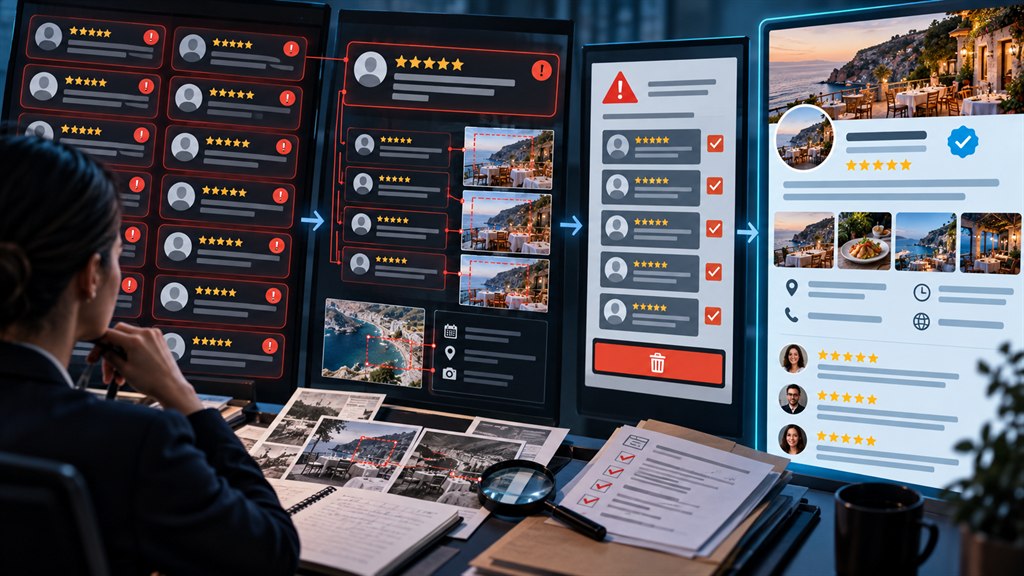
Fake review detection starts with your own records: check bookings, orders and calls before reporting.
What Google will remove
Google removes reviews that break its policies. Common Google review policy violations:
| Violation | Example |
|---|---|
| Spam reviews and fake engagement | Reviews from people who were never customers; bulk reviews |
| Conflict of interest reviews | Reviews by competitors, current or former employees, or owners |
| Off-topic reviews | Political rants or content not about an experience with the business |
| Harassment, hate speech, profanity | Personal attacks on staff |
| Personal information | Staff phone numbers or addresses |
Google will not remove a review simply because it is negative or you disagree with it.
How to report a Google review
- Reply publicly and politely first — future customers will see it either way.
- Find the review in Google Maps or Search, or in your Business Profile’s reviews.
- Choose to report it and select the specific policy it breaks.
- Use the Google reviews management tool to see the status of your report.
- If it is rejected and you have evidence, appeal Google review removal decisions once through the same tool.
That is how to report a Google review; reporting each review individually is more effective than one general complaint. This is the legitimate route to Google review removal — you cannot delete fake reviews directly.
Review bombing and coordinated attacks
Review bombing — many negative reviews in a short time, often after a news story or viral post — is something Google watches for and may temporarily restrict new reviews during. Report the reviews, document the timeline, and contact Google Business Profile support with the evidence. Publish a short public statement if the cause is a public incident.
Reporting fake reviews on other platforms
- Yelp: report reviews that break its content guidelines; Yelp also runs automated filtering.
- Trustpilot: flag reviews that break its guidelines; it may ask the reviewer for proof of experience.
- Tripadvisor: report through the management centre with details.
- Facebook: report recommendations that break community standards.
We document, report and escalate them — and rebuild your rating with genuine reviews.
The law on fake reviews
- US: the FTC’s Consumer Reviews and Testimonials Rule (finalised in 2024) bans fake reviews, buying fake reviews (positive or negative), undisclosed insider reviews and review suppression through threats — the so-called FTC fake review rule, with civil penalties for violations.
- UK: the Digital Markets, Competition and Consumers Act made fake reviews and concealed incentivised reviews banned practices from April 2025 — DMCC Act fake reviews rules are enforced by the CMA. See also fake reviews law UK guidance from the CMA.
- EU: the EU Omnibus Directive reviews rules ban fake reviews and require businesses to explain how they check reviews are genuine.
These rules cut both ways: they protect you from fake attacks and prohibit you from buying reviews or suppressing honest ones.
Defamatory reviews and legal action
Defamatory reviews — false statements of fact that damage your business — may justify legal action for fake reviews as a last resort, usually starting with a solicitor’s or attorney’s letter. Legal action is slow and can draw more attention to the review, so take advice first. Never threaten genuine reviewers: review suppression is itself unlawful in some countries.
Fake review removal services: a warning
Be cautious with any fake review removal service or review removal service that guarantees deletions. Nobody can force a platform to remove a review that complies with its policies; legitimate help means documenting violations, reporting them properly and building genuine reviews — which is how our reputation management service works.
Review extortion scams and review blackmail
A review extortion scam works like this: a business receives a wave of one-star reviews, followed by a message demanding payment to stop or remove them. Never pay. Collect fake review evidence — screenshots, dates, the demand message — report each review, and contact Google Business Profile support, which treats review blackmail seriously. Google may also show a notice about unusual activity on reviews and pause new reviews while it investigates.
Fake positive reviews and competitors
If a competitor appears to be boosting itself with fake positive reviews, you can report competitor fake reviews to the platform too, and in serious cases to consumer protection authorities. Do not retaliate with fake reviews of your own — it risks a Google Business Profile suspension and legal penalties.
Checking reviews and other platforms
How to tell if reviews are fake: look for clusters of similar wording, reviewer profiles with no history, and timing spikes. A fake review checker tool can flag suspicious patterns, but treat it as a prompt to investigate, not proof. Each platform runs its own detection — Yelp fake reviews are filtered by its recommendation software, Trustpilot fake reviews are removed by its integrity team, and Amazon fake reviews are pursued through Amazon’s own enforcement and legal action. If you face a coordinated review attack, document everything before reporting.
Fake review removal services: what they can and cannot do
Be careful with any fake review removal service that promises guaranteed deletion. Only the platform can remove a review, and only when it breaks that platform’s policies. A legitimate online reputation management company documents the evidence, reports through official channels, escalates where the platform allows, and helps you build genuine reviews so one fake review carries less weight.
For reviews that may be defamatory, speak to a lawyer rather than a marketing agency. Good reputation management services work alongside legal advice; they do not replace it.
Fake reviews: frequently asked questions
How do I remove fake Google reviews?
Report each review through Google Maps or your Business Profile, selecting the policy it breaks, track the decision in Google’s reviews management tool and appeal once if needed.
Can I delete a review from my Google Business Profile?
No. Only Google can remove reviews, and only those that break its policies.
What if a competitor leaves fake reviews?
Report them as conflict of interest, keep evidence, and seek legal advice if the reviews are defamatory or part of a sustained campaign.
Is buying reviews illegal?
In the US, UK and EU, buying fake reviews breaks consumer protection rules and can lead to fines, as well as removal by platforms.
What is review bombing?
A sudden wave of negative reviews, often from people who were not customers, usually triggered by news or social media. Report the reviews and contact platform support with evidence.
How long does Google take to remove a reported review?
It varies from days to weeks. Check the status in Google’s reviews management tool.
Someone is demanding money to remove bad reviews — what should I do?
Do not pay. Keep the evidence, report the reviews and the extortion attempt to the platform, and consider reporting it to the police or consumer authorities.
Can fake reviews get my Google profile suspended?
Buying or posting fake reviews for your own business can lead to review removal, restrictions or suspension. Being the target of fake reviews should not, but report them promptly.
Are fake review checker tools reliable?
They can flag suspicious patterns, but they are not proof. Always check your own records before reporting.
Can a reputation management company remove fake reviews?
No company can guarantee removal. A reputation management company can gather evidence, report the review through the platform’s official process and escalate it, but only the platform decides. Avoid any service that promises guaranteed removal for a fee.