International SEO is the work of making one brand rank in search results in several countries or languages. Choose a URL structure (country domains, subfolders or subdomains), give every market its own page with content written for that market, connect the versions with hreflang annotations that include return links, a self-reference and an x-default, and never redirect visitors by IP address. Then build local authority in each country with local links, reviews and mentions, and track every market separately in Search Console.
On this page
- What is international SEO?
- ccTLD vs subfolder vs subdomain
- How hreflang works
- hreflang mistakes to avoid
- Localise, don't just translate
- Why you should not redirect by IP
- Beyond Google: Baidu, Naver, Yandex and Bing
- Building authority in each country
- How to measure international SEO
- International SEO checklist
- Frequently asked questions
Most businesses that sell abroad start the same way: one English website, a currency switcher and the hope that Google will show the right page to the right country. Then the UK page ranks in Australia, the US page outranks the UK page in London, and the German translation never gets indexed at all.
This guide explains how international SEO actually works in 2026, which URL structure to choose, how to set up hreflang without the usual errors, and how to build enough local authority to rank in each country. It is the same process we use for clients across the 30 countries we serve.
What is international SEO?
International SEO is the process of optimising a website so search engines show the right language or country version of each page to searchers in each market. It covers URL structure, hreflang annotations, localised content and keyword research, and building authority in every country you target.
There are two kinds of international site, and many businesses are both:
- Multilingual: the same content in different languages, such as English, Arabic and French versions of one page.
- Multi-regional: pages for different countries, even in the same language, such as separate pages for the UK, the US and Australia with local prices, spelling and contact details.
ccTLD vs subfolder vs subdomain: which URL structure is best?
Google supports all three structures. The choice is about how strong a country signal you need, how much authority you can build per market, and how much infrastructure you want to run.
| Structure | Example | Strengths | Trade-offs |
|---|---|---|---|
| Country domain (ccTLD) | example.de, example.co.uk | Strongest country signal; trusted by local users | Each domain builds authority from zero; more cost and admin; only targets one country |
| Subfolder | example.com/de/, example.com/uk/ | Every market shares the main domain’s authority; one site to run | Weaker country signal on its own, so hreflang and local content matter more |
| Subdomain | de.example.com | Can be hosted separately; useful when local teams run their own sites | Authority is often split from the main domain; usually the weakest option for SEO |
| URL parameters | example.com/?lang=de | Easy to build | Google recommends against it: parameters are hard for users and search engines to separate |
Our default recommendation is subfolders on a generic .com domain. A new market inherits the authority the main site has already earned, which usually means rankings in months rather than years. Choose ccTLDs when a market is large enough to justify its own brand investment, or where local trust strongly favours a country domain, as it does in Germany and Japan.
How hreflang works
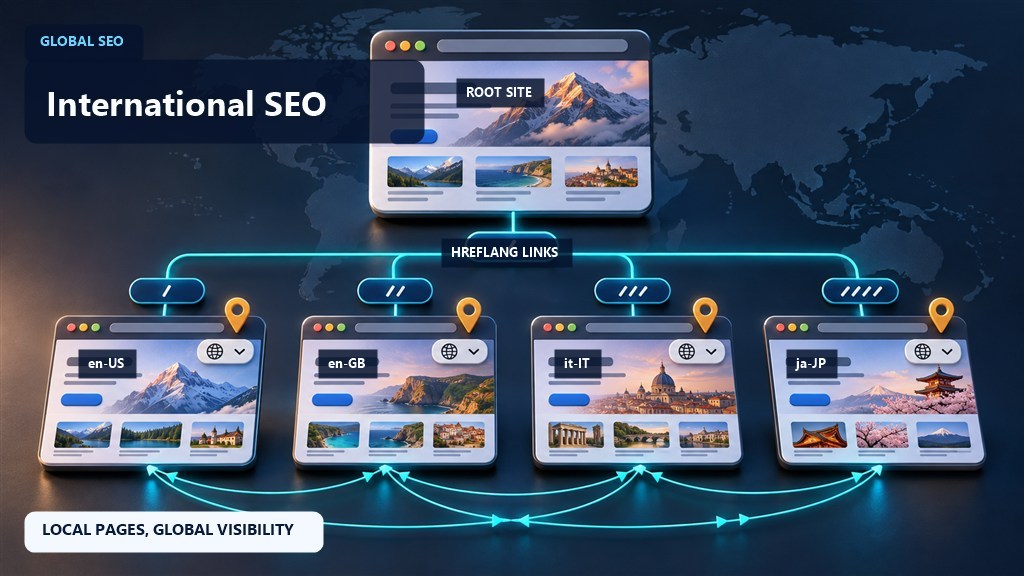
hreflang is an annotation that tells Google which language and region each version of a page is for, and where its alternatives are. It does not boost rankings. It makes sure that when your site already ranks, the searcher in Manchester sees the UK page and the searcher in Dubai sees the UAE page.
Each page lists every version of itself, including itself:
<link rel="alternate" hreflang="en-gb" href="https://example.com/uk/seo/" />
<link rel="alternate" hreflang="en-us" href="https://example.com/us/seo/" />
<link rel="alternate" hreflang="en-ae" href="https://example.com/ae/seo/" />
<link rel="alternate" hreflang="de-de" href="https://example.com/de/seo/" />
<link rel="alternate" hreflang="x-default" href="https://example.com/seo/" />
The rules that matter:
- Language first, region optional. The language is an ISO 639-1 code (
en,de,ar). The optional region is an ISO 3166-1 alpha-2 country code (gb,us,ae). A region on its own is invalid. - Every annotation needs a return link. If the UK page points to the US page, the US page must point back. Google ignores one-way pairs.
- Include a self-reference. Each page lists itself as well as its alternatives.
- Use
x-defaultfor the page shown to anyone who matches none of your versions, usually a global page or a country selector. - Use full absolute URLs that return a 200 status, are indexable and match each page’s canonical tag.
- Pick one method. Put hreflang in the HTML
<head>, in HTTP headers (useful for PDFs) or in your XML sitemap. On large sites the sitemap is easiest to maintain.
The hreflang mistakes we find most often
| Mistake | What happens | Fix |
|---|---|---|
en-uk instead of en-gb | The code is invalid, so the annotation is ignored | The ISO code for the United Kingdom is gb |
| Missing return links | Google discards the pair and may show the wrong country | Generate hreflang from one shared list so every page outputs the full set |
| Canonical pointing to another language | The alternate page is treated as a duplicate and dropped from the index | Each version must canonicalise to itself |
| hreflang to redirected, noindexed or 404 URLs | The cluster breaks | Crawl hreflang targets after every release |
| Same-language pages that are identical | Google may pick one version for every country | Localise prices, spelling, examples, contact details and proof |
Localise, don't just translate
hreflang only helps Google choose between pages. To rank, each page still has to be the best result for searchers in that country, and that takes more than translation.
- Research keywords in every market. People in the UK search for “solicitors”, people in the US search for “attorneys”, and in the UAE many searches mix English and Arabic. Volumes and competition differ by country, so build a separate keyword map for each one. Our keyword research guide walks through the process.
- Use local currency, units, spelling, dates and phone formats. They are trust signals for people, and they help separate same-language pages for search engines.
- Show local proof. Case studies, reviews and clients from that country do more for conversion than any translation.
- Use native writers or editors. Machine translation is a fine first draft, but unedited output reads as low quality to both readers and quality systems.
- Plan around local seasons. Black Friday, Diwali, Ramadan and the Australian end of financial year all move demand. See our Ramadan 2027 marketing plan for one example.
Why you should not redirect visitors by IP address
Automatically sending visitors to a country version based on their IP address feels helpful, but it causes two problems. Googlebot crawls mostly from US IP addresses, so it may never see your other versions. And travellers, expats and VPN users get stuck on the wrong site.
Instead, let every URL load for everyone, connect them with hreflang, and show a small banner suggesting the local version (“Looks like you’re in Australia. Go to the Australian site?”). Remember the visitor’s choice.
Beyond Google: Baidu, Naver, Yandex and Bing
Google dominates search in most countries, but not all of them:
- China: Google is blocked and Baidu leads. Ranking well usually needs a Simplified Chinese site hosted in mainland China, which requires an ICP licence.
- South Korea: Naver competes closely with Google and rewards activity on its own blog and community platforms.
- Russia: Yandex is the main search engine and puts heavy weight on user behaviour and regional signals.
- Bing: worth a separate check in every market, because Bing’s index also feeds Microsoft Copilot and some AI assistants. Bing has historically relied more on the
content-languagemeta tag than on hreflang, so adding both is a cheap safeguard.
Building authority in each country
A new market will not rank on technical setup alone. Search engines also look for signs that the brand is known in that country:
- Local links and press: coverage in national and trade publications, chambers of commerce and industry associations. See our link building guide.
- Local reviews: on platforms people in that market actually use, such as Trustpilot in the UK, Google reviews everywhere and Clutch for B2B services.
- Google Business Profile, only where you have a real address. If you serve a country remotely, say so honestly on the page instead of inventing an office.
- Brand mentions in AI answers. AI assistants answer in the searcher’s language and often favour local sources. Localised pages and local mentions improve your chances of being cited. Read more in GEO vs SEO.
How to measure international SEO
- Add a Search Console property for each country folder (for example
example.com/uk/) so every market has its own performance report. - Filter performance by country to check that UK searchers land on UK pages. If they land on the US version, hreflang is broken.
- Track rankings from each country and language, not just your home market.
- Report conversions per market in GA4 using country and page-path dimensions, so you can see revenue, not just traffic.
International SEO checklist
- Choose your target markets based on demand data and your ability to serve them.
- Choose one URL structure and apply it consistently.
- Research keywords separately for every country and language.
- Write or edit content with native speakers and add local proof.
- Implement hreflang with self-references, return links and
x-default. - Make every version canonicalise to itself.
- Remove IP-based redirects; add a suggestion banner instead.
- List every localised URL in your XML sitemap.
- Build local links, reviews and mentions in each market.
- Track rankings, traffic and conversions per country.
Related guides
- Multi-Location SEO: How to Rank Every Location in 2026
- How to Do Keyword Research for SEO in 2026
- Technical SEO: The 12-Point Audit Checklist for 2026
- Link Building for SEO: What Works in 2026
- GEO vs SEO: What’s Actually Different in 2026
Frequently asked questions
What is international SEO?
Optimising a website so search engines show the right language or country version of each page to searchers in each market. It covers URL structure, hreflang, localised content and keyword research, and local authority.
Is a subfolder or a ccTLD better for international SEO?
Subfolders on a strong .com let every market share one domain’s authority, so they usually rank faster. Country domains (ccTLDs) send the strongest country signal but each one builds authority from scratch.
Does hreflang improve rankings?
No. hreflang helps Google show the right version of a page that already ranks. Rankings still depend on content quality, relevance and authority in each market.
What is hreflang x-default?
The version shown to searchers who match none of your language or country annotations, usually a global page or a country selector.
Is translated content duplicate content?
No. Content in different languages is not treated as duplicate. Same-language pages for different countries are fine when connected with hreflang, though localising them helps each one rank.
Should I redirect visitors to their country site automatically?
No. IP-based redirects can stop Googlebot, which crawls mostly from the US, from seeing other versions. Suggest the local version with a banner instead.
Sources
Rank in every market you sell to
Planning a launch in a new country, or fixing hreflang on an existing site? We will audit your international setup and show what is stopping each market from ranking.