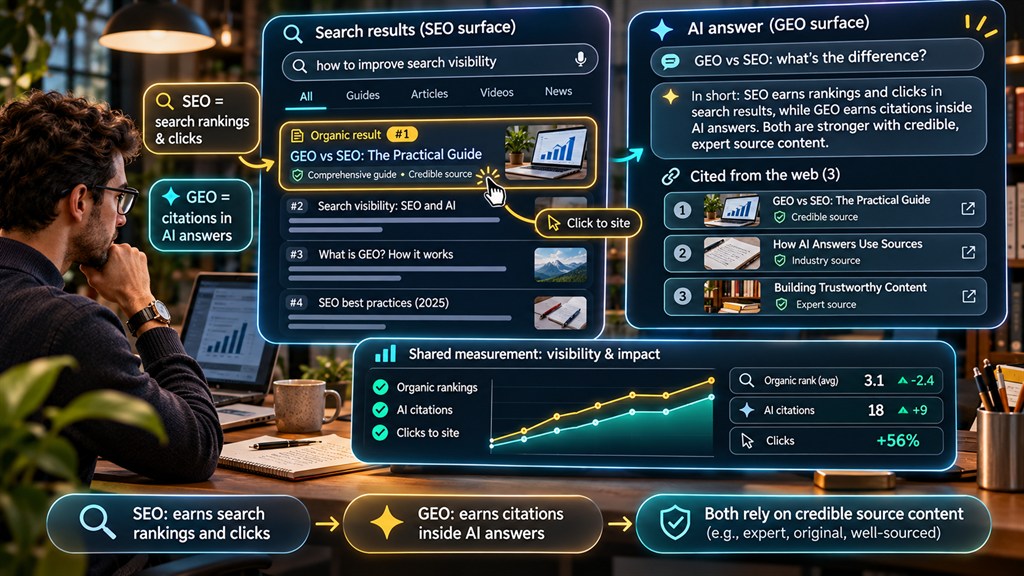
SEO earns a ranking position and a click in a list of results. GEO (generative engine optimisation) earns a mention or citation inside an AI-written answer in ChatGPT, Perplexity, Gemini, Copilot or Google AI Overviews. Both rest on the same foundations: crawlable pages, helpful content and a trusted brand. GEO adds three things: passages that can be quoted on their own, mentions on sites you do not own, and measurement by citations and share of voice rather than rank. Run them as one strategy, not two.
On this page
Every month another agency announces that SEO is dead and GEO is the future. Every month Google still sends more traffic to websites than every AI assistant combined. Both statements can be true at once, and that is why the GEO vs SEO question confuses so many marketing teams.
This guide sets out what each discipline is, where they overlap, the few places where they really are different, and how to plan for both without doubling your budget.
What are SEO and GEO?
SEO (search engine optimisation) is the work of earning higher positions in search engine results so people click through to your website. GEO (generative engine optimisation) is the work of getting your brand mentioned, recommended or cited inside answers written by AI systems such as ChatGPT, Perplexity, Gemini, Microsoft Copilot and Google AI Overviews.
You will also see AEO (answer engine optimisation), AIO and LLM SEO. In practice these describe the same goal as GEO: being the source an AI-generated answer relies on.
GEO vs SEO side by side
| SEO | GEO | |
|---|---|---|
| Goal | Rank a page and win the click | Be named or cited in the answer |
| Where you appear | Google and Bing results pages | ChatGPT, Perplexity, Gemini, Copilot, AI Overviews and AI Mode |
| Unit that competes | The whole page | A passage, fact or statement within a page |
| Sources that count | Mostly your own pages and the links pointing to them | Your pages plus reviews, forums, news, directories and comparisons that mention you |
| Query shape | Short keywords | Long, conversational questions, often with follow-ups |
| Main metrics | Rankings, clicks, organic conversions | Citations, mentions, share of voice, AI referral traffic |
| Measurement maturity | Mature: Search Console, rank trackers, analytics | Young: sampled prompts and AI visibility tools |
What stays the same
Most of what makes a site rank also makes it citable. Google says there are no extra technical requirements to appear in AI Overviews or AI Mode: a page must be indexed and eligible to show a snippet, and the usual SEO best practices apply.
- Crawlability and indexing. If Googlebot, Bingbot, OAI-SearchBot or PerplexityBot cannot fetch the page, no AI answer can use it.
- Helpful, original content. AI systems favour the same clear, accurate, first-hand content that ranks well.
- Authority and trust. Links, reviews and reputation still decide which sources are trusted.
- Technical health. Fast, stable pages with clean HTML are easier for every crawler to read.
Many AI assistants also pull from search indexes when they browse the web. A page that ranks well in Google or Bing has a better chance of being retrieved and cited.
What is actually different
1. Passages compete, not pages
An AI answer quotes or paraphrases a sentence or two. A page that buries its answer under 400 words of introduction can rank and still never be quoted. Open each section with a direct, self-contained answer, then add detail.
2. Mentions count, even without links
When someone asks “what is the best CRM for small businesses?”, the assistant combines what review sites, Reddit threads, comparison articles and news coverage say. Your own page is one input among many. GEO therefore includes digital PR, review generation and making sure your brand is described accurately wherever it appears.
3. One question becomes many searches
Google has described AI Mode as using a query fan-out technique: it breaks a question into related sub-queries and searches them at the same time. Pages that cover a topic thoroughly, including the follow-up questions, get more chances to be pulled in. This rewards the topic clusters good SEO already recommends.
4. Clear entities matter more
AI systems need to be sure who you are. Consistent names, addresses, descriptions and profiles across the web, plus Organization and Person schema, reduce the chance of being confused with another company.
5. Measurement is less precise
AI answers change between users, sessions and model updates. There is no Search Console equivalent for ChatGPT. You track a fixed set of prompts over time and treat the results as a trend, not an exact rank.
What the research says
The term GEO comes from a 2023 research paper by teams at Princeton University, Georgia Tech, the Allen Institute for AI and IIT Delhi. They tested how content changes affected visibility in generative search answers and found that some methods could increase visibility by up to 40%. Adding statistics, quotations from credible sources and citations performed best. Keyword stuffing did not help.
The practical lesson: content that is specific, sourced and easy to quote does better in AI answers. It is the same content a careful human reader trusts.
Does GEO replace SEO?
No. Organic search still drives far more website visits than AI assistants for almost every business, and the work that earns rankings is most of the work that earns citations. Treat GEO as an extension of SEO: the same foundations, plus a layer focused on answers, off-site mentions and new metrics.
The bigger shift is that rankings no longer guarantee clicks. With more searches ending on the results page (see our zero-click search guide), being the brand named in the answer matters even when nobody clicks.
A combined GEO and SEO plan
- Fix the foundations. Make sure every important page is crawlable and indexed, and that your robots.txt does not block the AI search crawlers you want to be cited by.
- Map the questions buyers ask. Combine keyword research with the long, conversational prompts people type into AI assistants.
- Write answer-first. Start each section with a one or two sentence answer, then support it with detail, data and examples.
- Add evidence. Original statistics, named sources, dates and first-hand experience make passages worth quoting.
- Clarify your entity. Keep business details consistent everywhere and add structured data that matches your visible content.
- Earn mentions off-site. Reviews, digital PR, expert quotes and inclusion in credible comparison lists.
- Measure both. Track rankings and clicks alongside a monthly prompt panel for citations and share of voice.
GEO myths to ignore
- “You need an llms.txt file to be cited.” It is cheap to add, but Google has said it does not use llms.txt for Search, and there is no evidence that it drives citations elsewhere.
- “Blocking Google-Extended keeps you out of AI Overviews.” It does not. Google-Extended controls use of your content for Gemini models, not for Google Search features. AI Overviews follow normal Googlebot and snippet controls.
- “AI content is penalised.” Google targets unhelpful content at scale, however it is made. Unedited, generic AI content simply loses to better pages.
- “GEO results are instant.” Live-search assistants can pick up a new page quickly, but brand mentions and authority take months, just as in SEO.
How to measure both
| Metric | Measures | Where to get it |
|---|---|---|
| Rankings and impressions | SEO visibility | Google Search Console, Bing Webmaster Tools, rank trackers |
| Organic clicks and conversions | SEO revenue impact | Search Console, GA4 |
| Citation rate | How often your pages are cited for target prompts | Manual prompt panel or AI visibility tools |
| Share of voice in AI answers | Your mentions compared with competitors’ | AI visibility tools |
| AI referral traffic | Visits from chatgpt.com, perplexity.ai, gemini.google.com and copilot | GA4 referral reports |
| Branded search volume | Demand created by being recommended | Search Console, Google Trends |
Our AI search visibility tracking guide explains how to set up a prompt panel and which tools to use.
Related guides
- Generative Engine Optimization (GEO): The 2026 Playbook
- How to Rank in ChatGPT, Perplexity, and Google AI Overviews: A Practical GEO Guide
- Answer Engine Optimization (AEO): Ranking in ChatGPT & Perplexity
- AI Search Visibility Tracking: How to Measure Your Brand in AI Search
- Schema Markup for AI Overviews and AI Search: What Actually Helps
Frequently asked questions
What is the difference between GEO and SEO?
SEO aims to rank a page in search results and win the click. GEO aims to get your brand mentioned or cited inside AI-generated answers in tools like ChatGPT, Perplexity, Gemini and Google AI Overviews.
Does GEO replace SEO?
No. GEO builds on SEO. Crawlable pages, helpful content and authority drive both, and organic search still sends most businesses far more traffic than AI assistants.
Is GEO the same as AEO?
Mostly. Answer engine optimisation (AEO) and generative engine optimisation (GEO) both describe optimising to be the source an AI-generated answer uses. The terms are used almost interchangeably.
How do I get my business cited by ChatGPT?
Make sure your pages can be crawled, answer common questions directly, add sourced facts and statistics, keep your business details consistent online and earn mentions on reviews, news and comparison sites.
How do you measure GEO?
Track a fixed set of prompts over time and record how often your brand is mentioned or cited, your share of voice against competitors, and AI referral traffic in GA4.
Do I need different content for GEO and SEO?
Usually not. One well-structured page with direct answers, evidence and clear headings serves both. The extra GEO work is mostly off-site: reviews, PR and mentions.
Sources
Get found in Google and in AI answers
We will check where your brand ranks in Google and where it is mentioned, or missing, in ChatGPT, Perplexity, Gemini and AI Overviews.