Agentic search is an assistant carrying out a multi-step task for someone: researching a service, comparing providers, checking availability, starting an enquiry. Agents need what good SEO already needs, only stricter — facts in machine-readable HTML and structured data, content that renders without heavy JavaScript, stable URLs, standard labelled forms, fast responses, and a deliberate AI crawler policy that your firewall actually honours. Sites that hide key facts in images, scripts or PDFs simply get skipped.

On this page
- What agentic search actually means
- Why this matters now, not later
- What AI agents need from a website
- The five places agents give up
- Structured data is the agent’s cheat sheet
- Deciding your AI crawler policy on purpose
- Content structure for agentic search
- Conversion paths that survive an agent
- Agentic commerce and booking: what changes for retail and services
- Measuring agent readiness
- The 12-point AI agent readiness checklist
- What agentic search means for local and service businesses
- Four myths about agentic search
- What agentic search does not change
- Frequently asked questions
What agentic search actually means
Traditional search hands a person ten links. Agentic search hands a person a finished step. Ask an assistant to “find a plumber who can come out tomorrow morning and get me a quote” and it will attempt exactly that: read several sites, compare what it finds, discard the ones it cannot parse, and start an enquiry with the one it can. If you are asking how to optimise for AI agents, this agentic SEO guide covers what AI shopping and booking agents need from your site in 2026.
The mechanics vary by platform — browsing modes inside assistants, agentic features in AI search products, standalone research agents, and a growing set of shopping and booking agents — but the pattern is consistent. Software reads your site on a person’s behalf, with no patience for ambiguity, no ability to guess what a graphic means, and a hard timeout.
For marketers, the shift is subtle but consequential. Your audience is no longer only the human reading the page. It is also the agent summarising your page into a one-line comparison against three competitors. If your key facts are not machine-readable, you are not in that comparison at all.
Treat every service page as though it will be read aloud to a buyer by a stranger who has thirty seconds, cannot see your design, and will not guess. That stranger is the agent.
Why this matters now, not later
Three things changed at once. Assistants gained reliable browsing, so they read live pages rather than only recalling training data. Commerce and booking integrations turned “find me” into “do it”. And buyers got comfortable delegating research, which is a behaviour change that does not reverse.
The practical consequence is a new failure mode. A site can rank, load fast for humans, convert reasonably, and still be invisible to agents because its prices live in a widget, its service areas live in a graphic, and its enquiry form breaks without JavaScript. None of that shows up in a rank tracker. All of it shows up the moment an agent tries to use the site.
The good news is that agent readiness overlaps almost entirely with solid technical SEO. There is very little new work here — it is the existing work, held to a stricter standard, with a few new decisions about crawlers.
What AI agents need from a website
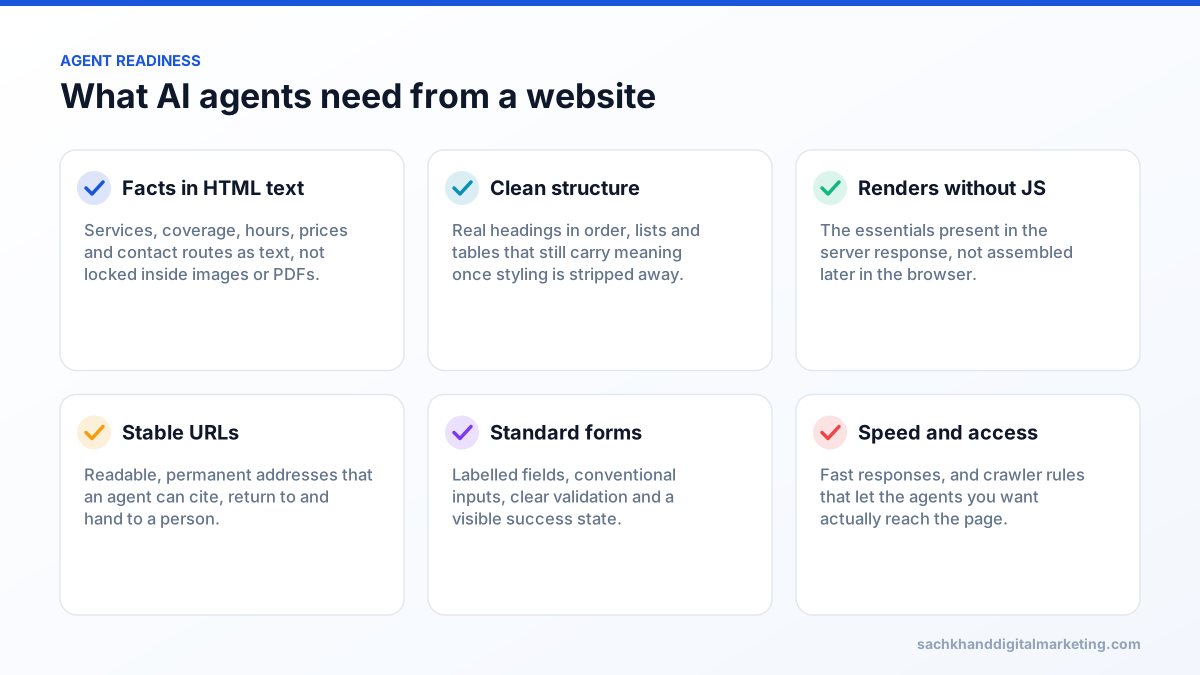
- Facts in markup, not pixels. Services, coverage areas, opening hours, prices where you publish them, availability, contact routes — in HTML text.
- Clean semantic structure. Real headings in order, lists and tables that carry meaning, landmarks that describe the page.
- Content that renders without heavy JavaScript. If the essentials only appear after client-side rendering, expect some agents to miss them.
- Stable, readable URLs. Agents cite, return to, and hand over URLs. Session parameters and ephemeral links break that chain.
- Forms that behave conventionally. Labelled inputs, standard types, clear required fields, a visible success state.
- Speed and reliability. Agents abandon slow pages. The Core Web Vitals work you already do serves this directly.
- Consistency across the site. Contradictory phone numbers, areas or prices force an agent to pick one, and it may not pick the current one.
Notice what is absent from that list: anything about visual design, animation or brand polish. Those still matter enormously for the human who arrives afterwards. They contribute nothing to whether the agent can use your site.
The five places agents give up
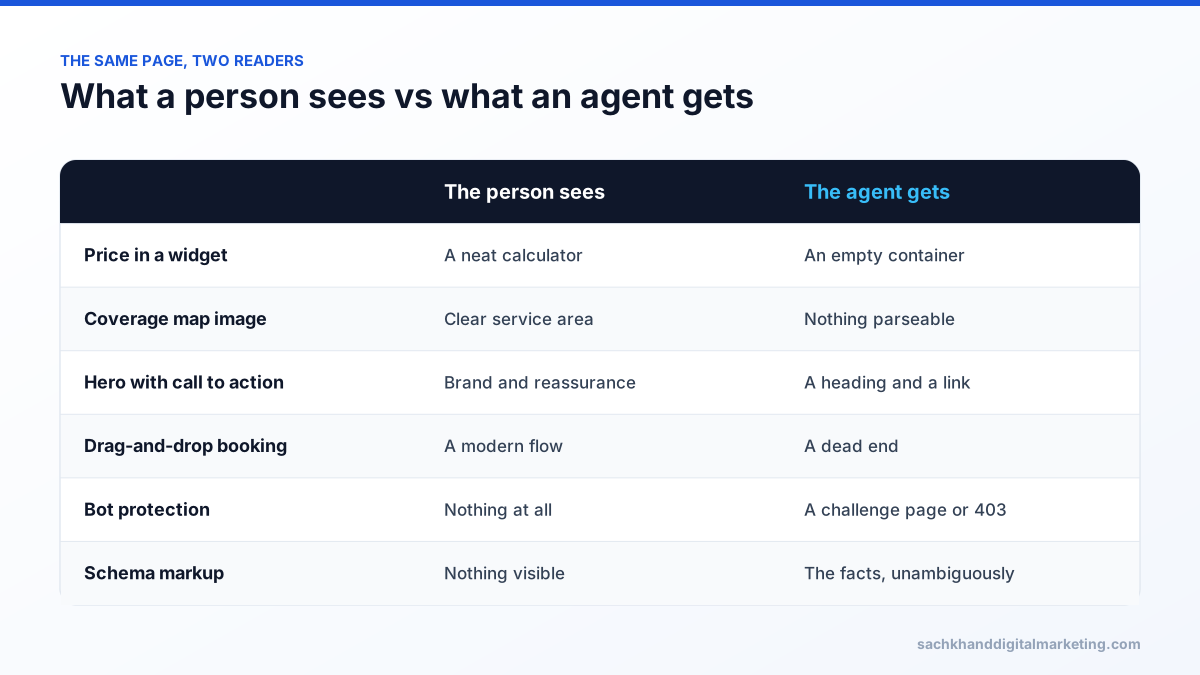
| Failure | What the agent sees | The fix |
|---|---|---|
| Key facts in an image, graphic or PDF | Nothing parseable | Repeat the same facts in HTML text near the image |
| Prices or availability only inside a widget | An empty container | Server-render the essentials; keep the widget as an enhancement |
| Forms needing drag, hover or multi-step scripting | A dead end | Provide a plain, labelled, standard form path |
| Aggressive bot protection or CDN rules | A challenge page or a 403 | Allow the agents you want; rate-limit instead of blocking |
| Critical content behind interaction (tabs, accordions loaded on click) | Partial content | Render the content in the DOM, hide it visually if needed |
The two-minute test anyone can run
Disable JavaScript, load your most important service page, and read what remains. That is roughly the worst case an agent sees. If the phone number, coverage area, price guidance, service list and enquiry route all survive, you are in reasonable shape. If the page is an empty shell, you have found your first project.
Follow it with a second test: ask a mainstream assistant to complete a real task on your site — find a price, confirm whether you serve a particular suburb, start a booking — and watch where it stalls. The point at which it starts guessing is the point at which your markup stopped being clear.
Structured data is the agent’s cheat sheet
Schema markup stops being a rich-result trick and becomes the machine-readable version of your business. For agent readiness, prioritise the types that describe what you do, where you do it, and what it costs.
| Schema type | What it tells an agent | Priority |
|---|---|---|
| Organization / LocalBusiness | Who you are, contact details, hours, areas served | Essential |
| Service | What each page actually offers and where | Essential for service businesses |
| Product / Offer | What is sold, at what price, in what condition | Essential for retail |
| FAQPage | Direct question-and-answer pairs | High value, low effort |
| BreadcrumbList | Where the page sits in the site | Helps agents navigate |
| Review / AggregateRating | Third-party judgement, where genuinely earned | Use only per platform guidelines |
| OpeningHoursSpecification | When you are actually available | Critical for booking tasks |
Two rules govern all of it. The markup must match the visible page, because contradictions cost trust with search engines and agents alike. And the entity details — name, address, phone, service areas — must be identical everywhere they appear, on your site and off it. An agent comparing three sources of your phone number is an agent about to give a user the wrong one.
Deciding your AI crawler policy on purpose
Agents and answer engines identify themselves with distinct user agents. They do different jobs: some fetch a page because a user asked for it right now, some index for answers, some collect data for training. Treating them as one category is how sites accidentally remove themselves from AI answers.
- Live fetchers retrieve a page during a user’s session. Blocking these directly blocks tasks users asked for.
- Answer indexers build the index that citations are drawn from. Blocking these removes you from shortlists.
- Training crawlers collect data for model development. Restricting these is a legitimate, separate business decision.
Most service businesses gain far more from being cited and acted upon than they lose from being summarised, so they allow the first two and decide the third deliberately. Media and data businesses often weigh it differently, and that is a reasonable difference in commercial position rather than a difference in best practice.
A CDN, WAF or bot-protection rule blocking AI user agents before robots.txt is ever consulted. Check there first. Your robots.txt can be perfectly welcoming while your firewall returns 403 to every agent that tries.
Where llms.txt fits
llms.txt is a proposed convention for pointing assistants at your most useful content in a simplified form. It is not a standard, adoption is inconsistent, and no major platform guarantees it is read. Adding one costs almost nothing and may help; relying on it instead of clean HTML and accurate structured data is not a strategy. Treat it as an optional extra, not a substitute.
Content structure for agentic search
Agents extract, they do not appreciate. That changes how a page should be written far more than how it should look.
- Answer first. Put the direct answer in the opening lines, then the nuance. Agents frequently read only the first portion of a page.
- One idea per heading. Headings act as the extraction index. Vague headings hide good content.
- Facts in lists and tables. Comparable facts — prices, coverage, timelines, inclusions — are far easier to extract from a table than from a paragraph.
- State the qualifiers. Who it applies to, where, when, and what is excluded. Agents need scope to decide relevance.
- Repeat critical facts. Coverage area and contact route should appear on every page that could be an entry point, not only on the contact page.
- Avoid unexplained jargon and internal names. A product line called “Tier Three” means nothing to an agent comparing options.
This is the same writing discipline that earns citations in AI answers, which is why agent readiness and generative engine optimisation converge. Write for extraction, design for humans, and neither audience is short-changed.
Get a prioritised action plan from our specialists, free.
Conversion paths that survive an agent
Getting into the shortlist is half the job. The other half is being the option the agent can actually act on.
Forms
Standard field types, real <label> elements, sensible autocomplete attributes, clear validation messages, and a success state that says what happens next. If a booking journey requires drag-and-drop, hover-revealed options or a multi-step widget with no plain fallback, expect agents — and a meaningful share of humans on assistive technology — to fail it.
Contact routes
Offer more than one, in text: phone, email, form. An agent that cannot complete a form may still hand the user a phone number, which still counts as a lead.
Pricing and availability
You do not have to publish exact prices. You do have to publish something an agent can use: a starting price, a typical range, a call-out fee, a statement that quotes are free. “Contact us for pricing” is a shrug, and in an agent comparison a shrug loses to a number.
Bot protection that does not fight your buyers
CAPTCHAs and aggressive challenges block agents by design. That may be exactly what you want on an admin route and exactly what you do not want on an enquiry form. Decide per path rather than globally, and monitor conversion rates after any change to bot-protection rules.
Agentic commerce and booking: what changes for retail and services
Where transactions are involved, the requirements tighten. An agent comparing products needs attributes it can align: price, availability, variant, shipping, returns, condition. An agent booking a service needs hours, coverage, lead time and a bookable route.
- Feed and markup parity. The price and availability in your Product markup should match the page, the feed and the basket.
- Returns, delivery and warranty in text. These are decision criteria in comparisons, and they are usually buried in a linked policy nobody parses.
- Variant clarity. Size, capacity, material and compatibility stated as attributes rather than implied by the product photo.
- Service constraints stated. Minimum charges, out-of-hours rates, suburbs excluded, lead times in busy season.
None of this is new commercially — it is the information a good salesperson volunteers. Agentic search simply punishes leaving it unstated, because the agent will compare you against a competitor who did state it.
Measuring agent readiness
Two measurement habits keep this honest rather than theoretical.
Server logs
Filter for AI user agents and check three things monthly: are they reaching your commercial pages, are they getting 200s rather than 403s or challenges, and is activity rising or falling. Log data is first-party and complete, which makes it the most trustworthy signal in this entire area. Our AI visibility tracking guide covers the reporting format.
Task tests
Once a month, give an assistant three real tasks against your site and record where it stalls. Keep the tasks fixed so the results are comparable. This is slower than a dashboard and catches problems no dashboard reports — such as the agent confidently quoting a price you removed a year ago from a page you forgot to unpublish.
The 12-point AI agent readiness checklist
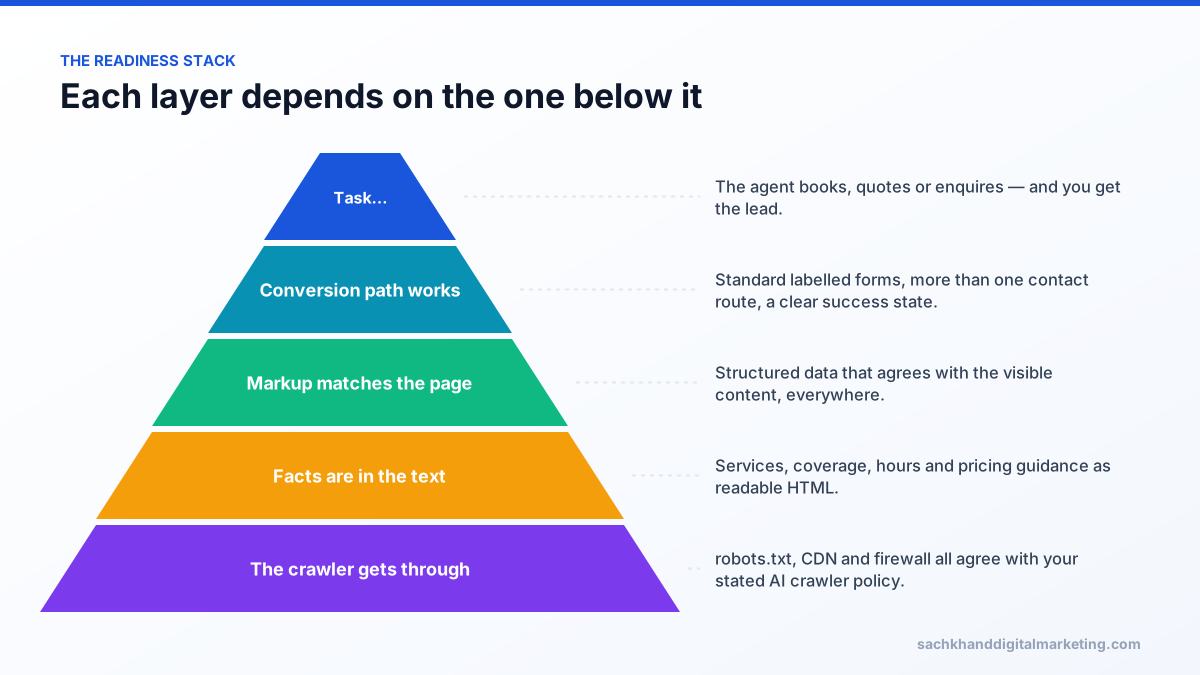
- Key facts appear as HTML text, not only in images, graphics or PDFs
- Every service page states what, where, and how to start — within the first screen
- Some form of pricing guidance exists in text, even if it is a range or a call-out fee
- Structured data is present, valid, and consistent with the visible content
- The page renders its essentials without client-side JavaScript
- URLs are stable, readable and free of session parameters
- Forms use standard labelled fields with a clear success state
- More than one contact route is available in text
- Contact details and service areas are identical sitewide and on external profiles
- robots.txt, CDN and firewall rules all agree with your stated AI crawler policy
- Server logs confirm AI bots fetch your key pages and receive 200s
- A monthly task test confirms an assistant can complete a real job on your site
Most sites pass six or seven of these on the first audit. The failures cluster in the same places every time: facts locked in graphics, pricing absent, and a firewall quietly blocking the agents the marketing team is trying to attract.
What agentic search means for local and service businesses
Most commentary on agentic search assumes an ecommerce catalogue. For local service businesses — trades, clinics, professional services, home services — the mechanics are different and, in several ways, more favourable.
An agent handling “find someone to fix a leaking hot water system in Bendigo tomorrow” is doing what a person used to do with three browser tabs and two phone calls. It needs four facts fast: do you cover that area, do you do that job, can you come when asked, and how do I start. A business that states all four in text, consistently, on the page the agent lands on, wins a disproportionate share of those tasks — not because it is bigger, but because it is legible.
- Coverage stated as a list, not a map image. Suburbs, postcodes or regions in text, including what you do not cover.
- Availability language that means something. “Same-day for calls before 11am” beats “fast response”, and an agent can act on it.
- Job types spelled out. The specific problems you fix, in the words customers use, not the words your industry uses.
- Pricing signals. A call-out fee, a typical range, or a clear statement that quotes are free.
- A route that works at 11pm. An emergency line or an after-hours form, stated plainly.
This is also why agent readiness and local SEO overlap so heavily. Consistent business details, accurate service areas, current hours and a strong profile presence serve the human searcher, the map pack and the agent simultaneously. The work is not additive; it is the same work, held to a stricter standard.
Four myths about agentic search
“Agents will kill SEO”
Agents have to read something. They read the web, and they prefer sources that are clear, current and corroborated. That is a description of good SEO, not its replacement. What is genuinely at risk is content whose only value was occupying a ranking slot for a question it answered poorly.
“We need a special version of our site for agents”
Almost never. A parallel machine-readable site is expensive, drifts out of sync with the real one, and creates exactly the contradictions that damage trust. Fix the primary site instead: text facts, clean HTML, accurate markup.
“Blocking AI crawlers protects our business”
It protects your content from being summarised and removes you from the shortlist at the same time. For most service businesses that is a poor trade. For businesses whose product is the content itself, it may be the right one. The mistake is making the decision by accident, through a firewall rule nobody reviewed.
“This is years away”
The readiness work takes weeks and improves conversion, accessibility and traditional search at the same time. There is no scenario where clearer facts, faster pages and working forms are wasted effort, which makes waiting the only genuinely risky option.
What agentic search does not change
It is worth ending with the boundaries, because vendors are already overselling this. Agentic search does not remove the need for a persuasive page — a human still arrives and still needs a reason to choose you. It does not make brand irrelevant; if anything, being a known name makes an agent more likely to include you. It does not abolish keyword research, though it widens it: people phrase requests to agents as tasks with constraints, so cover task wording as well as keyword wording.
And it does not replace conversion work. An agent that fills your form has done the same job as a click from organic search — it has delivered an opportunity to a business that still has to answer the phone, quote quickly and follow up. The winners in agentic search will be the businesses that are easy for machines to read and easy for people to buy from, in that order.
Frequently asked questions
What is agentic search?
Agentic search is when an AI assistant carries out a multi-step task on a user’s behalf rather than simply answering a question — researching options, comparing providers, checking availability, filling a form or starting a booking. The assistant reads live websites during the task, which means your site is being evaluated by software rather than only by a person.
How do I make my website AI agent ready?
Put your key facts in HTML text rather than images or PDFs, make sure the essentials render without JavaScript, add accurate structured data that matches the visible page, keep URLs stable, use standard labelled forms, publish some pricing guidance, and confirm your robots.txt, CDN and firewall all allow the AI agents you want to reach you. Then test it by asking an assistant to complete a real task on your site.
Will AI agents replace search traffic?
They will replace some of it and reshape the rest. Expect fewer clicks on purely informational queries and a growing share of visits that arrive later in the decision, after an agent has already narrowed the field. Being included in that comparison becomes more valuable than owning a mid-funnel ranking.
Should we block AI crawlers to protect our content?
It depends on your business model. Blocking answer and fetch bots protects content from being summarised, but it also removes you from answers and agent shortlists. Most service businesses gain more from being cited than they lose. Media and data businesses often decide differently. Whatever you choose, make it a deliberate policy and check that your firewall enforces the same rule as your robots.txt.
Is llms.txt required for agentic search?
No. It is a proposed convention rather than a standard, and support across platforms is inconsistent. Adding one costs very little, but it is not a substitute for clean semantic HTML, accurate structured data and content that renders without JavaScript — which is what agents actually rely on.
Does agentic search change keyword research?
It widens it rather than replacing it. People speak to agents in full sentences with constraints — timeframes, budgets, locations, conditions — so research should cover task phrasing alongside traditional keywords. The underlying commercial intent is unchanged; the wording is longer and more specific.
How do I test whether an AI agent can use my website?
Run three checks. Load your key page with JavaScript disabled and see what survives. Ask a mainstream assistant to complete a real task on your site and note where it stalls. Then check your server logs to confirm AI user agents are fetching your commercial pages and receiving 200 responses rather than challenges or 403s.
Does structured data help with AI agents?
Yes. Structured data is the machine-readable summary of what your page claims, so it reduces the guesswork for an agent comparing options. Prioritise Organization or LocalBusiness, Service, Product and Offer, FAQPage and opening hours, and make sure every value matches what a human sees on the page.
What is agentic commerce?
Agentic commerce describes AI agents carrying out buying tasks — comparing products, checking stock, and in some implementations completing a purchase. It raises the importance of accurate product attributes, prices, availability, delivery and returns information in both your markup and your feed, because those are the fields an agent compares.
Do I need to redesign my site for agentic search?
Almost never. The work is mostly content and technical hygiene: move facts out of graphics, render essentials server-side, tidy structured data, simplify forms and fix crawler access. Visual design is irrelevant to the agent and still matters to the human who arrives afterwards, so there is rarely a reason to rebuild.
Is your site readable by AI agents and assistants?
Our free audit covers the technical basics, your structured data and whether AI crawlers can actually reach the pages that matter to your pipeline.