The DPDP Act, 2023 and DPDP Rules, 2025 require Indian businesses to collect personal data only after a clear, standalone notice and free, specific, unambiguous consent, to let people withdraw as easily as they agreed, to protect and delete data on time and to get verifiable parental consent for anyone under 18. Most duties that affect marketing apply from 13 May 2027. Fix lead forms and WhatsApp opt-ins, keep consent records, re-permission old lists and stop using unconsented data before then.
On this page
- What is the DPDP Act, and why does it matter to marketers?
- DPDP Act timeline: when do the rules apply?
- What counts as valid consent under the DPDP Act?
- DPDP and WhatsApp, SMS and email marketing
- Old contact lists: keep, re-permission or delete?
- Children’s data: a bigger issue than most marketers expect
- Cookies, analytics and retargeting
- Security, breaches and deleting data
- DPDP Act penalties
- DPDP compliance checklist for marketing teams
- A six-month plan to May 2027
- The upside: better data, better marketing
- DPDP questions from marketers
For years, Indian marketing ran on lists nobody could fully explain: numbers collected at a trade fair, emails from a contest, WhatsApp contacts exported from a CRM. That era is ending. The Digital Personal Data Protection Act, 2023 (the DPDP Act) and the DPDP Rules, 2025 set out how businesses may collect and use personal data, and most of the duties that matter to marketers become enforceable on 13 May 2027.
Six months sounds like plenty of time. It is not, if your consent records are scattered across a website form, a WhatsApp Business account, an email tool and a sales spreadsheet. This guide explains, in plain English, what the DPDP Act means for digital marketing in India: what counts as valid consent, what changes for WhatsApp, SMS and email, how the deadline works and a month-by-month plan to get ready. It is practical guidance, not legal advice; confirm specifics with your lawyer.
What is the DPDP Act, and why does it matter to marketers?
The DPDP Act, 2023 is India’s first comprehensive law on digital personal data. It requires businesses to collect personal data only with a clear notice and valid consent (or another lawful ground), use it only for the stated purpose, let people withdraw consent as easily as they gave it, protect it, and delete it when the purpose is over. The DPDP Rules, 2025 set the operational details and deadlines.
Marketing is one of the most data-hungry functions in any business, so it feels the law first. Lead forms, newsletter sign-ups, WhatsApp opt-ins, retargeting audiences, CRM uploads to Meta and Google, and loyalty programmes all involve personal data. Under the Act your business is the data fiduciary (it decides why and how data is used), the customer is the data principal, and your agencies and software vendors are usually data processors acting on your instructions. Responsibility stays with you even when a vendor does the work.
DPDP Act timeline: when do the rules apply?
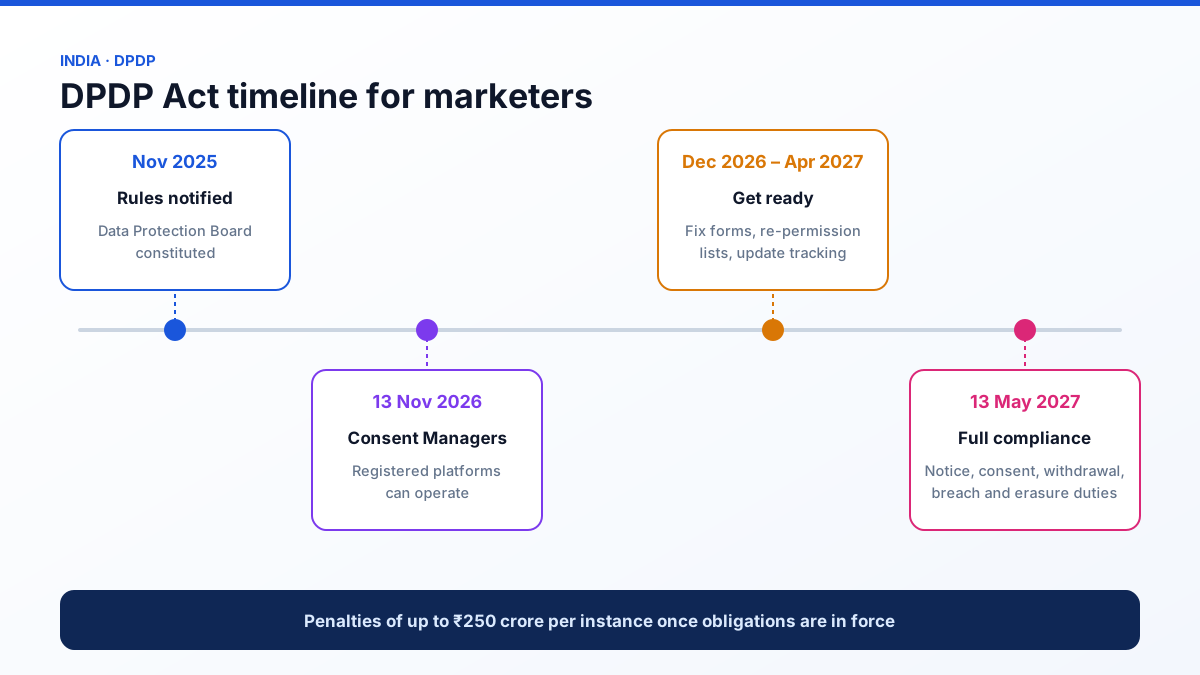
The Rules were notified in November 2025 with a phased rollout rather than a single switch-on date.
| Date | What happens | What it means for marketing |
|---|---|---|
| November 2025 | Rules notified; the Data Protection Board of India constituted | The clock starts. Use the window to audit data and fix consent flows |
| 13 November 2026 | Framework for registered Consent Managers becomes operational | Customers can start using third-party platforms to give and withdraw consent; using one is optional for most businesses |
| 13 May 2027 | Core obligations enforceable: notice, consent, withdrawal, security, breach reporting, erasure, children’s data | Every campaign must run on data you can show was collected lawfully |
Some compliance guides mention discussions about shortening the 18-month window. Plan for May 2027, but build as if the date could come sooner; the work is the same either way.
What counts as valid consent under the DPDP Act?
Consent under the Act must be free, specific, informed, unconditional and unambiguous, given by a clear affirmative action, and limited to the data needed for the stated purpose. In practice, for a marketing team, that rules out several habits that are still common in India:
- Pre-ticked boxes (“I agree to receive offers” already checked).
- Bundled consent, where agreeing to the terms of sale also signs someone up for promotions.
- Silence or inactivity treated as agreement.
- Asking for more than you need, such as date of birth and address on a brochure download.
- One consent for everything: a WhatsApp order update and a WhatsApp promotion are different purposes and should be separate choices.
The consent notice
Before or at the moment you collect data, you must give a notice that stands on its own (not buried in terms of service), in clear and plain language, describing the personal data being collected, the specific purposes and how the person can withdraw consent, exercise their rights and complain to the Data Protection Board. Customers can ask for the notice in English or any of the languages in the Eighth Schedule of the Constitution, so plan Hindi and regional-language versions for the markets you serve.
Withdrawal must be as easy as giving consent
If someone opted in with one tap, they must be able to opt out with one tap. An “Unsubscribe” link that leads to a login page, or a WhatsApp opt-out that needs a phone call, will not meet that standard. Once consent is withdrawn you must stop processing for that purpose within a reasonable time, and make sure your processors stop too.
DPDP and WhatsApp, SMS and email marketing
These three channels carry most direct marketing in India, and each needs its own consent trail.
| Channel | What to change | Evidence to keep |
|---|---|---|
| Separate opt-ins for service messages and promotions; a clear “STOP” option in every promotional template; no bulk messaging to exported contact lists | Opt-in source, timestamp, wording shown, and opt-out events | |
| SMS | Keep TRAI DLT registration and templates, and add DPDP-style notice and consent at the point of collection | Consent record linked to each number, plus DLT consent templates |
| Unticked newsletter checkbox, one-click unsubscribe, and separate lists by purpose | Sign-up form version, double opt-in confirmation where used, unsubscribe logs | |
| Ads audiences | Upload customer lists to Meta, Google or LinkedIn only where the notice covered that use | Which list, which purpose, which notice version |
The DPDP Act sits alongside, not instead of, existing rules such as TRAI’s commercial communication regulations for calls and SMS. Meeting one does not mean you meet the other. See our guide to email deliverability and our WhatsApp marketing service for channel-specific setup.
Old contact lists: keep, re-permission or delete?
Many Indian businesses hold years of contacts collected without any record of consent. Rather than gamble on that data after May 2027, sort it now:
- Inventory every list: CRM, email tool, WhatsApp, POS, event registrations, agency-held lists.
- Tag the source and consent evidence for each record, where it exists.
- Run a re-permission campaign for contacts without clear consent: a short, honest message explaining what you send and asking them to opt in again.
- Retire what does not opt in. A smaller, consented list usually performs better anyway, with fewer spam complaints and blocks.
- Stop buying or renting lists. You cannot show that the people on them consented to hear from you.
Our re-engagement campaign guide covers how to write re-permission messages that people actually answer.
Children’s data: a bigger issue than most marketers expect
Under the DPDP Act, a “child” is anyone under 18, not under 13 as in many other countries. Processing a child’s personal data needs verifiable consent from a parent or lawful guardian, and the Act prohibits tracking, behavioural monitoring and targeted advertising directed at children. That matters for:
- Coaching institutes, schools and edtech platforms collecting student enquiries.
- Gaming, fashion and food brands with large teenage audiences.
- Contests and giveaways that do not check age.
If your audience includes under-18s, collect enquiries from parents, add age checks where appropriate, and remove young audiences from interest-based targeting. Education businesses should read our education SEO page with this in mind.
We will check your forms, WhatsApp opt-ins and email sign-ups against the new rules, free.
Cookies, analytics and retargeting
The DPDP Act does not have a separate cookie law like Europe’s, but tracking that identifies a person is still processing personal data. Practical steps:
- Show a clear notice about analytics and advertising tracking, with a real choice for non-essential tags.
- Configure Google Tag Manager so advertising tags respect that choice; Google’s Consent Mode makes this easier.
- Use server-side tracking only for consented data; it is not a way round the rules.
- Set data retention in GA4 to what you need, not the maximum by default.
Our analytics and tracking service sets this up so your reports stay useful while respecting choices.
Security, breaches and deleting data
Businesses must protect personal data with reasonable security safeguards, including access control, encryption where appropriate and logs. If a breach happens, you must tell the Data Protection Board and the affected people, and send the Board a detailed report within 72 hours. For marketing teams, the biggest risks are often mundane: spreadsheets shared by link, ex-employees still in the WhatsApp Business account, agencies holding customer exports long after a campaign ends.
Data must also be erased once its purpose is complete or consent is withdrawn, unless another law requires you to keep it. Set retention periods for leads that never converted, and make sure your vendors delete data when a contract ends.
DPDP Act penalties
| Failure | Maximum penalty per instance |
|---|---|
| Not taking reasonable security safeguards, leading to a breach | ₹250 crore |
| Not notifying the Board or affected people of a breach | ₹200 crore |
| Breaching the obligations on children’s data | ₹200 crore |
| Other breaches of the Act or Rules | ₹50 crore |
The Board considers factors such as the nature and duration of the breach and steps taken to mitigate it, so documented effort counts. The larger cost for most brands, though, is commercial: blocked WhatsApp numbers, damaged sender reputation and lost customer trust.
DPDP compliance checklist for marketing teams
- Every lead form has a standalone notice, unticked consent boxes and separate choices per purpose.
- Notices are available in the Indian languages your customers use.
- Consent records store source, timestamp, notice version and purpose.
- One-click opt-out works on email, WhatsApp and SMS, and syncs to every tool.
- Old lists are tagged; contacts without evidence have been asked to re-confirm.
- Under-18 audiences are handled with parental consent and excluded from targeted advertising.
- Analytics and ad tags respect visitors’ tracking choices.
- Agency and vendor contracts cover security, purpose limits and deletion.
- Retention periods are set for leads, customers and audiences.
- A breach response plan names who notifies the Board within 72 hours.
A six-month plan to May 2027
| When | Focus |
|---|---|
| December 2026 | Map every data source, tool and vendor; name an owner for marketing data |
| January 2027 | Rewrite notices and consent wording; fix forms and WhatsApp opt-in flows |
| February 2027 | Launch re-permission campaigns; set up consent logging in CRM |
| March 2027 | Update tracking, cookie choices and ad audience uploads; review vendor contracts |
| April 2027 | Delete or archive unconsented data; test opt-outs and breach drill |
| May 2027 | Final checks before 13 May; document what was done |
The upside: better data, better marketing
Consent-led marketing tends to produce smaller lists with higher engagement, lower spam complaints and better deliverability. It also pushes brands towards channels that do not depend on rented data at all: organic search, content people choose to read and a website that earns enquiries. If DPDP makes your outbound lists shrink, invest in being found. Start with our SEO services in India and lead generation.
Related guides
- Email Marketing in 2026: Deliverability and ROI
- SMS vs Email Marketing
- Email Re-engagement Campaigns
- Wedding Season Marketing in India
DPDP for marketers: your questions answered
When does the DPDP Act apply to marketing?
The Rules were notified in November 2025 with an 18-month phase-in. Most obligations that affect marketing, including notice, consent and withdrawal, are enforceable from 13 May 2027.
Can I still send WhatsApp marketing messages under the DPDP Act?
Yes, to people who have given clear, specific consent to receive promotional messages, with an easy way to opt out. Messages to contacts without a consent record are the main risk.
Does the DPDP Act apply to small businesses?
Yes. The Act applies to any business processing digital personal data in India, regardless of size, though some obligations are heavier for businesses designated as Significant Data Fiduciaries.
Who is a child under the DPDP Act?
Anyone under 18. Processing their data needs verifiable parental consent, and tracking, behavioural monitoring and targeted advertising directed at children are prohibited.
What is a Consent Manager under the DPDP Rules?
A company registered with the Data Protection Board that lets people give, manage and withdraw consent through one platform. The framework became operational on 13 November 2026; using one is optional for most businesses.
What is the maximum penalty under the DPDP Act?
Up to ₹250 crore per instance for failing to take reasonable security safeguards. Other breaches carry penalties of up to ₹200 crore or ₹50 crore.
Does the DPDP Act apply to foreign companies?
It applies to processing within India and to processing outside India connected with offering goods or services to people in India.
Sources
- Ministry of Electronics and Information Technology (MeitY) – DPDP Act, 2023 and DPDP Rules, 2025
- Fisher Phillips: India’s new data privacy rules are here – timeline, penalties and breach reporting
- Telecom Regulatory Authority of India (TRAI) – commercial communication rules for SMS and calls
This article is general information, not legal advice. Check the official Rules and take legal advice for your business.
Make your marketing DPDP-ready before May 2027
Send us your lead forms and opt-in flows. We will list what needs to change before 13 May 2027, in plain English.