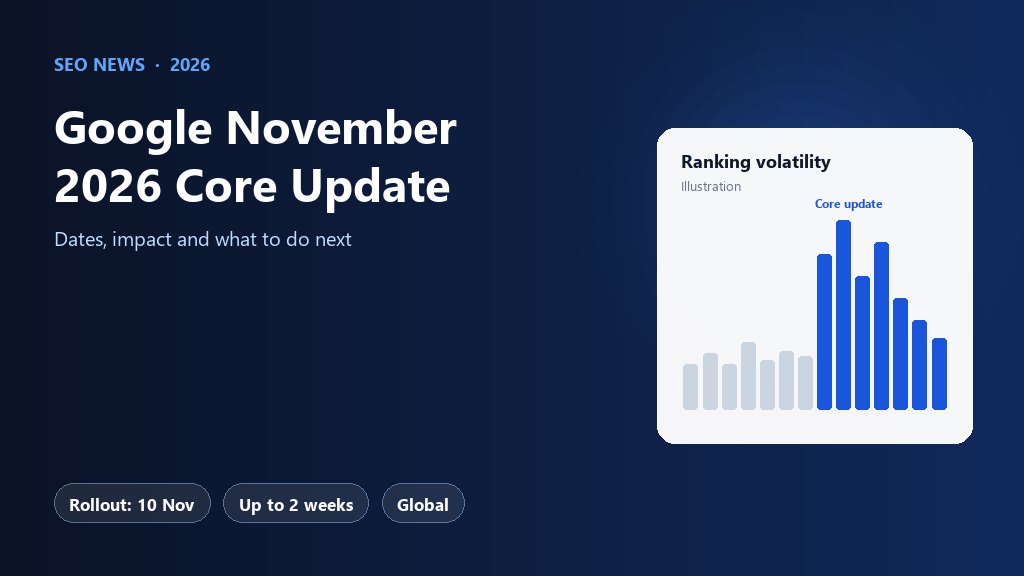
The Google November 2026 core update began rolling out on 10 November 2026 and may take up to two weeks, so it should finish around 24 November. It applies to all languages and countries and is the third core update of 2026. A ranking drop is not a penalty. Wait until the rollout ends, then compare Search Console data for a week after completion with 3–9 November, find the pages that lost the most, and improve them against Google’s helpful-content questions rather than making quick fixes.
On this page
- What is the Google November 2026 core update?
- Is the Google core update finished?
- Google algorithm updates in 2026: the full timeline
- What is a Google core update?
- Why the timing matters: core update meets Black Friday
- What Google said (and did not say)
- Why did my Google ranking drop? How to diagnose it
- How to recover from a Google core update
- Core update checklist: what to do now and after the rollout
- Does the core update affect Google Maps and local rankings?
- When is the next Google core update?
- Frequently asked questions
Google started rolling out the November 2026 core update on 10 November 2026. If your rankings, impressions or leads have been jumping around this week, this is the most likely reason. It is the third Google core update of 2026, it applies to every language and country, and it lands right before Black Friday and Cyber Monday, the most important traffic weeks of the year for many businesses.
This guide covers what we know so far: the confirmed dates, what Google has and has not said, how it fits into the Google algorithm update timeline for 2026, how to tell whether the update has affected your site, and what to do if your Google ranking dropped. We will keep this page updated as the rollout progresses.
What is the Google November 2026 core update?
The Google November 2026 core update is a broad change to Google’s core ranking systems that began rolling out on 10 November 2026 at 10:06 a.m. Pacific Time. Google says it applies globally and to all languages and may take up to two weeks to complete. It does not target specific sites; it reassesses how relevant and helpful content is across the whole web.
On LinkedIn, Google Search Central described it as “a regular update designed to better surface relevant, satisfying content for searchers from all types of sites,” the same wording it used for the March 2026 core update.
November 2026 core update: key facts
| Detail | What we know |
|---|---|
| Start date | 10 November 2026, 10:06 a.m. PT (Google Search Status Dashboard) |
| Expected duration | “May take up to 2 weeks to complete”, so likely finished around 24 November 2026 |
| Scope | Global, all languages, all types of sites |
| Type | Broad core update (not a spam update or a Discover-only update) |
| Position in 2026 | Third core update of the year, after March and May |
| Status (13 November 2026) | Still rolling out; Google has not announced completion |
| AI Overviews / AI Mode | Google has made no specific statement linking this update to its AI features |
Is the Google core update finished?
Not yet. As of 13 November 2026, the Google Search Status Dashboard still lists the November 2026 core update as active. Core updates in 2026 have taken around 12 days each, so expect the rollout to end somewhere between 22 and 24 November 2026.
To check the Google core update status yourself:
- Open the Google Search Status Dashboard (status.search.google.com) and look under Ranking. An active update shows as an ongoing incident; a finished one shows a completion note with the end time.
- Check Google’s ranking release history page in Search Central, which Google updates once a rollout ends.
- Follow Google Search Central on LinkedIn or X, where completions are usually announced.
Rank trackers and Google algorithm update volatility tools will show turbulence during the rollout, but readings taken before completion reflect an unfinished update. Treat early “winners and losers” lists, including the threads on Reddit and SEO forums, as preliminary.
Google algorithm updates in 2026: the full timeline
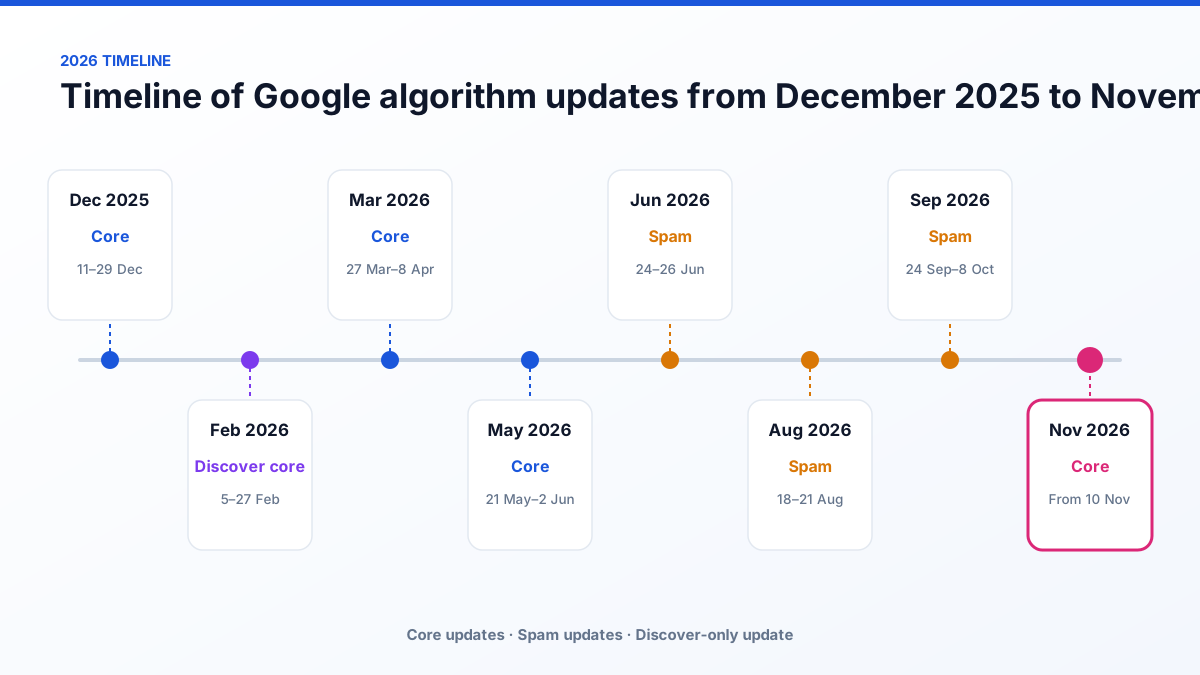
Here is every confirmed ranking update on the Search Status Dashboard in the past year, so you can match any change in your Search Console data to the right event.
| Update | Started | Completed | Duration |
|---|---|---|---|
| December 2025 core update | 11 Dec 2025 | 29 Dec 2025 | 18 days |
| February 2026 Discover core update | 5 Feb 2026 | 27 Feb 2026 | 22 days (Discover only) |
| March 2026 core update | 27 Mar 2026 | 8 Apr 2026 | About 12 days |
| May 2026 core update | 21 May 2026 | 2 Jun 2026 | About 12 days |
| June 2026 spam update | 24 Jun 2026 | 26 Jun 2026 | About 2 days |
| August 2026 spam update | 18 Aug 2026 | 21 Aug 2026 | About 3 days |
| September 2026 spam update | 24 Sep 2026 | 8 Oct 2026 | About 14 days |
| November 2026 core update | 10 Nov 2026 | In progress | Up to 2 weeks |
The 173-day gap since the May core update was the longest between core updates this year, which is one reason the November update may feel bigger for some sites: it reflects six months of changes on the web.
What is a Google core update?
A Google core update (or broad core update) is a significant change to the main systems Google uses to rank search results. Google runs several each year. Unlike a spam update, which targets specific manipulative tactics, a core update reassesses content quality and relevance across the board. A useful way to think about it is a refreshed list of the best films of all time: the films that slipped down did not get worse, but newer and better ones may now deserve a higher place.
That has three practical consequences:
- A drop is not a penalty. Google is clear that a ranking decline after a core update does not, on its own, mean a page broke a rule. There is no manual action to appeal.
- There is no single fix. Core updates do not target one factor, so removing one element of a page rarely changes anything.
- Most sites see little change. Google says most sites do not need to worry about core updates. Big movements tend to affect sites whose content is thin, outdated or less helpful than competing pages.
Core update vs. spam update vs. Discover update
| Type | What it does | Typical length |
|---|---|---|
| Core update | Broad reassessment of relevance and quality across all of Search | About 2 weeks |
| Spam update | Improves detection of spam tactics, such as scaled content abuse, expired domain abuse and link spam | Days to 2 weeks |
| Discover core update | Changes ranking in the Google Discover feed only, not web search results | Up to 3 weeks |
A short history of major Google algorithm updates
Today’s core updates build on systems Google introduced over the past 15 years. The Google algorithm update history worth knowing:
- Panda (2011): demoted thin, low-quality content.
- Penguin (2012): targeted manipulative link schemes.
- Hummingbird (2013): rebuilt search around the meaning of whole queries, not single keywords.
- Pigeon (2014): tied local results more closely to traditional web ranking signals.
- Mobile-friendly update (2015) and RankBrain (2015): mobile usability and machine learning in ranking.
- BERT (2019): better understanding of natural language.
- Helpful content system (2022): rewarded people-first content; it was folded into the core ranking systems in March 2024.
Since 2024, Google has mostly communicated through named core and spam updates rather than new branded algorithms, which is why “which update hit me?” is now usually answered by dates.
Why the timing matters: core update meets Black Friday
If the rollout runs the full two weeks, it ends around 24 November 2026, just before US Thanksgiving (26 November), Black Friday (27 November) and Cyber Monday (30 November). In India, the period also overlaps with wedding-season and end-of-year sale campaigns.
That creates two problems:
- Rankings may still be moving during peak demand. E-commerce and local businesses should not rely on organic search alone for holiday revenue this year. Keep paid search, email and social campaigns ready to fill gaps. Our Black Friday 2026 guide covers the rest of the plan.
- Your data will be distorted. Google’s standard advice is to compare a week after the update with a week before it. This year the “after” week is a holiday week. Compare against the same dates in 2025 as well, and look at rankings and impressions, not just clicks and revenue.
What Google said (and did not say)
Google confirmed the dates, the global scope and the goal of surfacing “relevant, satisfying content”. It did not say:
- which ranking systems, industries or content types are most affected;
- a firm end date;
- anything about AI-generated content specifically, or about AI Overviews and AI Mode.
On AI content, Google’s long-standing position still applies: it rewards helpful content however it is produced, but using automation to mass-produce pages with little value breaks its scaled content abuse policy. If you published large volumes of AI-written pages this year, review them against the questions below. See our guide to AI content SEO.
Get a prioritised recovery plan from our SEO specialists, free.
Why did my Google ranking drop? How to diagnose it
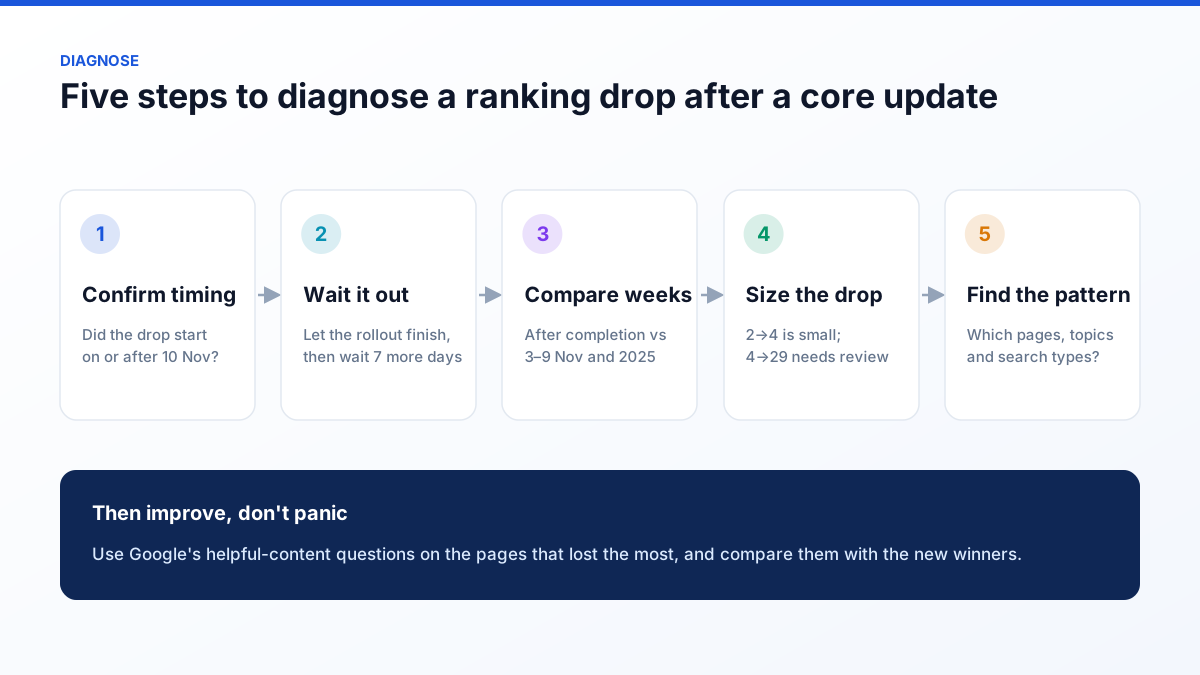
If your Google ranking dropped overnight this week, do not change anything yet. Work through these steps first.
- Confirm the timing. In Google Search Console, open Performance → Search results and add an annotation or note for 10 November 2026. If the decline began before that date, look for another cause: a site migration, tracking change, technical error or seasonal dip.
- Wait for the rollout to finish. Rankings often swing up and down during a core update. Google recommends waiting at least one full week after completion before analysing.
- Compare the right periods. Compare a week after completion with the week of 3 to 9 November 2026, and with the same weeks in 2025 for seasonal queries.
- Size the drop by position. A page moving from position 2 to 4 is a small change that may not need action. A page falling from position 4 to 29 is a large change that deserves a deeper review.
- Find the pattern. Filter by page and query. Are losses concentrated on one section, one content type or one topic? Site-wide drops point to overall quality and trust; narrow drops point to specific pages being outranked.
- Check search types separately. Review Web, Image, Video and News results separately, and check Discover in its own report.
- Look at who replaced you. Search your lost queries and study the pages now ranking. What do they offer that yours does not: first-hand experience, fresher data, a clearer answer, a better format?
How to recover from a Google core update
Google core update recovery is about improving content for people, not reversing a penalty. Google’s guidance and our experience with client sites point to the same priorities:
1. Review content with Google’s self-assessment questions
Google publishes a list of questions for creating helpful, people-first content. The most useful ones to ask about each affected page:
- Does the content provide original information, reporting, research or analysis?
- Does it provide a substantial, complete description of the topic?
- Does it show first-hand expertise and a depth of knowledge?
- Would someone leave feeling they had learned enough to achieve their goal?
- Was it created mainly to help people, or mainly to attract search visits?
Ideally, ask someone outside your team to answer these honestly.
2. Strengthen E-E-A-T signals
Add named authors with real credentials, show first-hand experience (photos, case studies, test results), cite sources, keep facts current and make it easy to see who runs the site. For “Your Money or Your Life” topics such as health, finance and legal, this matters even more.
3. Improve before you delete
Google advises against quick fixes and says deleting content should be a last resort. Update and merge thin or overlapping pages, improve readability and structure, and fill gaps that the pages now outranking you cover. Leave pages that still perform well alone.
4. Rule out technical problems
Core updates are not technical, but a coincident technical issue can make a drop worse. Check indexing, crawl errors, Core Web Vitals and internal links with our technical SEO checklist.
5. Be patient
Improvements can be picked up within days, but recovery often takes months and sometimes only shows after the next core update. For a full process, read our in-depth core update recovery guide.
Core update checklist: what to do now and after the rollout
| When | What to do |
|---|---|
| During the rollout (10–24 Nov) | Annotate the start date, monitor but do not react, keep holiday paid and email campaigns ready, avoid major site changes or migrations |
| When Google confirms completion | Record the end date, then wait at least seven days |
| One week after completion | Compare Search Console data with 3–9 Nov 2026 and the same period in 2025; list pages with large position drops |
| Weeks 2–6 | Audit affected pages against the self-assessment questions, improve content and E-E-A-T, fix technical issues |
| Ongoing | Track rankings monthly, publish genuinely helpful content, and measure again after the next core update |
Does the core update affect Google Maps and local rankings?
Core updates are changes to web search ranking. Google has not said the November 2026 core update changes the local pack or Google Maps, which use their own local ranking systems based on relevance, distance and prominence. However, your website’s strength feeds into local prominence, so a website hit by the update can lose some local visibility too. Keep your Google Business Profile complete and active; our Google Business Profile checklist and local SEO playbook cover the details.
When is the next Google core update?
Google does not pre-announce core updates. Over the past year it ran core updates in December 2025, March 2026, May 2026 and November 2026, so another broad update in the first half of 2027 is likely. Google also makes smaller, unannounced improvements continuously, which is why some sites recover gradually between named updates.
The best way to prepare for the next core update is the same as recovering from this one: publish content that is clearly better than the alternatives for the people searching, and keep your site technically sound. Read common SEO mistakes in 2026 to check you are not making the avoidable ones.
Related guides
- How to Recover From a Google Core Update
- Google Search Console for Technical SEO
- SEO Audit Checklist for Business Websites
- Zero-Click Searches in 2026
- AI Content SEO: Use AI Without Losing Rankings
Google November 2026 core update: frequently asked questions
When did the Google November 2026 core update start?
It started on 10 November 2026 at 10:06 a.m. Pacific Time, according to Google’s Search Status Dashboard.
How long will the November 2026 core update take?
Google says it may take up to two weeks, so it is likely to finish around 24 November 2026. Earlier 2026 core updates took about 12 days.
Is the Google core update finished?
As of 13 November 2026 it is still rolling out. Check the Google Search Status Dashboard for the completion notice.
Is a core update a penalty?
No. Google says a drop after a core update does not mean a page broke its rules. Core updates reassess relevance and quality across all sites, so other pages may simply be judged more helpful.
Why did my Google ranking drop suddenly?
If the drop started on or after 10 November 2026, the core update is the likely cause. If it started earlier, check for technical errors, site changes, tracking problems or seasonal demand changes.
How do I recover from a Google core update?
Wait for the rollout to finish, find which pages lost the most, compare them with the pages now ranking, and improve them using Google’s helpful content self-assessment questions. Recovery can take months and sometimes shows after the next core update.
Does the November core update target AI content?
Google has not said so. Its policies reward helpful content however it is made, but mass-produced pages with little value can break its scaled content abuse policy.
How many core updates did Google release in 2026?
Three so far: March, May and November 2026. Google also released a Discover core update in February and spam updates in June, August and September.
Sources
- Google Search Status Dashboard – start time, scope and completion status
- Google Search Central: Google Search’s core updates – what core updates are and how to assess impact
- Google Search Central: Creating helpful, reliable, people-first content – self-assessment questions
- Google Search Central: Ranking release history
- Search Engine Journal: Google’s November 2026 Core Update Starts Rolling Out – 2026 update dates and durations
Lost rankings in the November core update?
Talk to our team about your goals. We will show you where the biggest wins are, starting with a free, no-obligation audit.