Realistic AI-generated or altered images, audio and video that could be mistaken for real generally need a clear label: under the EU AI Act from 2 August 2026, under India’s amended IT Rules from 20 February 2026, and under Meta, YouTube and TikTok policies. In the US, the FTC bans fake reviews and testimonials, including from people who do not exist. Minor AI edits and human-reviewed copy usually need no label. Record AI use, label synthetic people, voices and scenes, and never invent customers or results.

On this page
- Do marketers have to label AI-generated content?
- Key dates for AI content rules
- EU AI Act: what Article 50 means for marketing
- India’s IT Rules on synthetic content
- United States: fake reviews and endorsements
- Platform AI labels: Instagram, Facebook, YouTube, TikTok and Google
- What needs a label, and what usually does not
- Labelling and consumer trust
- A simple AI disclosure policy for marketing teams
- How to label AI content in practice
- Agencies, freelancers and creators
- Who owns AI-made marketing content?
- Does AI content hurt SEO?
- Frequently asked questions
AI-generated images, voices and videos are now everywhere in marketing, and so are the rules about labelling them. In 2026 two major sets of rules took effect: India’s amended IT Rules on synthetic content in February, and the EU AI Act’s transparency obligations in August. Meanwhile Instagram, Facebook, YouTube and TikTok label AI content themselves and ask creators to disclose it.
For marketers the questions are practical: do you have to label AI content in ads and posts, what exactly needs a label, and what happens if you get it wrong? This guide covers the rules in the EU, India and the US, the platform policies, and a simple disclosure policy you can adopt across markets. It is general guidance, not legal advice.
Do marketers have to label AI-generated content?
Often, yes. Realistic AI-generated or AI-altered images, audio and video that could be mistaken for real generally need a clear label under the EU AI Act (from 2 August 2026), India’s IT Rules (from 20 February 2026) and the policies of Meta, YouTube and TikTok. AI used for minor edits, drafting or clearly artistic work usually does not. Fake testimonials and reviews are banned outright in the US, labelled or not.
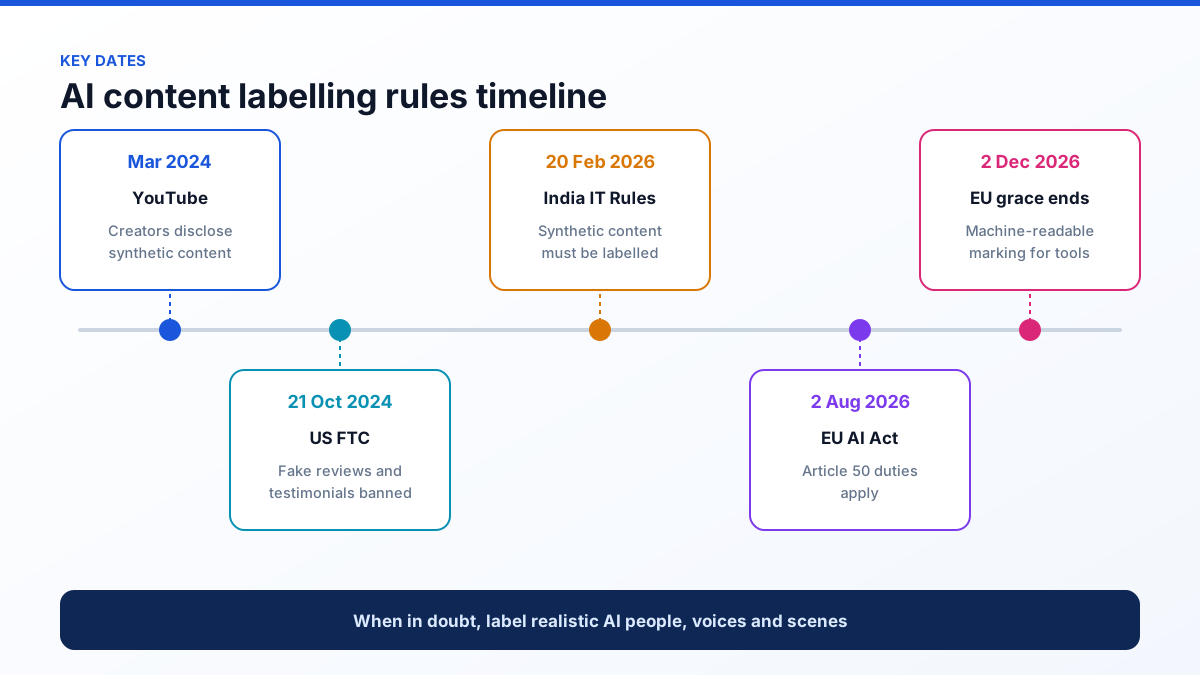
Key dates for AI content rules
| Date | Rule | Who it affects |
|---|---|---|
| March 2024 | YouTube requires creators to disclose realistic altered or synthetic content | Anyone uploading to YouTube |
| 21 October 2024 | FTC consumer-review rule in force: no fake reviews or testimonials, including invented “people” | Businesses marketing to US consumers |
| 20 February 2026 | India’s amended IT Rules on synthetically generated information take effect | Platforms in India, and the brands and creators posting there |
| 2 August 2026 | EU AI Act Article 50 transparency obligations apply | AI providers and businesses publishing AI content to EU audiences |
| 2 December 2026 | Grace period ends for machine-readable marking by some existing generative AI systems in the EU | AI tool providers |
EU AI Act: what Article 50 means for marketing
Article 50 of the EU AI Act sets transparency duties for certain AI uses. Two matter most for marketers:
- Deepfakes must be disclosed. If you publish AI-generated or manipulated images, audio or video that resemble real people, objects, places or events and could falsely appear authentic, you must disclose that it is artificially generated or manipulated. For evidently artistic, creative, satirical or fictional work, the duty is lighter: disclose in a way that does not spoil the work.
- AI text on matters of public interest must be disclosed, unless it has been through human review and someone holds editorial responsibility.
Providers of generative AI tools must also mark outputs in a machine-readable way, with a grace period to 2 December 2026 for some systems already on the market. The European Commission has published guidance, a voluntary code of practice and optional EU icons for labelling. Fines can reach €15 million or 3% of worldwide turnover. The rules apply when content is published to people in the EU, so a brand outside Europe running EU campaigns is in scope.
India’s IT Rules on synthetic content
India notified the Information Technology (Intermediary Guidelines and Digital Media Ethics Code) Amendment Rules, 2026 on 10 February 2026, in force from 20 February 2026. They define synthetically generated information as audio, visual or audio-visual content artificially or algorithmically created or altered so that it appears real, and require it to be prominently labelled so users can identify it immediately. The duties sit mainly with platforms, which must label such content and, according to legal summaries, ask users to declare it, and remove unlawful deepfakes faster than before.
For brands and creators in India, the practical effect is that undisclosed realistic AI content is more likely to be labelled, restricted or removed by the platform. Declare AI use when uploading, and do not use synthetic content that impersonates real people. If you also collect personal data in campaigns, read our guide to India’s DPDP Act for marketers.
United States: fake reviews and endorsements
The US has no single federal AI labelling law for ads, but existing consumer protection rules apply. The FTC’s rule on consumer reviews and testimonials, in force since 21 October 2024, bans fake reviews and testimonials, including those attributed to people who do not exist, such as AI-generated “customers”. The FTC’s endorsement guides also require honest, disclosed endorsements. Several US states have their own rules on deceptive AI content, particularly in political advertising.
Platform AI labels: Instagram, Facebook, YouTube, TikTok and Google
| Platform | What it does | What marketers should do |
|---|---|---|
| Instagram and Facebook | Shows an “AI info” label when it detects industry-standard AI signals in a file or when the user discloses AI use; asks users to disclose photorealistic video and realistic audio made with AI | Disclose realistic AI content when posting; expect files from AI tools to be labelled automatically |
| YouTube | Requires creators to disclose realistic altered or synthetic content in YouTube Studio; shows a label in the description, or on the video for sensitive topics | Tick the disclosure for realistic synthetic scenes, voices or people |
| TikTok | Requires labels on realistic AI-generated content and can label it automatically using Content Credentials | Use TikTok’s AI-generated content label; keep creator briefs clear on disclosure |
| Google Ads | Requires disclosure in election ads that contain synthetic content depicting realistic people or events | Follow political content rules where they apply; keep all ad claims accurate |
Can you remove the AI label on Instagram?
This is one of the most searched questions about AI labels. If you add the label yourself, you can edit it. If Meta detects AI signals in the file, such as the metadata many AI tools add, the label may be applied automatically and you may not be able to remove it. Trying to strip metadata to avoid labels is a poor idea for brands: it risks misleading people and breaking platform rules.
We will review how your team uses AI in ads and content and suggest a simple labelling policy, free.
What needs a label, and what usually does not
| Usually label | Usually no label needed |
|---|---|
| A realistic AI-generated person presenting your product | AI used to draft copy that a person edits and approves |
| AI voice cloning or a synthetic voice-over that sounds like a real person | Colour correction, cropping or removing a background blemish |
| A realistic scene of an event that did not happen | Obviously stylised illustrations or animation |
| Altered footage of a real place or person | AI translation reviewed by a native speaker |
| AI-written articles on public-interest topics published without human review (EU) | Resizing an approved ad for different placements |
When in doubt, label. A short, honest note such as “Image created with AI” costs little and protects trust; being caught hiding AI use costs far more.
Labelling and consumer trust
Disclosure is not only a legal box to tick. Research on AI in customer experiences repeatedly finds that people value being told when they are dealing with AI, and Kantar’s ad testing shows that AI-made ads still score below human-made ones on average. Brands that are open about where AI helps, and keep real people in testimonials and stories, tend to avoid the backlash that hidden AI attracts. See our guide to AI-generated ads for the creative side.
A simple AI disclosure policy for marketing teams
- Record AI use on every asset: which tool, what it generated or changed.
- Label realistic synthetic people, voices and scenes in every market, using platform tools where available.
- Never invent customers, reviews, results or endorsements, with or without AI.
- Get consent before using anyone’s likeness or voice, including staff.
- Keep human review for claims, regulated sectors and public-interest content.
- Brief agencies and creators on the policy and make it part of contracts.
- Check market rules before launching campaigns in the EU, India or other regulated markets.
How to label AI content in practice
| Format | Example wording | Where to put it |
|---|---|---|
| Image ad or post | “Image created with AI” | On the image or in the first line of the caption, plus the platform’s AI label |
| Video with an AI presenter | “This presenter is AI-generated” | On screen at the start, and in the description |
| Synthetic voice-over | “Voice-over generated with AI” | In the caption or credits; spoken disclosure for audio-only ads |
| Virtual staging or product renders | “Digitally staged” or “Rendered image” | On or next to the image |
| AI chatbot on your site | “You are chatting with an AI assistant” | At the start of the conversation, with a way to reach a person |
Keep labels short, visible and in the language of the ad. A label hidden in small print or at the end of a long caption does not meet the spirit of any of these rules.
Agencies, freelancers and creators
Much AI content reaches the market through partners, so put the rules in writing. Contracts and briefs should require partners to tell you when AI was used to create or alter an asset, to label realistic synthetic content, to hold the rights and consents for any likeness or voice used, and never to fabricate reviews, testimonials or results. Ask creators to use each platform’s own AI disclosure tools, and keep a record of which assets used AI so you can answer questions later.
Who owns AI-made marketing content?
Labelling and ownership are separate questions. A label tells people how content was made; it does not decide who owns it. In the US, the Copyright Office has said that purely AI-generated material is not protected by copyright, though human creative contributions can be. Rules elsewhere are still developing. For brands, the safest approach is to keep people in charge of signature assets, check each AI tool’s terms on commercial use and ownership, and keep records showing the human work behind important content.
Does AI content hurt SEO?
Using AI to help create a page is not, by itself, a ranking problem; thin, mass-produced pages are. Labelling images or videos as AI-made does not affect rankings in itself. What matters is that pages are accurate, useful and show real expertise. Read AI content SEO for how to use AI without losing rankings.
Related guides
- AI-Generated Ads in 2026
- AI Agents for Marketing Teams
- DPDP Act for Marketers in India
- Fake Reviews: How to Report and Remove Them
AI content labelling: frequently asked questions
Do I have to label AI-generated content on Instagram?
Meta asks users to disclose photorealistic video and realistic audio made with AI, and labels content automatically when it detects AI signals. Disclosing realistic AI content is the safe approach.
Does YouTube label AI-generated content?
Yes. Creators must disclose realistic altered or synthetic content in YouTube Studio, and YouTube shows a label, more prominently for sensitive topics.
When did the EU AI Act transparency rules start?
The Article 50 transparency obligations apply from 2 August 2026, with a grace period to 2 December 2026 for machine-readable marking by some existing generative AI systems.
What are the deepfake rules in India?
Amended IT Rules in force since 20 February 2026 require synthetically generated content that appears real to be prominently labelled on platforms, with faster removal of unlawful deepfakes.
Are AI-generated reviews legal?
In the US, the FTC bans fake reviews and testimonials, including those from people who do not exist. Fake reviews also breach platform rules and consumer laws in most countries.
Do AI-written blog posts need a label?
Usually not when a person reviews and edits them. In the EU, AI-generated text published to inform the public on matters of public interest needs disclosure unless it has had human review and editorial responsibility.
Can I remove the AI info label from Instagram?
You can edit a label you added yourself, but a label applied because Meta detected AI signals in the file may not be removable.
Sources
- EU AI Act: Practical guide to Article 50 transparency rules
- Travers Smith: EU AI Act transparency rules take effect 2 August 2026
- Khaitan & Co: MeitY notifies the IT Amendment Rules 2026
- Business Today: Government mandates labels on AI-generated content
- US FTC: Final rule banning fake reviews and testimonials
Rules change quickly; treat this as a starting point and confirm details with a lawyer for each market you advertise in.
Use AI in marketing without risking trust
Tell us how your team uses AI in ads and content. We will flag what needs labelling in each market and draft a simple policy.