AI-generated ads use generative AI for images, video, copy, voice or presenters. Meta’s Advantage+ creative, Google Ads and TikTok’s Symphony tools can now produce and adapt creative automatically. Kantar’s testing data shows generative-AI ads averaging the 54th percentile against the 65th for other ads, so AI works best for variations, resizing and testing around a strong human idea, not as a replacement for it. Avoid AI “customers” and fake testimonials, check every claim, and label realistic synthetic content where rules require.
On this page
- What are AI-generated ads?
- What the ad platforms’ AI tools do today
- Do AI-generated ads perform?
- Where AI-generated ad creative works well
- Where AI ads backfire
- AI UGC ads and AI avatars: use with care
- A human + AI creative workflow that works
- How to test AI creative against human creative
- AI-generated ads by industry
- How to brief AI creative tools
- What AI changes about creative budgets
- Disclosure rules for AI-generated ads
- Who owns AI-generated ad creative?
- AI ad generators for small businesses
- Frequently asked questions
Every major ad platform now wants to make your ads for you. Meta can expand images, rewrite headlines, generate backgrounds and turn product photos into short videos, and has been reported to be working towards campaigns built end to end from little more than a website address and a budget. Google offers generative image and text tools inside Google Ads, and TikTok’s Symphony suite includes AI avatars and video tools. The promise is simple: more ads, faster, for less.
The evidence is more complicated. Kantar’s ad-testing database shows AI-generated ads scoring, on average, at the 54th percentile, against the 65th for ads made without generative AI. This guide covers what the platforms’ AI creative tools actually do, where AI-generated ads work and where they backfire, how to combine AI speed with human judgement, and the disclosure rules you need to follow.
What are AI-generated ads?
AI-generated ads are adverts where some or all of the creative, such as images, video, copy, voice-over or presenters, is produced by generative AI rather than shot, designed or written from scratch. They range from small edits, such as an AI-extended background, to fully synthetic videos with AI avatars, scripts and music.
It helps to separate three levels, because the risks are very different:
| Level | Examples | Risk to brand trust |
|---|---|---|
| AI-assisted | Headline variations, resizing for placements, background clean-up, translation drafts | Low; viewers rarely notice |
| AI-generated assets | Generated product scenes, lifestyle images, music, voice-overs | Medium; quality and accuracy vary |
| Fully synthetic | AI avatars presenting products, AI “UGC” testimonials, AI-generated people and settings | High; viewers often spot it, and disclosure rules may apply |
What the ad platforms’ AI tools do today
| Platform | AI creative features | What to watch |
|---|---|---|
| Meta (Facebook, Instagram) | Advantage+ creative: image expansion, background generation, text variations, image-to-video and automatic adjustments per placement | Review every enhancement before it runs; some can change how products look |
| Google Ads | Generated headlines, descriptions and image assets for Performance Max, Demand Gen and Search | Generated claims must still be accurate and approved; check brand guidelines |
| YouTube | AI tools to cut, resize and adapt video for Shorts and in-stream | The first five seconds still decide skip or watch |
| TikTok | Symphony tools, including AI scripts, editing and digital avatars | TikTok labels AI-generated content; native creator content often wins |
The direction is clear: platforms want advertisers to hand over more of the creative and the targeting. That can work, but only when the business still controls the offer, the claims and the brand. See how this fits Meta’s wider automation in Advantage+ vs manual campaigns.
Do AI-generated ads perform?
Sometimes, and it depends heavily on how they are made. The headline finding from Kantar’s LINK database, that generative-AI ads score lower on average than other ads, does not mean AI creative fails. It means the average AI ad is not yet as effective as the average conventionally made ad. Kantar also reported that in India, generative-AI ads performed on par with traditionally produced ads, including on emotional response, which suggests execution and audience matter more than the tool.
What the data and campaign experience point to:
- Volume is not the same as effectiveness. AI makes it cheap to produce fifty variations; it does not make fifty good ideas.
- Distinctiveness suffers. Generic AI images look like everyone else’s generic AI images, which weakens brand recognition.
- People react to obvious synthetic content. High-profile AI-made holiday adverts, including Coca-Cola’s in 2024, drew public criticism even when the production was technically impressive.
- Testing speed is the real gain. AI is most valuable for producing variations of a strong human idea, so you can test hooks, formats and offers faster.
Where AI-generated ad creative works well
- Resizing and adapting one approved creative for feed, Stories, Reels, Shorts and display.
- Copy variations for testing different benefits, offers and calls to action.
- Product backgrounds and seasonal versions of real product photography, such as a Diwali, Ramadan or Christmas setting.
- Localisation drafts for other languages, finished by native speakers.
- Storyboards and concepts before an expensive shoot, so the team agrees the idea first.
- Catalogue scale: creating consistent images for thousands of products where a photo shoot per product is impossible.
Where AI ads backfire
- Fake testimonials. AI avatars presented as real customers mislead viewers, and in the US the FTC’s rule on fake reviews and testimonials, in force since October 2024, bans testimonials from people who do not exist.
- Products that do not look like the product. AI “enhancements” that change colour, size or detail lead to returns and complaints.
- Emotion-led brand films. Audiences tend to be most critical when AI replaces people in stories about family, care or community.
- Regulated sectors. Health, finance, property and legal claims need human review; AI can invent features, figures or outcomes.
- Uncanny faces and hands. Even small errors break trust instantly.
We will compare your AI-made and human-made creative on cost per result and show where each works, free.
AI UGC ads and AI avatars: use with care
“AI UGC” tools generate videos of synthetic people talking about a product in the casual style of user-generated content. They are cheap and fast, which is why searches for AI UGC ads and AI avatar video ads have grown. Use them only where nobody could be misled:
- Never present an avatar as a real customer or show results the product has not achieved.
- Use avatars for clearly explanatory content, such as how to use a product or what a plan includes.
- Label synthetic presenters where the platform or the law requires it, and consider labelling even where it is optional.
- For real testimonials, use real customers with their permission; they almost always outperform avatars on trust.
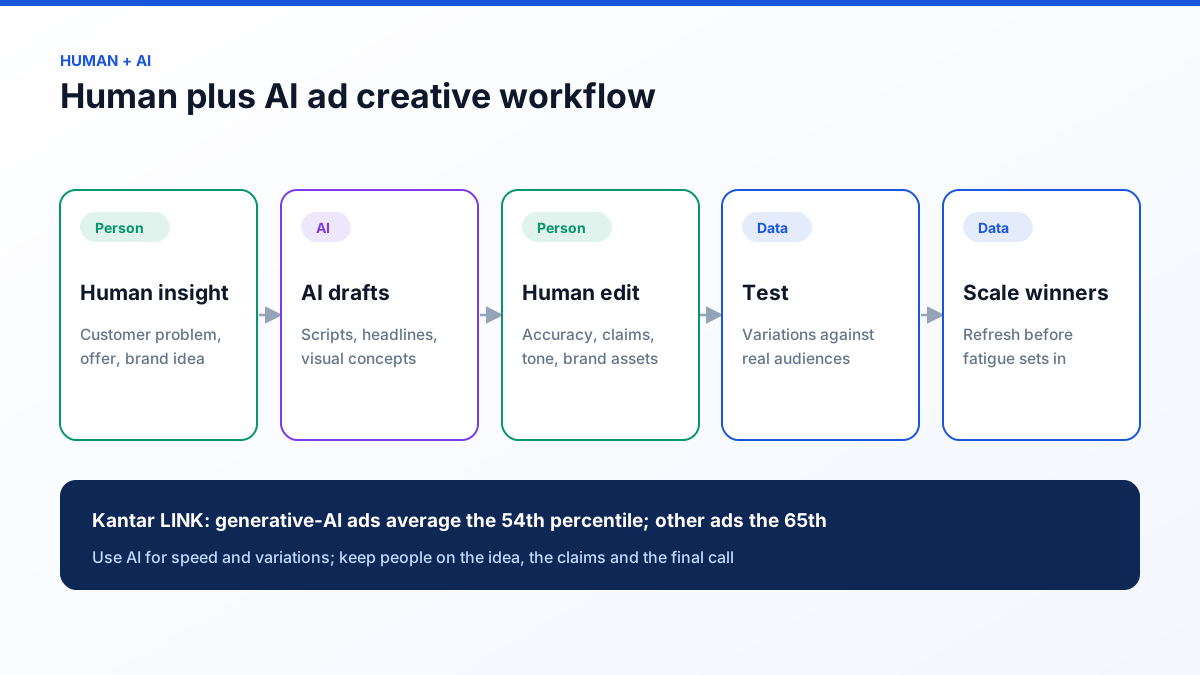
A human + AI creative workflow that works
- Start with a human insight: a real customer problem, a clear offer and a distinctive brand idea.
- Use AI for drafts and variations: scripts, headlines, visual concepts and formats.
- Edit with people: check product accuracy, claims, tone, cultural fit and brand assets.
- Test with real audiences: run variations against each other with clear success measures.
- Scale the winners and retire the rest: refresh before fatigue sets in.
Our Meta Ads, Google Ads and YouTube marketing teams use this approach: AI for speed, people for the idea and the final call.
How to test AI creative against human creative
| Measure | Why it matters for AI creative |
|---|---|
| Hook rate and hold rate (video) | Shows whether AI-made openings actually stop the scroll |
| Cost per result | The fair comparison: cheaper production means nothing if results cost more |
| Conversion rate after the click | Catches ads that win clicks but mislead about the product |
| Comments and hide rates | Early warning of audience pushback against synthetic content |
| Brand search and recall (larger budgets) | Checks whether generic AI visuals weaken brand memory |
Run AI and human versions in the same campaign with the same budget and audience, and judge after enough results to be confident, not after the first day.
AI-generated ads by industry
| Industry | Good uses of AI creative | Keep human |
|---|---|---|
| E-commerce and retail | Catalogue images, seasonal backgrounds, size and format variations | Product accuracy, colour and fit |
| Local services | Copy variations, simple offer graphics, translated versions | Real photos of staff, vans, premises and finished jobs |
| Healthcare and wellness | Layout and format drafts | Every claim, before-and-after image and testimonial |
| Real estate | Ad copy variants, area descriptions, virtual staging clearly labelled | Actual property photos, prices and floor plans |
| B2B and SaaS | Explainer storyboards, product UI mock-ups, LinkedIn copy tests | Customer stories, data and quotes |
| Education | Course promo variations in several languages | Real students, results and faculty |
How to brief AI creative tools
AI output is only as good as the brief. Before generating anything, write down:
- The single message: one benefit or offer per ad, not five.
- The audience: who they are, what they care about and where they will see the ad.
- Brand rules: colours, fonts, logo placement, words you never use.
- Proof: the real facts the ad may use: prices, ratings, guarantees.
- Format: placement, length and whether it must work with the sound off.
- What not to show: no invented people as customers, no unapproved claims, no competitors’ branding.
What AI changes about creative budgets
AI lowers the cost of each variation, so the budget shifts rather than disappears. Spend less on producing many assets and more on the parts AI cannot do well: original photography and video of real products and people, a strong creative idea and the time to test properly. A useful rule of thumb is to keep one real shoot per season and use AI to stretch it across placements, languages and tests. Our design team works this way for clients who need volume without losing quality.
Disclosure rules for AI-generated ads
Labelling rules for AI content now apply in several markets, and platforms label some AI content automatically:
- EU: the AI Act’s transparency rules, in force since 2 August 2026, require deployers to disclose deepfakes, meaning realistic AI-generated or altered images, audio or video.
- India: since February 2026, platforms must flag realistic synthetic media clearly, so undisclosed AI ads risk being labelled or removed.
- Platforms: Meta, YouTube and TikTok label AI content and ask users to disclose realistic synthetic media; political and social-issue ads have stricter rules.
Our guide to AI content labelling rules for marketers covers each market in detail.
Who owns AI-generated ad creative?
Ownership of AI output is less settled than ownership of work made by people. The US Copyright Office has said that material generated entirely by AI, without enough human creative input, is not protected by copyright, while human selection, arrangement and editing can be. Other countries are still working through the question. For advertisers, that has three practical consequences: a competitor may be able to reuse a purely AI-generated image, your most important brand assets (logo, mascot, signature visuals) should be created or substantially shaped by people, and you should check each AI tool’s terms for who owns the output and whether it can be used commercially. Keep records of the human creative work behind key assets.
AI ad generators for small businesses
Free and low-cost AI ad generators can help a small business that has no designer: they turn a product photo and a few lines of text into ready-sized ads. Use them as a starting point, then:
- Replace generic stock-style images with real photos of your product, premises and team where possible.
- Check every claim, price and offer before publishing.
- Keep your logo, colours and tone consistent so customers recognise you.
- Test two or three versions rather than publishing one AI draft.
Related guides
- Meta Ads in 2026: Algorithm Changes
- AI PPC Automation
- Short-Form Video Strategy
- AI Agents for Marketing Teams
AI-generated ads: frequently asked questions
Do AI-generated ads perform as well as human-made ads?
On average, not yet. Kantar’s ad-testing data shows generative-AI ads averaging the 54th percentile against the 65th for other ads, though results vary by market and execution.
Can Meta create ads automatically with AI?
Meta’s Advantage+ creative tools can generate backgrounds, expand images, write text variations and create video from images, and Meta has been reported to be working towards fully automated campaigns.
Are AI UGC ads legal?
Synthetic presenters are not banned, but presenting them as real customers can mislead consumers and break rules such as the US FTC ban on fake testimonials. Disclose clearly and never invent results.
Do AI-generated ads need a label?
Realistic synthetic images, audio or video may need disclosure under the EU AI Act, India’s IT Rules and platform policies. Check the rules for each market and platform.
Which AI ad maker should a business use?
The best tool is the one built into the platform you advertise on, used with your own photos and brand assets, and tested against human-made creative.
Why do people dislike some AI-generated ads?
Common reasons are uncanny faces, generic visuals, and the sense that a brand replaced real people in emotional stories. Clear value and honesty reduce the backlash.
How should we test AI creative?
Run AI and human versions side by side with the same budget and audience, and compare cost per result, post-click conversion and audience feedback.
Sources
- Kantar: The state of GenAI in media and advertising – LINK database percentile comparison
- Kantar: Generative AI in creative development and testing – India results
- US FTC: Final rule banning fake reviews and testimonials
- Meta Business Help Center – Advantage+ creative features
Get AI speed without losing what makes your ads work
Share an ad account and we will compare your AI-made and human-made creative on cost per result, then suggest where AI should and should not be used.