An AI marketing agent uses a large language model to plan and carry out multi-step tasks, such as pulling reports, checking ad accounts, repurposing content or qualifying leads, within rules set by people. Genpact’s November 2026 survey found 79% of enterprises have agents in production but only 15% have tied the spend to profit and loss. Start with repetitive, low-risk tasks, give each agent an owner, limits, approvals and a log, and measure each task before and after, including the human time spent checking the agent’s work.

On this page
- What is an AI agent in marketing?
- AI agent use cases that work in marketing
- Agents built into marketing platforms
- Where AI agents go wrong
- Three myths about AI agents in marketing
- Guardrails before you switch an agent on
- How to prove the ROI of AI agents in marketing
- Example: a weekly reporting agent, step by step
- A 90-day plan for introducing AI agents
- Questions to ask before buying an AI agent tool
- AI agents for small businesses and small teams
- When an agent should hand over to a person
- How agents change marketing roles
- Agents are also changing how customers find you
- Frequently asked questions
In 2024 marketers asked AI to write things. In 2026 they are asking it to do things: pull the weekly report, adjust bids, draft and schedule posts, qualify leads, brief creators and flag problems before anyone notices. These are AI agents, and every marketing platform now ships some version of them.
The gap between adoption and results is wide. A Genpact survey of more than 2,000 executives, published on 12 November 2026, found that 79% of enterprises have AI agents in production, but only 15% have fully tied their AI investment to profit-and-loss outcomes. This guide explains what agentic AI in marketing actually means, the use cases that pay off, where agents go wrong, and a simple way to prove whether they are worth it.
What is an AI agent in marketing?
An AI marketing agent is software that uses a large language model to plan and carry out multi-step marketing tasks with some independence: it can read data, use tools such as an ad platform or CRM, make decisions within set rules and report back, rather than only answering a single prompt.
| AI assistant (chatbot) | Automation (rules) | AI agent | |
|---|---|---|---|
| How it works | Answers a prompt | Follows fixed if-then rules | Plans steps towards a goal and uses tools |
| Example | “Write three subject lines” | “Send email B if no open in 3 days” | “Find under-performing campaigns, draft fixes and ask for approval” |
| Human role | Does the work, uses AI for drafts | Designs the rules | Sets goals, limits and approvals |
| Main risk | Wrong facts | Rigid rules | Wrong actions taken at speed |
AI agent use cases that work in marketing
The best early uses are repetitive, data-heavy tasks with a clear right answer and low risk if something goes wrong.
| Use case | What the agent does | Human checkpoint |
|---|---|---|
| Reporting | Pulls data from GA4, ad platforms and the CRM, writes a weekly summary and flags anomalies | Analyst reviews conclusions before they go to leadership |
| Paid media hygiene | Finds wasted search terms, broken links, disapproved ads and budget pacing issues | Specialist approves negatives and budget changes |
| Content repurposing | Turns a webinar or long article into posts, email copy and video scripts | Editor checks facts, tone and claims |
| SEO maintenance | Checks pages for broken links, missing titles, slow templates and outdated content | SEO lead prioritises fixes |
| Lead qualification | Answers website and messaging enquiries, asks qualifying questions and books calls | Clear hand-off to a person for complex or unhappy customers |
| Competitor monitoring | Tracks competitor ads, pricing pages and AI search mentions | Strategist decides what to act on |
| Creator outreach | Shortlists creators by audience and drafts outreach | Brand team vets creators and approves terms |
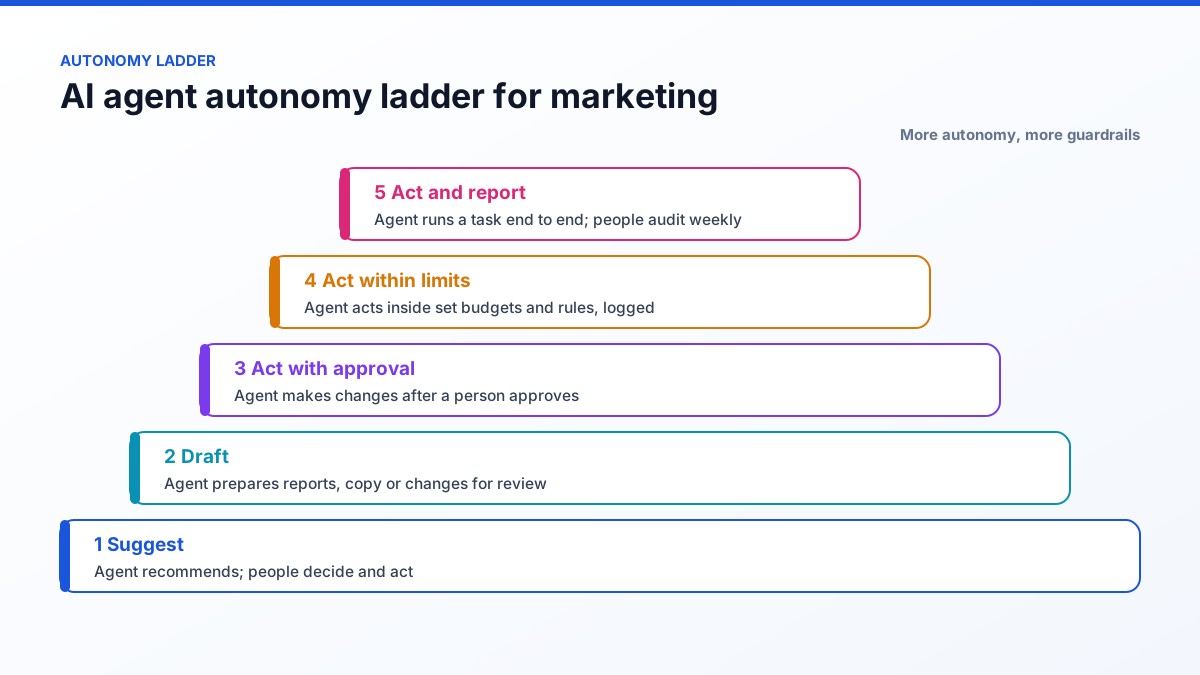
Agents built into marketing platforms
You may already be using agents without calling them that. Ad platforms increasingly offer AI that builds campaigns, generates creative and adjusts targeting automatically, and Meta has been reported to be adding agent features inside Ads Manager. CRMs, email platforms and analytics tools have added assistants that take actions, not just answer questions.
Platform agents have one big advantage, direct access to the data and controls, and one big limitation: they optimise for the platform’s own metrics. An ad platform’s agent will rarely tell you to move budget to another channel. Keep an independent view of results across channels; see our analytics and tracking service and AI PPC automation guide.
Where AI agents go wrong
- Confident mistakes at speed. An agent that misreads a report can pause the wrong campaign or email the wrong segment before anyone notices.
- Optimising the wrong goal. Agents chase whatever you measure; if that is clicks or leads, quality can drop.
- Brand and legal risk. Agent-written replies and posts can make claims you cannot support or use the wrong tone with an upset customer.
- Data exposure. Agents with broad access to CRMs and inboxes can move personal data where it should not go; check this against privacy rules such as India’s DPDP Act.
- Hidden costs. Usage-based pricing, set-up time and the human hours spent checking output can eat the savings.
- Unclear accountability. If nobody owns an agent’s actions, nobody notices when it drifts.
Three myths about AI agents in marketing
- “Agents run themselves.” Every useful agent needs a clear goal, limits and someone checking its work, especially in the first months.
- “More agents means more savings.” Each agent adds set-up, cost and oversight. One reliable agent beats five half-trusted ones.
- “The platform’s agent knows best.” Platform agents optimise for their own platform’s results; cross-channel decisions still need your own data and judgement.
Guardrails before you switch an agent on
- A named owner for each agent, responsible for its results and its mistakes.
- Written limits: budgets it may change, channels it may post to, data it may access.
- Approval steps for anything customer-facing, financial or irreversible.
- A log of every action the agent takes, reviewed weekly at first.
- A kill switch that a non-technical person can use.
- Clear disclosure when customers are talking to an AI rather than a person.
- A test period in a low-risk account or segment before wider use.
We will map your team’s repetitive tasks and show which are safe to hand to AI first, free.
How to prove the ROI of AI agents in marketing
Most teams cannot yet show what their AI spend returns, which is exactly the gap the Genpact research highlights. A simple framework closes it:
- Pick one task and measure it before the agent: hours spent, cost, error rate and the business result it supports.
- Run the agent on that task for a fixed period, with the same measures.
- Count the full cost: software, set-up, and the human time spent checking and correcting.
- Measure quality, not just speed: lead quality, conversion rate, complaints, errors caught.
- Tie it to money: hours freed and what they were used for, or revenue protected or gained.
| Use case | Efficiency measure | Outcome measure |
|---|---|---|
| Reporting agent | Analyst hours per week | Issues spotted earlier, decisions made faster |
| Paid media agent | Time on account checks | Wasted spend removed, cost per qualified lead |
| Content agent | Hours per finished piece | Engagement, rankings, leads from content |
| Lead qualification agent | Response time to enquiries | Booked calls, lead-to-customer rate, complaints |
Example: a weekly reporting agent, step by step
- Every Monday, the agent pulls last week’s sessions, leads and revenue from GA4, spend and conversions from Google and Meta, and closed deals from the CRM.
- It compares each metric with the previous week and the same week last year, and flags anything outside the normal range.
- It writes a one-page summary: what changed, the likely reason and suggested actions.
- A marketer checks the numbers and the reasoning, corrects anything wrong and adds context the agent cannot know, such as a sale or a site outage.
- The approved summary goes to the team. Corrections are noted so the agent’s instructions can be improved.
The value is not just hours saved; it is that problems such as a broken form or a tracking failure are spotted on Monday rather than at the end of the month.
A 90-day plan for introducing AI agents
| Days | Focus |
|---|---|
| 1–15 | List repetitive tasks, estimate hours and risk, and pick one low-risk task |
| 16–30 | Measure the task as it is done today; write the agent’s goal, limits and approval steps |
| 31–60 | Run the agent in “draft” mode, with every output checked by a person |
| 61–75 | Compare time, cost, quality and errors with the baseline |
| 76–90 | Decide: expand, adjust or stop. Only then choose the next task |
Questions to ask before buying an AI agent tool
- Which of our systems does it need access to, and can access be limited to read-only?
- Can every action be logged, reviewed and reversed?
- Where is our data stored and processed, and is it used to train the vendor’s models?
- How is pricing calculated, and what happens to cost as usage grows?
- Can we require human approval for specific actions?
- What happens when the agent is unsure: does it stop and ask, or guess?
- Can we export our instructions and data if we switch tools?
AI agents for small businesses and small teams
Small teams often gain the most, because one person may run ads, email, social and the website. Start with tools you already pay for before adding new platforms:
- Use your email or CRM platform’s built-in assistant to draft campaigns and segment lists.
- Set up a weekly automated report from GA4 and your ad accounts, with an AI-written summary you check.
- Use a website or WhatsApp chat assistant for opening hours, pricing questions and bookings, with a clear route to a person.
- Keep strategy, offers and anything sensitive with people.
When an agent should hand over to a person
Customer-facing agents, such as website chat or WhatsApp assistants, need clear rules for when to stop and pass the conversation to a human. Hand over when the customer is unhappy or complaining, when money, refunds or contracts are involved, when health, legal or safety questions come up, when the agent is unsure or has answered the same question twice, and whenever the customer asks for a person. Make the hand-off smooth: pass the conversation history so the customer does not repeat themselves, and tell them honestly that they are moving from an AI assistant to a member of the team. A fast, polite hand-off protects more revenue than an agent that tries to handle everything.
How agents change marketing roles
Agents shift work rather than remove it. Genpact’s research found that 92% of organisations with agents in live production had kept or increased human headcount. In marketing, time moves from assembling reports and resizing assets towards strategy, creative ideas, customer understanding and checking the agents’ work. The new skills are writing clear briefs and rules for agents, judging their output and knowing when not to automate.
Agents are also changing how customers find you
Agents do not only work for marketers; customers use them too, asking AI assistants to research, compare and even buy. That makes it more important that your site is easy for AI systems to read and that your brand is described accurately across the web. See agentic search, agentic commerce and how to rank in AI search.
Related guides
AI agents in marketing: frequently asked questions
What is agentic AI in marketing?
AI that plans and carries out multi-step marketing tasks, such as reporting, campaign checks or lead qualification, using tools and data within rules set by people.
What is the difference between AI agents and marketing automation?
Automation follows fixed rules you design. Agents decide the steps towards a goal, adapt to new information and can use several tools, which makes them more flexible and riskier.
Will AI agents replace marketers?
They replace tasks more than roles. Research from Genpact found most organisations with agents in production kept or grew human headcount, with people moving to strategy and oversight.
Which marketing tasks should we automate with agents first?
Repetitive, low-risk tasks with clear answers: reporting, account checks, content repurposing drafts and technical SEO monitoring.
How do I measure the ROI of AI agents?
Measure a task before and after, count the full cost including human review time, and tie results to business outcomes such as cost per qualified lead or revenue.
Are AI agents safe to use with customer data?
Only with clear limits on what data they can access, logs of their actions and compliance with privacy laws in the markets you serve.
Do small businesses need AI agents?
Not as a separate purchase at first. The AI features in tools you already use, such as email, CRM and analytics, usually deliver most of the benefit.
Sources
- Genpact: Autonomy in Practice – agents in production, P&L linkage and headcount
- Agile Brand Guide: Marketing technology and AI news, November 2026 – agentic marketing launches
Put AI agents to work safely in your marketing
Tell us which tasks eat your team’s week. We will suggest which are safe to hand to an agent first and how to measure the result.